

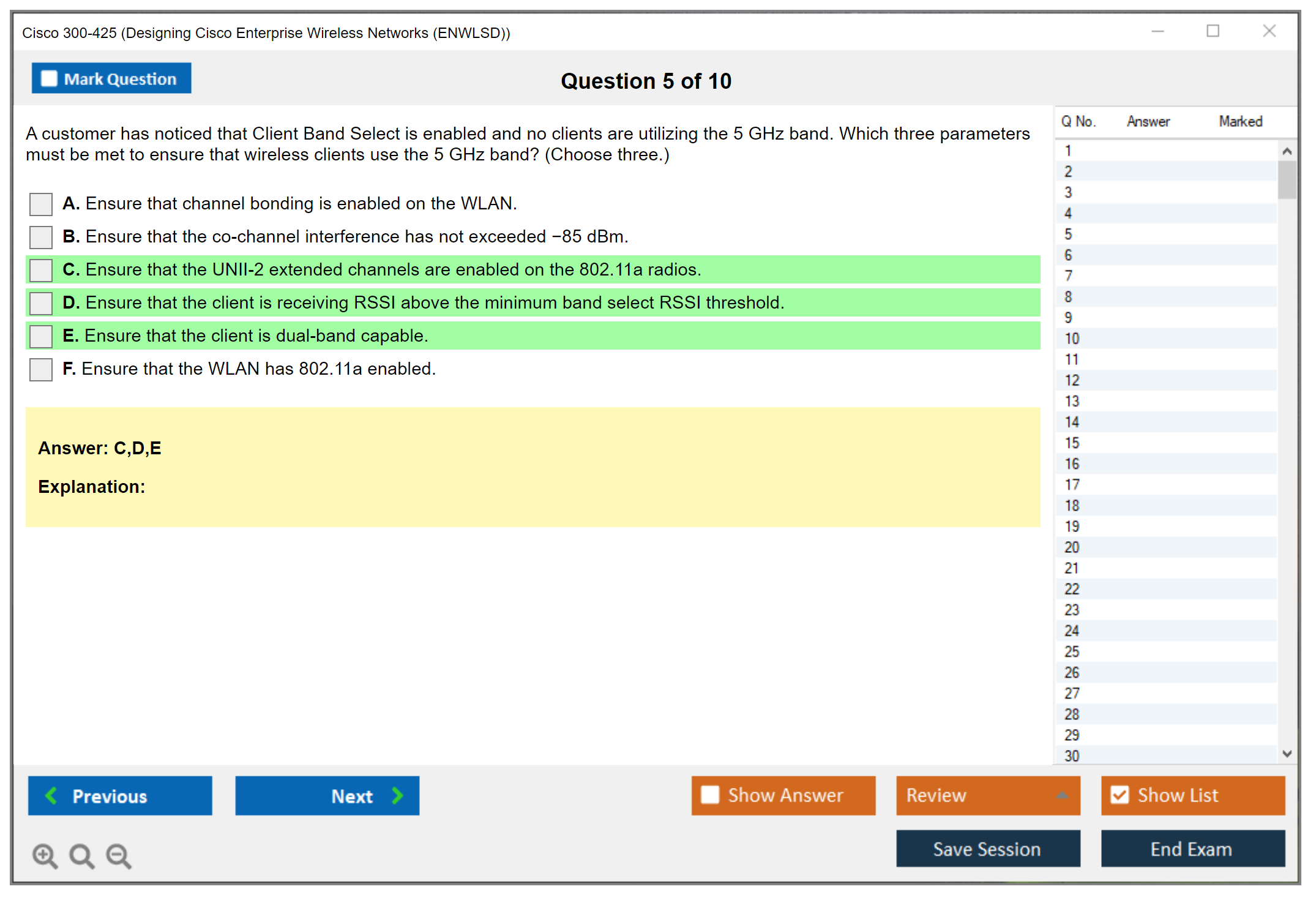
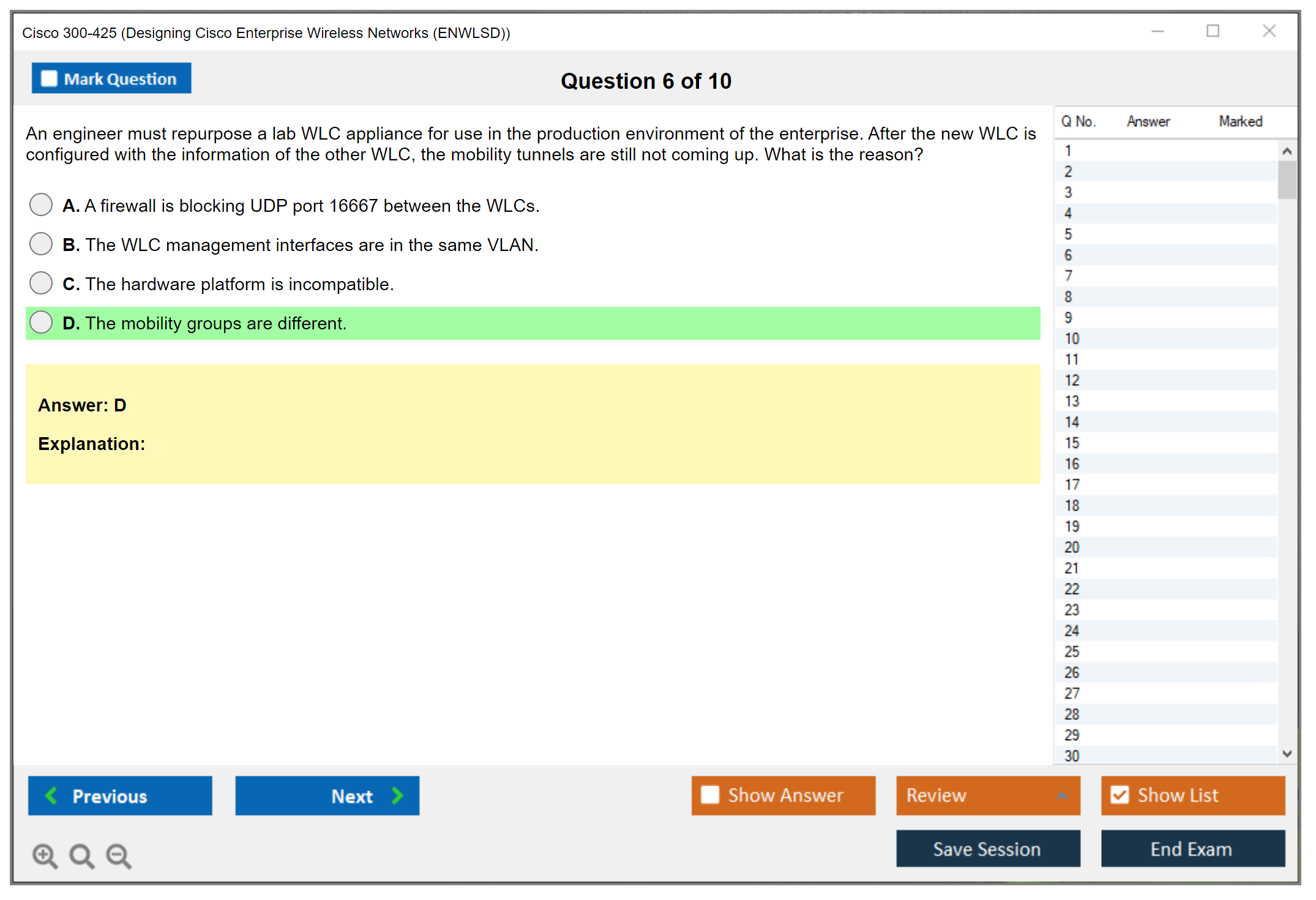
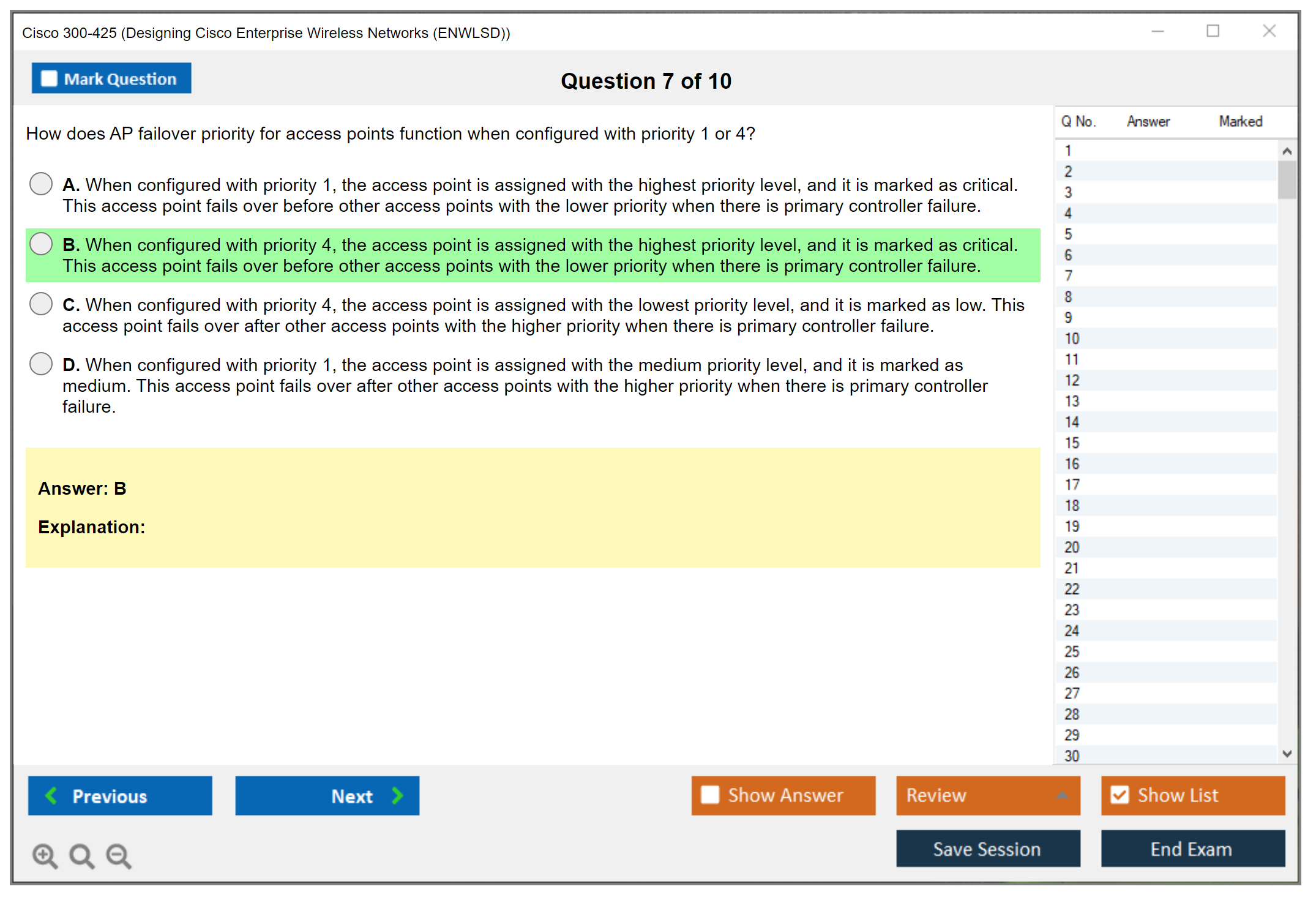
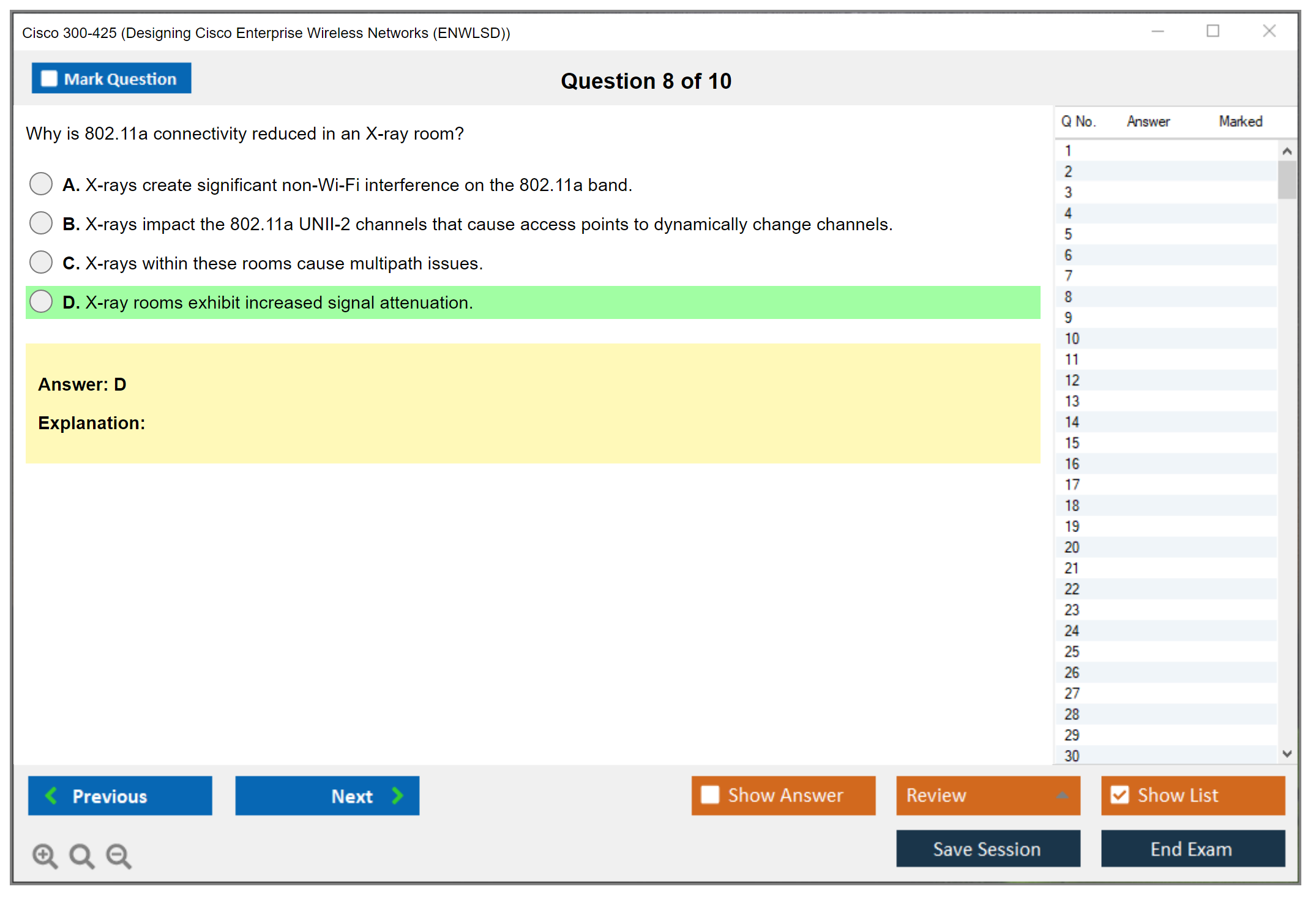
Cisco 300-425 ENWLSD Exam Overview
What exactly is the Cisco 300-425 ENWLSD exam and why should you care
The Cisco 300-425 ENWLSD exam is your proof. Officially it's called Designing Cisco Enterprise Wireless Networks, and it shows you can actually design enterprise wireless networks instead of just fumbling around in some GUI hoping things work out. It's a concentration exam for the Cisco Certified Specialist - Enterprise Wireless Design certification, which (I mean, the title sounds ridiculously fancy) but really it just demonstrates you can make intelligent architectural decisions about wireless infrastructure before anyone starts mounting access points on ceilings.
Here's where it gets interesting. This exam also counts as one of the qualifying concentration exams toward the CCNP Enterprise certification track, so if you've already knocked out the 350-401 ENCOR core exam, passing ENWLSD gets you that full CCNP Enterprise credential. Not a bad deal at all.
What makes this different from something like the 300-430 ENWLSI implementation exam? Focus. You're concentrating on design principles rather than configuration commands or troubleshooting workflows. Let me clarify. You're not being tested on memorizing CLI syntax here. You're being asked to make real architectural decisions based on business requirements, RF characteristics, and actual real-world constraints that you'd face in production environments. Can you determine whether a high-density deployment needs more APs or just different channel planning? Do you really understand the trade-offs between coverage and capacity? That's ENWLSD.
The exam covers modern Cisco wireless technologies including Cisco Trigger wireless solutions, DNA Center wireless assurance, and SD-Access wireless integration. The thing is, Cisco's been pushing hard on the DNA Center and SD-Access stuff lately, so expect those topics to show up way more than you might see in older wireless exams. The exam also digs deep into RF design fundamentals, site survey methodologies, wireless architecture patterns, and high availability implementations.
Who actually needs to take this thing
Network design engineers are obvious candidates. But if you're a wireless specialist who's been doing implementation work for years and want to validate your design expertise beyond just knowing how to configure controller settings, this exam makes total sense for you too.
Network architects working on campus, branch, and remote office wireless solutions will find ENWLSD directly applicable to their day-to-day responsibilities. Like, this isn't theoretical stuff you'll never use. It's what you're already doing or should be doing in those environments. Pre-sales engineers are another big group. If you're designing wireless solutions for customer proposals, having this certification adds serious credibility when you're presenting to technical stakeholders who want proof you actually understand what you're proposing instead of just reading from vendor datasheets.
I've also seen plenty of IT professionals transitioning from wired networking to wireless design roles use this exam as a way to formalize their knowledge and fill gaps they didn't even know existed. Wireless is different enough from wired that you can't just assume your 200-301 CCNA knowledge translates directly. RF propagation, channel planning, roaming optimization. These are really specialized skills that require different thinking. Side note: I once watched a very confident CCNP spend forty-five minutes trying to figure out why clients kept dropping in a conference room, only to discover he'd placed an AP directly next to a microwave that ran during lunch meetings. RF is weird like that.
Experienced wireless administrators seeking formal validation of design competencies can benefit here. You might've been deploying and maintaining wireless networks for years, but having the ENWLSD certification demonstrates you can think strategically about architecture, not just tactically about fixes. Consultants who provide wireless network design services to multiple organizations particularly value this credential because it shows clients you're not just winging it based on whatever worked at your last gig.
How this fits into Cisco's certification ecosystem
Cisco revamped their entire certification structure back in 2020. They moved to a modular approach that's way more flexible than the old linear tracks where you had to follow a rigid path. ENWLSD is positioned as a concentration exam in this new framework. You can take it after passing the CCNP Enterprise core exam to achieve CCNP Enterprise certification, which is still one of the most respected mid-level networking certs out there in the industry.
But here's what's cool about this. You can also take ENWLSD independently to earn the Cisco Certified Specialist - Enterprise Wireless Design credential without necessarily pursuing the full CCNP. Perfect if you're specializing in wireless and don't want to invest time in all the broader enterprise topics covered in exams like 300-410 ENARSI that might not directly apply to your role or career goals.
The exam complements other wireless exams. Implementation-focused folks might pair ENWLSD with 300-430 ENWLSI, while automation enthusiasts could add 300-435 ENAUTO to round out their skills and create a more complete skillset. There's no required sequence here. You can pursue specialist certifications before or after CCNP, which gives you way more control over your certification path than the old days when everything was rigid and you had to follow a predetermined track.
ENWLSD represents intermediate-to-advanced level knowledge. It's positioned above CCNA in terms of difficulty and specialization, but it requires specific wireless expertise that even some experienced network engineers might not have if they've focused primarily on routing and switching throughout their careers.
What you'll actually face in the exam room
The Cisco 300-425 exam is computer-based. It's delivered through Pearson VUE testing centers or online proctoring if you prefer taking it from home. You get 90 minutes to work through approximately 55-65 questions, though the exact number varies by exam version because Cisco uses adaptive question pools that change.
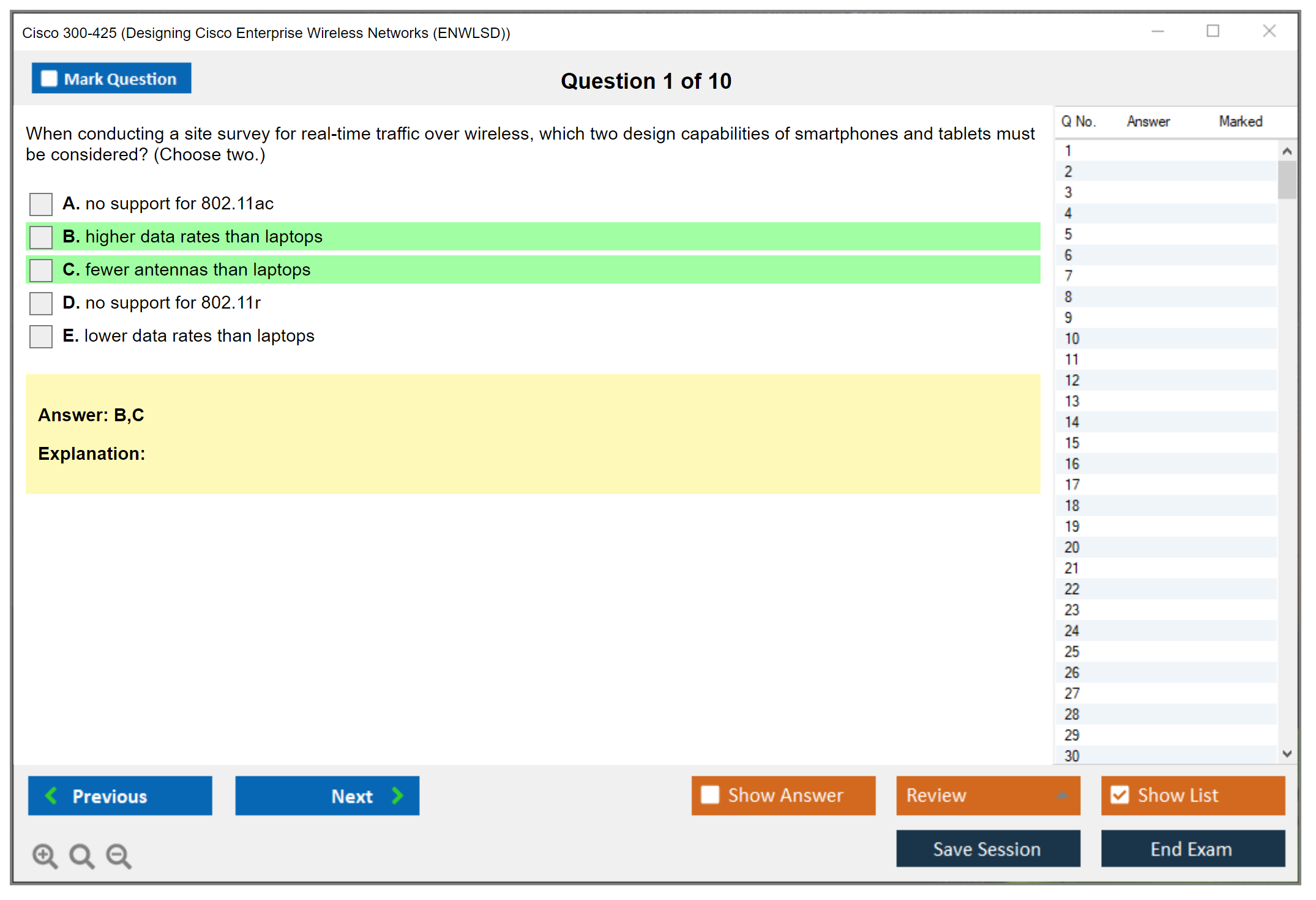
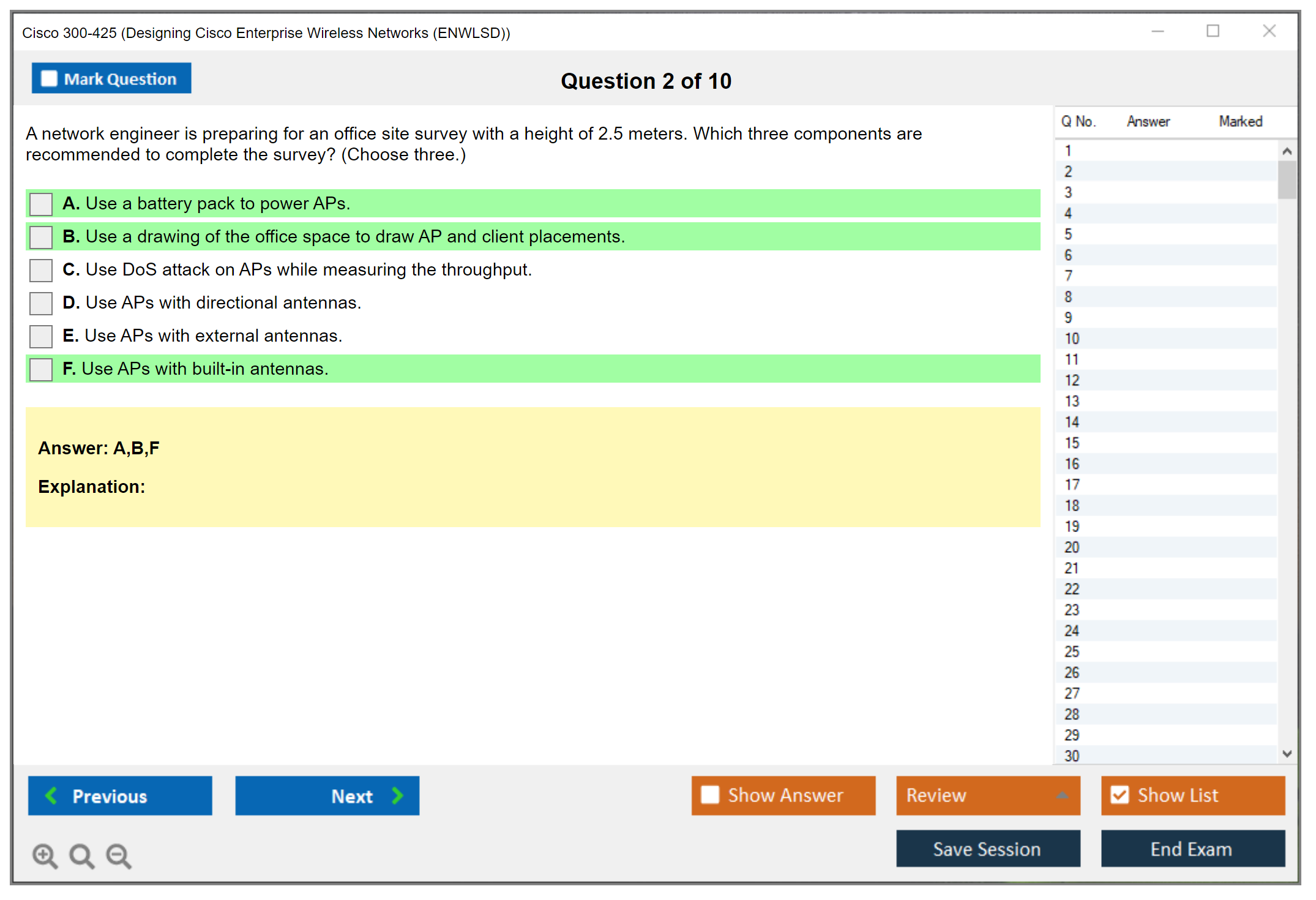
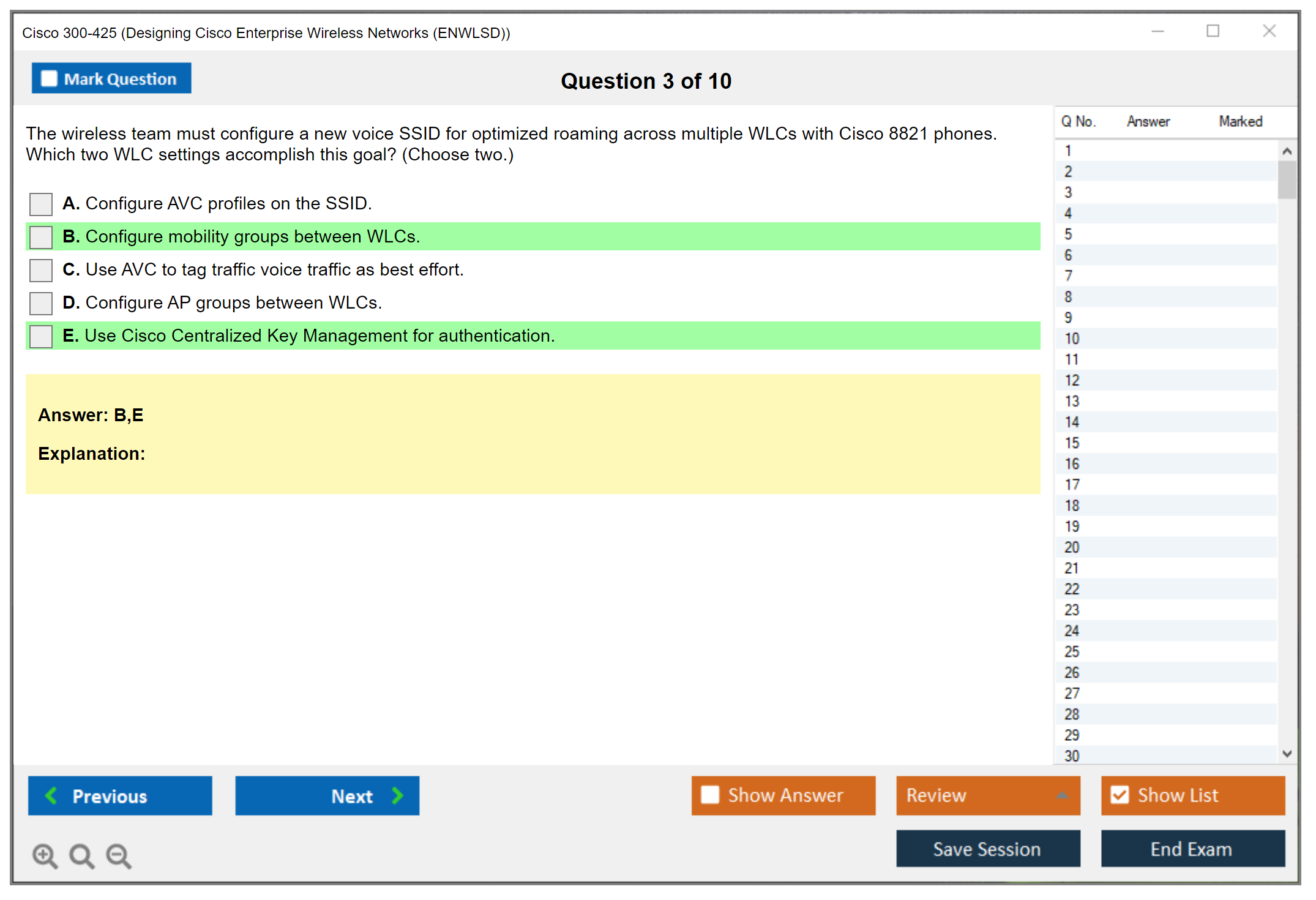
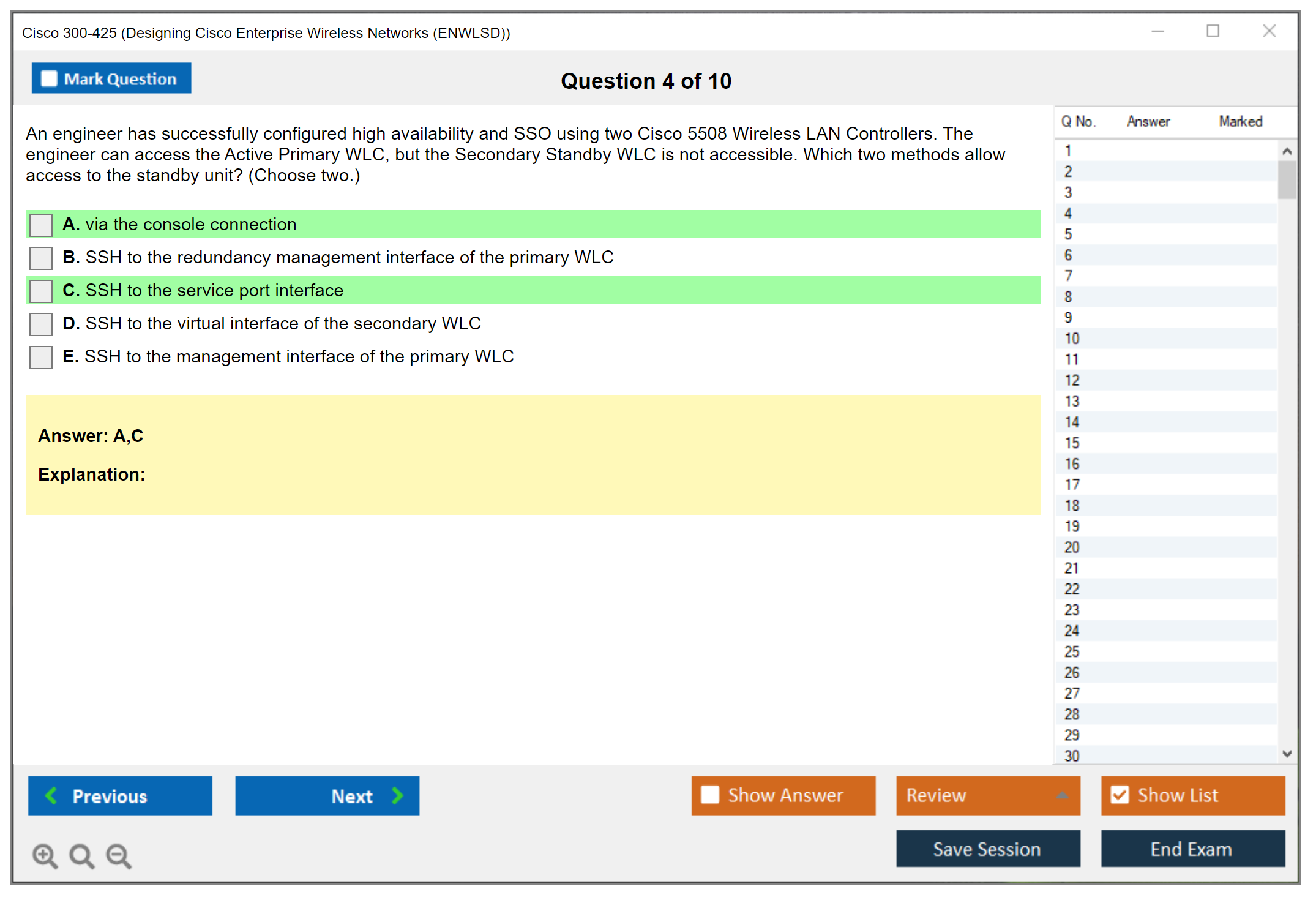
Multiple choice single answer. Multiple choice multiple answer. Drag-and-drop. Simulation-based design scenarios. Those design scenarios are where things get interesting (and a bit tricky if you're not prepared). You might see a floor plan with specific requirements like "support 500 concurrent users with voice traffic" and need to select appropriate AP placement, channel assignments, or controller configurations that actually meet those requirements without over-engineering or under-delivering.
Some questions include exhibits such as floor plans, RF heat maps, or network topology diagrams that you'll need to interpret quickly because that 90-minute timer keeps running and doesn't care about your stress level. This is closed-book format with no reference materials allowed during the exam, so you can't pull up Cisco design guides or your notes mid-test when you forget something.
The exam's available in English. Potential translations exist in other languages depending on your region. Whether you take it in a testing center or through online proctoring, expect strict monitoring. Cameras, screen recording, the whole deal because Cisco takes exam security seriously and they're not messing around with that.
Why ENWLSD stands apart from other wireless certs
This exam emphasizes design methodology. Decision-making rather than CLI commands or configuration syntax. You won't spend much time memorizing exact command structures like you would in implementation exams where knowing the precise syntax matters. Instead, you're being tested on your ability to understand trade-offs between different design approaches. Coverage versus capacity, cost versus performance, scalability versus simplicity. All those real-world tensions that you'll face when designing actual networks for actual organizations with actual budgets and constraints.
The exam tests your ability to interpret business requirements and translate them into technical wireless designs that actually work. A requirement like "provide smooth roaming for voice clients across a three-building campus" needs to be converted into specific design decisions about controller placement, AP density, channel reuse patterns, and QoS policies. This translation skill is what separates good wireless engineers from mediocre ones.
There's significant focus on RF fundamentals. Propagation characteristics. Site survey methodologies. Look, if you don't understand how signals attenuate through different building materials or why 5 GHz behaves differently than 2.4 GHz in certain environments, you're going to struggle here and probably fail.
The exam also covers emerging technologies. Wi-Fi 6 and Wi-Fi 6E. IoT integration. Location-based services. Cisco wants to make sure you're designing networks for current and near-future requirements, not just legacy 802.11ac deployments that were relevant five years ago. High availability design patterns and redundancy strategies get plenty of attention too, because nobody wants to be the engineer who designed a single point of failure into a mission-critical wireless network and has to explain that decision when everything goes down.
Security design considerations run throughout. Authentication mechanisms. Encryption standards. Guest access architectures. You need to understand how to design secure wireless networks that still meet usability requirements because security that nobody can actually use isn't really useful. Integration knowledge between wireless infrastructure and other enterprise systems like DNA Center, ISE, and SD-Access is increasingly important because Cisco's pushing hard on these bundled solutions, so understanding how they fit together architecturally is absolutely necessary.
The career impact of earning ENWLSD certification
Specialized wireless expertise is in high demand right now, and ENWLSD demonstrates you have it in a verifiable way. In competitive job markets, this certification differentiates you from network generalists who might understand routing protocols but get fuzzy when asked about channel bonding or client roaming thresholds or anything requiring actual wireless-specific knowledge.
The credential provides credibility. When you're proposing wireless designs to stakeholders and clients who control budgets, having ENWLSD after your name helps establish that you know what you're talking about instead of just sounding confident. It's often required or preferred for wireless design engineer, network architect, and senior wireless specialist roles at enterprises and Cisco partners who want proof of skills before hiring.
The certification is recognized globally. This matters if you're working for multinational organizations or considering career opportunities in different regions where local certifications might not carry weight. It contributes to professional development and career advancement in network infrastructure roles, particularly as more organizations prioritize wireless-first or wireless-only strategies that require specialized design expertise.
It may lead to salary increases too. Wireless-certified professionals often earn 10-20% more than non-certified peers in similar roles, though exact numbers vary by location and organization size and industry. More importantly though, ENWLSD validates continuous learning and commitment to staying current with wireless technology evolution, something employers increasingly value as the technology space keeps shifting and they need people who won't become obsolete in two years.
Cisco 300-425 Exam Cost and Registration
Quick context on what this exam is
Okay, so Cisco 300-425 ENWLSD is the Designing Cisco Enterprise Wireless Networks exam. It's a design-focused test that maps to enterprise wireless planning, not "configure this CLI knob" all day. Think architecture choices, RF design and site surveys, roaming decisions, and high availability wireless design tradeoffs that bite you later if you wing it.
This matters because people show up expecting a wireless config exam, then get absolutely punched in the face by design scenarios and "best option" questions that feel subjective unless you've read Cisco's validated approaches. Yep. That.
What ENWLSD covers and who it's for
The Designing Cisco Enterprise Wireless Networks exam is for folks doing Cisco Enterprise Wireless design, or moving from operations into design. If you've been deploying controllers, tuning RF profiles, and arguing about voice roaming, you're in the right neighborhood.
Newer engineers can take it too. No gatekeeping. But it's harder cold.
If you're aiming at ENWLSD certification as part of a professional-level track, honestly you'll want comfort with Cisco Trigger wireless architecture concepts, design docs, and the "why" behind recommendations, not just "how to click it in the GUI".
Exam cost and what that really means
Let's talk Cisco 300-425 exam cost without pretending it's the only expense, because the thing is there's always more.
The standard list price for the Cisco 300-425 exam is $300 USD (as of 2026). That's the number most people quote, and it's usually accurate when you're budgeting, but look, your checkout price may not be exactly $300 because pricing may vary by geographic region due to local taxes, currency conversion, and regional pricing policies that nobody reads until checkout. Some countries also have slightly different pricing structures based on purchasing power parity, so two engineers in different regions can pay different totals for the same ENWLSD certification attempt.
Also, the exam fee is only the exam fee. Nothing else.
Cisco ENWLSD study materials, training courses, lab subscriptions, and Cisco 300-425 practice tests are separate investments. Honestly they can dwarf the $300 if you go all-in on official training plus third-party practice platforms. You can self-study cheaply with docs and a good plan, but if your employer isn't paying, you should price this like a project, not a single checkout screen.
Cisco occasionally offers promotional pricing or discounts through partner programs or learning events. Don't count on it, but do check. If you work at a company that buys training in bulk, enterprise volume licensing or Cisco Learning Credits (CLCs) can cut the real cost for organizations training multiple employees. That's where this exam gets way easier to justify on a team budget.
Retakes, refunds, and the "don't fail casually" reality
Here's the part people skip until they're mad, which is basically everyone after attempt two.
Retake policy: if you fail, you must wait 5 calendar days before rescheduling. Third and subsequent attempts require a 180-day waiting period. That second rule is brutal if you treat attempts like practice runs, because you can accidentally lock yourself out of your timeline for half a year.
Fees aren't friendly either. Failed exam fees are non-refundable, and no refunds are provided for passed exams either, because you passed. That's normal in certification testing, but it still stings if you scheduled too early and "almost" made it. Schedule when you're ready. Or at least when your practice scores are stable.
How to register through Pearson VUE
Registration's conducted through Pearson VUE, Cisco's authorized testing delivery partner. You do everything at pearsonvue.com/cisco, and the process is pretty standard, but small mistakes can cause annoying exam-day problems.
Create or log into your Pearson VUE account. Use the exact name on your government-issued ID. Exact. Not "close enough". Then search the exam catalog for exam code "300-425" or "ENWLSD". Pick your delivery method, select a date/time, and handle payment.
Payment's usually credit card or debit card, or voucher if you have one purchased through Cisco or partners. When you finish, you'll get a confirmation email with exam details, location or online instructions, and your appointment reference number. Save it. Screenshot it. Forward it to your work email if you're expensing it. Whatever. Just don't lose it.
Testing center or online proctored, and what I'd pick
You can take ENWLSD at a physical Pearson VUE testing center with an on-site proctor, or take the online proctored exam from home or office with a remote proctor watching via webcam.
Testing centers are boring, and that's the point. Controlled environment, provided computers, minimal distractions, and fewer weird "your antivirus blocked the secure browser" moments. If you've never done online proctoring, a testing center's the lowest drama option.
Online proctoring is convenient. And also picky.
You need stable internet, a webcam, a microphone, and a private testing space that doesn't have your roommate yelling about laundry in the background. You'll do a system check before the exam to verify technical requirements. You should do that check days before, not ten minutes before, because troubleshooting under a countdown timer is a special kind of stress nobody needs. The online option offers more scheduling flexibility and eliminates travel, which is great if you live far from a testing center or you're booking around work shifts.
Both delivery methods have identical exam content and equal certification value. Choose based on your technical setup, how quiet your space is, and whether being watched on camera makes you anxious. For some people it absolutely does. I once tanked a practice run because I kept thinking about the proctor watching me scratch my nose, which sounds stupid but brains do weird things under pressure.
Rescheduling and cancellation policies (read this twice)
Pearson VUE's rule is simple and unforgiving, which is their brand honestly.
You can reschedule or cancel without penalty if you do it at least 24 hours before your appointment. If you try to reschedule or cancel within 24 hours, you forfeit the entire exam fee. No-shows also forfeit the fee, with no refund or credit.
Pearson VUE provides online tools to reschedule from your account dashboard. Use them. Don't rely on "I'll call support" as your plan. Emergency situations may be considered case-by-case with documentation, but I wouldn't bet $300 on "they'll understand".
Best practice is scheduling when you're confident in readiness, and building buffer time in your study plan so you're not doing a panicked reschedule the night before because you finally looked at the Cisco 300-425 exam objectives and realized RF design is half your weak spots.
Payment methods, vouchers, and employer reimbursement
Direct payment via major credit cards like Visa, MasterCard, and American Express is accepted during registration. Vouchers can be purchased from the Cisco Learning Store or authorized Cisco Learning Partners. Vouchers are nice because you can buy now and schedule later.
But watch the expiration date. Vouchers typically expire, often around 12 months from purchase, so plan your timeline and don't treat vouchers like gift cards you can forget in a drawer for three years.
Corporate accounts sometimes use purchase orders or training budgets through enterprise agreements. Cisco Learning Credits (CLCs) can be applied toward exam costs if your org has a balance. Also, some employers reimburse certification exam costs upon successful completion, which is great, but it also means failing's on your dime, so be clear on the policy before you click "schedule".
Keep receipts and confirmation numbers. This is boring admin work. Still required.
ID requirements and exam-day check-in
Testing center exams require two forms of valid, non-expired government-issued identification that match your registration exactly, like they're checking for international spies or something. Primary ID must include photograph, signature, and full name matching your registration. Acceptable primary IDs include passport, driver's license, national ID card, or military ID. Secondary ID must include name and signature, like a credit card or employee badge.
Online proctored exams typically require showing your primary ID to the webcam during check-in. Same rule: the name must exactly match the name used during registration.
Arrive 15 minutes early for testing center appointments. Late arrivals, usually more than 15 minutes, may be denied entry and you lose the fee. Not gonna lie, that's the worst way to burn $300.
Passing score, difficulty, and prep (the stuff people ask anyway)
Cisco 300-425 passing score's a common search, and here's the deal: Cisco typically doesn't publish a fixed passing score. You'll get a pass/fail result and a score report with section-level feedback, but you shouldn't plan around "I need X points". Plan around mastering the blueprint.
ENWLSD difficulty is real if you're coming from pure operations without design background. The hardest parts tend to be RF design and site surveys, roaming behavior, high availability wireless design, and architecture decisions where multiple answers sound plausible but only one matches Cisco's recommended design path.
For Cisco 300-425 exam objectives, use Cisco's official exam topics page as your source of truth. Print it. Track it. Build notes per bullet. Then pick Cisco ENWLSD study materials that match those bullets: official Cisco training if you like structure, Cisco design guides and validated designs if you like reading, and labs or config reps if you need to connect the design theory to what controllers and APs actually do.
Cisco 300-425 practice tests can help, but only if they're high quality and explanation-heavy. If a practice bank feels like trivia or has sketchy answers, ditch it. Use practice questions to find weak domains, then go back to docs and your notes, because memorizing bad questions is how people fail twice and then meet that 180-day wait rule.
Quick FAQs people ask
What's the Cisco 300-425 ENWLSD exam used for? It's used to validate Cisco Enterprise Wireless design skills, especially architecture, RF planning, and design choices in enterprise deployments.
How much does the Cisco 300-425 exam cost? $300 USD list price (as of 2026), with regional variation from taxes and pricing policies.
What's the passing score for ENWLSD? Cisco usually doesn't publish a fixed number, and you receive pass/fail plus a score report.
How hard's the Cisco ENWLSD exam? Hard if you lack design experience, manageable if you've done real wireless planning and you study the official blueprint thoroughly.
What're the best study materials and practice tests for 300-425? Official Cisco training and design docs are the safest base, then add selective practice tests with strong explanations and align everything to the exam objectives and wireless LAN design best practices.
Passing Score and Scoring System for Cisco 300-425
What you're actually getting scored on
Cisco doesn't just count up your right answers and call it a day. They use this scaled scoring thing that honestly makes sense once you wrap your head around it. Every exam gets scored on a 300-1000 point scale. Your raw score (meaning the actual number of questions you got right) gets converted through some psychometric analysis that sounds fancy but basically just makes sure everyone's playing the same game.
Different versions of the 300-425 ENWLSD exam exist. Some might have slightly harder questions than others. The scaling process accounts for these difficulty variations so that passing one version means the same thing as passing another. You're not getting screwed just because you happened to get the harder question set on Tuesday afternoon versus the easier one someone else got on Monday morning.
The algorithm actually weighs questions differently based on how hard they are. Nailing that complex RF propagation design question probably counts more than getting a basic SSID configuration question right. This approach keeps standards consistent across all those different exam versions floating around in Pearson VUE testing centers.
You won't see a percentage on your score report. No "you got 78% correct" message. Just that scaled number between 300 and 1000, which represents your competency level according to Cisco's standards.
The passing score mystery nobody talks about
Here's the thing that frustrates everyone: Cisco doesn't publish the exact passing score for the 300-425. Not officially anyway. You'll see "Pass" or "Fail" on your screen when you finish, along with your scaled score, but Cisco keeps the actual cutoff number close to their chest.
Based on what candidates report and industry chatter, most Cisco exams land somewhere in the 750-850 range for passing. I mean, that's a pretty wide spread, but it gives you a ballpark. The ENWLSD probably falls in there too. Some versions might require 790, others might be calibrated to 825. It varies based on that psychometric calibration I mentioned earlier.
Why the secrecy?
Cisco reserves the right to adjust passing scores based on exam performance data. If a particular version turns out way harder than intended, they can recalibrate. If it's too easy, same deal. This flexibility protects the certification's value over time. My brother once failed a Microsoft cert by three points and spent weeks obsessing over whether the scaled score reflected his actual knowledge or just bad luck with question selection. That kind of overthinking doesn't help anyone.
No partial credit exists either. You pass and get certified, or you fail and need to retake. There's no "almost passed" certificate. Your score report will break down your performance by exam domain though, showing whether you performed below, near, or above target in each section. That domain-level feedback becomes key if you don't pass on the first try.
When I work with people preparing for Cisco exams, I always tell them to aim higher than whatever they think the passing score might be. Shooting for 850+ gives you breathing room for those tricky questions that inevitably show up. If you're studying with 300-425 practice exam questions priced at $36.99, you want to consistently score well above that estimated passing threshold before scheduling your real attempt.
Getting your results and what they mean
The second you click that final "Submit" button, you'll see preliminary results. Pass or fail shows up immediately on screen. It's nerve-wracking but at least you're not waiting weeks like some other certifications make you do.
Your official score report appears in your Pearson VUE account within 24-48 hours. This report includes your scaled score and that performance breakdown by domain. Each exam section shows whether you were below target, near target, or above target. These indicators help you figure out where you actually struggled versus where you crushed it.
If you passed, Cisco's certification tracking system updates within 3-5 business days. Your digital badge and certificate become available through their tracking portal. If you're using the 300-425 toward CCNP Enterprise certification, you still need to pass the 350-401 ENCOR core exam within a three-year window for the full CCNP.
Failed attempts get detailed feedback too, which honestly makes retaking way more focused. You won't see specific questions or correct answers (Cisco guards exam security pretty seriously) but you'll know which domains need work. Maybe your RF design and site survey skills were solid, but high availability wireless design concepts tripped you up. That score report tells you exactly where to concentrate your restudy efforts.
When the first attempt doesn't work out
Not gonna lie, plenty of people don't pass on their first try. Wireless design is really complex, mixing RF physics, network architecture, security considerations, and real-world constraints. I've watched experienced network engineers who crush routing and switching struggle with ENWLSD concepts.
If you fail, Cisco enforces a mandatory 5-day waiting period before you can retake. After a second failure, it's 15 days. After a third, you're waiting 180 days. These cooling-off periods exist to prevent people from just memorizing question dumps and retaking immediately.
Use that score report strategically.
If you scored below target in RF design and site surveys but above target everywhere else, you know exactly what needs attention. Maybe you need more hands-on practice with Ekahau or similar survey tools. Or maybe the math behind Fresnel zones and EIRP calculations needs another pass. Could be you just had a bad day and need to review everything again with fresh eyes.
Different study resources help too. If you studied primarily with official Cisco documentation the first time, maybe add some lab practice or a different training course. The 300-425 practice exam questions pack at $36.99 can expose you to question formats and topics you might have missed. Just don't rely solely on practice tests. Actually understanding the design principles matters more than memorizing answers.
Many successful ENWLSD holders passed on their second attempt after targeted preparation. That first failure often reveals knowledge gaps that weren't obvious during initial studying. Consider it a learning opportunity rather than a personal defeat. You're building expertise in enterprise wireless design, which takes time and experience beyond just passing an exam.
What happens after you pass
Your passing score is valid immediately and permanently for that specific exam attempt. The Specialist certification you earn (Enterprise Wireless Design) stays active for three years from your pass date. Track that expiration through Cisco's certification dashboard because letting it lapse means starting over.
If you're building toward CCNP Enterprise, remember that specialist certifications like ENWLSD are only part of the picture. The CCNP requires passing both ENCOR and a specialist exam like 300-425. Some people tackle 300-420 ENSLD or 300-415 ENSDWI instead, depending on their career focus. All valid paths.
Recertification becomes necessary before that three-year mark hits. You can retake the exam, pass a different specialist exam, earn continuing education credits, or pass a higher-level exam like CCIE. Cisco offers flexibility here, recognizing that professionals stay current in different ways.
The scored exam itself doesn't expire. Your 850 or whatever you scored stays in Cisco's records. But the certification status requires renewal. It's similar to how passing your driver's test years ago doesn't mean your license never expires. You proved competency once, and Cisco wants verification you're maintaining it.
For people combining multiple Cisco certifications, that three-year renewal cycle applies across your portfolio. Passing one renewal exam can refresh multiple certifications simultaneously. Someone holding both CCNP Enterprise and CCNP Security might satisfy renewal requirements for both with a single exam, depending on which one they choose.
Cisco 300-425 Difficulty Level and Common Challenges
What ENWLSD actually is
Cisco 300-425 ENWLSD is the CCNP Enterprise wireless design concentration exam. The official name is the Designing Cisco Enterprise Wireless Networks exam, and the vibe is exactly what that title implies: you get handed scenarios, constraints, and "pick the best design" choices. Not a bunch of rote CLI recall you can memorize like flash cards and call it a day. Design brain required. Wired-only habits? They'll hurt you here.
This exam validates you can design enterprise WLANs that won't collapse under real clients, real walls, real interference, and real politics from security teams who think everything should be locked down like Fort Knox even though users need to actually connect. That's why people respect the ENWLSD certification more than they expect going in. You can't fake good design for long when the helpdesk starts getting flooded with angry tickets.
Who should take it (and who probably shouldn't yet)
If you already touch wireless at work, even part time, you're the target. Perfect fit. If you're a network engineer who keeps getting dragged into "why is Zoom bad in the conference rooms" conversations, this is your lane. Passing this exam will finally give you the vocabulary and framework to fix it instead of just nodding along while everyone complains. If you only know switching and routing and you've never had to think about RF, client roaming, or what a high-density room does to airtime, look, you can still pass. But you're signing up for extra homework. I mean extra.
No gatekeeping here. Just reality. RF is physics, not magic.
Cost and scheduling details you should know
The Cisco 300-425 exam cost is typically $300 USD (exam price), but prices can shift with region, currency conversion, and local taxes that nobody warns you about until checkout. Some countries end up paying noticeably more after VAT gets tacked on. Budget accordingly.
Scheduling is through Pearson VUE like most Cisco exams. You pick online proctored or a test center, and I prefer test centers because home proctoring can be weirdly picky about desks, webcams, background noise, and whether your cat decides to make a cameo appearance during the session.
Passing score: what people keep asking, and what Cisco actually says
People keep hunting for the Cisco 300-425 passing score like it's a magic number that'll calm their nerves and tell them exactly how many questions they can afford to miss. Cisco typically does not publish a fixed passing score for these exams. You get pass/fail and a score report with domain-level feedback, and that's it. No negotiation. Scaled scoring exists, and question weighting is a thing, so two people can walk out with different raw experiences and still land on the same result.
Annoying? Yes. Normal? Also yes. Plan accordingly.
Difficulty level: where it sits in the Cisco hierarchy
Here's the real talk: Cisco 300-425 ENWLSD is intermediate-to-advanced in the Cisco certification hierarchy. It's more challenging than CCNA-level exams, and it's comparable to other CCNP concentration exams, but it hits different because design questions punish shallow understanding in a way that implementation exams just don't.
You need theory. You need judgment. Memorization alone won't carry you, because the exam keeps asking "what should you do" when there are multiple reasonable options that all seem plausible. You have to pick what best matches the business requirements, constraints, and Cisco recommended approaches. Not just what sounds cool or what you did at your last job.
Design makes people uncomfortable. No CLI to hide behind, no config to copy-paste.
Candidates with strong RF fundamentals and hands-on wireless experience usually find it manageable. Maybe even enjoyable if they're the design-minded type. Meanwhile folks coming from purely wired networking backgrounds often struggle with wireless-specific concepts, because wired thinking is deterministic and wireless is probabilistic. The exam quietly expects you to accept that ambiguity without panicking.
Cisco doesn't publish pass rates (they never do), but industry estimates you'll hear tossed around are roughly 60 to 70% for well-prepared candidates. Not scientific data. Still directionally useful for setting expectations.
Also, not gonna lie, many people find ENWLSD harder than implementation exams because design requires deeper understanding of why you're doing something. Not just how to click it in a GUI or what command to type. Implementation can be studied like a recipe you follow step-by-step. Design is more like cooking without measuring cups while someone changes the requirements mid-meal and asks you to accommodate vegetarians you didn't know were coming. Plus you burned the first batch and the smoke alarm won't shut up.
The topics that punch people in the face
Candidate feedback is pretty consistent about what hurts most, and the thing is, these aren't secrets. They're right there in the blueprint, but people underestimate them anyway.
RF propagation and signal behavior across indoor, outdoor, and high-density environments is a huge one. You're juggling attenuation, multipath, contention, and the fact that humans are basically bags of water that absorb RF like sponges nobody asked for. Fresnel zones matter more than people expect, especially outdoors. Antenna radiation patterns confuse people who have only ever used internal omni APs and never thought about directional gain or vertical/horizontal polarization. Free space path loss calculations show up and suddenly everyone wishes they paid more attention in physics class.
Site survey methodologies are another trap that looks simple until it isn't. Predictive vs. post-deployment surveys sound straightforward until you're asked what each can and cannot prove. How do you interpret results when they contradict each other? What do you do when the floor plan lies or the building materials changed after the drawings were made and nobody bothered to tell you? Floor plans everywhere. Heat maps. Visual scenarios that require you to actually read and interpret, not just recognize a keyword.
Capacity planning and AP density for high-density deployments also gets spicy in a hurry. It's not "add more APs" because too many cells can create co-channel interference and airtime contention that makes performance worse, not better. The exam expects you to reason through channel width choices, spatial reuse, and what the client population actually does during peak hours. Not what the VP thinks they do.
Other commonly missed areas: roaming optimization across client types and apps (especially voice and video, which are unforgiving), high availability wireless design (controller clustering, SSO, AP redundancy patterns that don't waste money), DNA Center integration for automation and assurance (because Cisco loves their current-gen platforms), and security design decisions where user experience fights the security team and you have to pick something that won't become operational misery six months later.
Guest access architecture is its own little world too. Anchor controllers, DMZ placement, authentication flows, and how traffic should hairpin or tunnel. Plus what happens when you scale it or need separation between internal and guest without creating two completely separate networks. Location services design pops up as well, like CMX style deployments, AP placement for accuracy (which is not the same as coverage), and BLE integration details that are easy to hand-wave until an exam question forces precision you didn't prepare for.
Misconceptions that make ENWLSD feel "unfair"
The biggest misconception is thinking configuration knowledge alone is enough without design principles backing it up. Knowing where the checkbox is does not mean you know when to check it or what happens downstream. Another one is people memorizing specific numbers without understanding the concepts and trade-offs behind them. Then the exam changes one assumption like client density or application type and the whole memorized answer collapses like a house of cards.
Underestimating RF fundamentals is basically self-sabotage at this point. So is expecting single correct answers when many design scenarios have multiple valid approaches. The exam is testing your ability to choose the best fit for stated requirements. Not your ability to find the one true religion of WLAN design that works everywhere forever.
I also see candidates neglect Cisco-specific architectures like FlexConnect, fabric wireless, and SD-Access integration. They studied "wireless" generically instead of studying Cisco Enterprise Wireless design the Cisco way, with Cisco naming conventions and Cisco architectural preferences that don't always match what other vendors do. Business requirement analysis matters too. Translating "we need better Wi-Fi" into technical requirements is part of the job, and the exam reflects that reality whether you like it or not.
Last one worth mentioning. Relying only on third-party materials without touching official Cisco docs. Third-party is fine for structure and practice, but you should still read official Cisco docs and design guides. The wording and preferences in those documents often map directly to what ends up on the exam. Missing that alignment costs points for no good reason.
How it compares with other Cisco exams
ENWLSD is more design-focused than 300-430 ENWLSI, which is implementation and troubleshooting (the "make it work and fix it when it breaks" exam). ENCOR covers wireless at a higher level as part of the broader enterprise stack, so ENWLSD goes deeper on RF, surveys, and architecture decisions that ENCOR only touches lightly. It's also less hands-on configuration than the old CCNA Wireless (retired), and more conceptual and architectural. A lot of wireless LAN design best practices baked into scenario questions instead of "configure this specific thing and move on."
It's not CCIE Wireless level (also retired, RIP), but it still demands professional-level thinking and judgment. Compared to automation exams like ENAUTO, ENWLSD is about design choices and trade-offs. Not programmability or Python scripts, even though Cisco Trigger wireless architecture plus DNA Center concepts show up a lot more than older generations of wireless exams ever did.
Exam objectives and how to use them without wasting time
The Cisco 300-425 exam objectives are your map. Ignoring them is like trying to work through a new city without GPS. Possible, but unnecessarily painful. Don't "study everything wireless" because that's a recipe for burnout. Study what Cisco says is on the blueprint, then go one layer deeper where you're weak. Especially around RF design and site surveys and high availability wireless design, which show up constantly. Grab the official exam topics page from Cisco's site and treat it like a checklist. But also like a set of prompts for mini design exercises you can do on paper or a whiteboard.
Prereqs and recommended background
There are no formal ENWLSD prerequisites. Cisco will happily take your exam fee either way, no questions asked. Practically, you want baseline enterprise networking knowledge plus comfort with WLAN concepts like SSIDs, authentication models, roaming, and controller-based architectures. The exam assumes you already know what those are and won't waste time explaining them. If you've done real deployments, even small ones, you'll recognize patterns faster and recover from curveball questions more easily.
Study materials, practice tests, and a realistic plan
For Cisco ENWLSD study materials, start with official Cisco training options. Cisco Learning Network, digital learning paths, and the instructor-led course aligned to ENWLSD if your budget allows (it's expensive, but thorough). Then add Cisco documentation: design guides, validated designs, and configuration guides for Trigger 9800 and DNA Center. Those docs are long and dense but full of the reasoning behind design decisions. They're long. Skim smart. Focus on decisions and constraints, not just feature lists.
Practice tests help, but only if you use them to find gaps and improve your reasoning. Not to collect memorized answers like Pokemon cards. Look for scenario-heavy questions, explanations that cite docs or logic instead of just giving you the answer, and coverage aligned to the blueprint without a bunch of outdated fluff. If you want a paid bank for repetition and pacing once you've built your foundation, the 300-425 Practice Exam Questions Pack is $36.99 and works as a drilling tool. Especially once you've already read the official material and you're trying to harden recall under time pressure. I mean, don't make it your only resource or you'll regret it, but use it after you understand the why and it's solid for timing practice.
Time estimates assuming 10 to 15 hours per week of actual focused study. Not just having a PDF open while you scroll your phone. Experienced wireless pros with 2+ years hands-on can often do 4 to 6 weeks focused. Network engineers new to wireless design usually need 8 to 12 weeks to absorb the RF and architectural concepts. CCNA-level folks with limited wireless exposure should plan 12 to 16 weeks and include labbing, reading floor plans, and doing your own mini designs on paper to build the muscle. If you're busy with life and work, add time. Quality beats quantity, and passive reading is weak.
Also, do at least some work with visual artifacts. Floor plans, predictive heat maps, post-deployment survey outputs. The exam likes that format and it's jarring if you've never practiced interpreting them under time pressure. And yes, run practice questions timed at some point. The 300-425 Practice Exam Questions Pack can help with pacing if you treat it like a mirror for self-assessment, not a cheat code to avoid actual learning.
Renewal and validity basics
Cisco professional certifications run on a three-year recertification cycle, which means you can't just pass once and coast forever. You can renew by retesting, passing qualifying exams, or using Cisco Continuing Education credits if you prefer that route and you're disciplined enough to track them. Keep receipts. Track your CE progress. Don't wait until the last month before expiration and then panic. Ask me how I know that's a bad idea.
FAQs people ask nonstop
What is the Cisco 300-425 ENWLSD exam used for?
It validates wireless design skills for enterprise networks. It counts as a CCNP Enterprise concentration exam toward the CCNP Enterprise certification, which is what most people are chasing.
How much does the Cisco 300-425 exam cost?
Typically $300 USD, but region, currency, and taxes can change the final price, sometimes significantly.
What is the passing score for ENWLSD?
Cisco typically doesn't publish a fixed passing score. You receive pass/fail and a domain breakdown on the score report, which is helpful for retakes but frustrating if you like exact numbers.
How hard is the Cisco ENWLSD exam?
Intermediate-to-advanced difficulty. Harder than CCNA, similar to other CCNP concentrations. Conceptually tougher because design questions can have multiple valid approaches and you have to pick the best one. Not just a correct one.
What are the best study materials and practice tests for 300-425?
Official Cisco training and Cisco design docs first. Then labs and scenario practice to build judgment. For question drilling and timing, tools like the 300-425 Practice Exam Questions Pack can help sharpen your recall and pacing, as long as you're using it to expose weak areas instead of trying to memorize your way through without understanding the underlying concepts.
Cisco 300-425 Exam Objectives and Blueprint
So you're eyeing the Cisco 300-425 ENWLSD exam. Smart move if wireless network design is your thing. This cert lives under the CCNP Enterprise umbrella, and honestly, it's one of those tests that really separates people who just configure access points from those who actually understand why a wireless network works the way it does. The underlying principles and trade-offs that come into play when you're dealing with complex RF environments and multiple competing requirements. Anyone can plug in a controller and push SSIDs around, but designing an enterprise wireless solution that actually scales and doesn't fall apart when 500 users show up demanding TikTok and Zoom simultaneously? That's different.
The Designing Cisco Enterprise Wireless Networks exam focuses on planning and design rather than hands-on implementation. Wait, let me clarify. You'll definitely need to know how things get implemented, but the exam itself tests whether you can make the right architectural decisions upfront. You'll spend considerable time thinking about RF fundamentals, site survey methodology, high availability wireless design, and how to make architectural decisions that don't come back to bite you six months later when the CFO asks why the warehouse Wi-Fi can't handle the new inventory scanners. It pairs naturally with the 300-430 ENWLSI exam, which handles the implementation side of enterprise wireless.
What this exam actually covers
Cisco publishes an official exam topics blueprint, and honestly, you should download that PDF before you do anything else. Like, literally before buying study materials or scheduling the exam. The 300-425 exam objectives break down into roughly four major domains, though the exact weighting shifts slightly as Cisco updates the exam based on current industry practices and technology evolution. You'll see heavy emphasis on wireless network design principles, which includes everything from choosing the right architecture (centralized vs. distributed vs. cloud-managed) to figuring out how many access points you need and where to put them based on actual coverage requirements.
RF design gets massive attention. Not gonna lie, this is where a lot of people struggle hard. You need to understand propagation characteristics, antenna patterns, channel planning for both 2.4 GHz and 5 GHz (and increasingly 6 GHz with Wi-Fi 6E), and how to interpret heat maps from site survey tools in ways that translate to real-world performance. I've seen folks who can configure Trigger 9800 controllers in their sleep absolutely freeze when asked to explain why a particular antenna type makes sense in a warehouse versus an office environment with cubicles and conference rooms.
Security design shows up too. WPA3 considerations, segmentation strategies using ISE integration, guest access architecture that balances convenience with compliance. Then there's the operational side: monitoring approaches, troubleshooting methodology, and designing for manageability at scale when you've got hundreds or thousands of APs spread across multiple sites.
How much you'll pay and how to register
The Cisco 300-425 exam cost sits at $300 USD as of this writing, which is pretty standard for CCNP concentration exams across the board. Prices vary by country and sometimes local taxes get added depending on regional regulations, so check Cisco's official exam registration page for your specific region before budgeting. You schedule through Pearson VUE, either at a testing center or via online proctoring if you prefer testing from home in your pajamas.
Look, $300 isn't pocket change for most people. Some folks compare this to other vendor certs and grumble about Cisco's pricing model, but Cisco exams tend to hold their value in the job market better than some alternatives. If you're already working toward CCNP Enterprise by taking 350-401 ENCOR, adding the wireless concentration makes sense for a lot of network architects. Speaking of which, I watched someone recently schedule their exam on a Friday afternoon thinking they'd be relaxed after a week of work, only to realize halfway through that their brain was already checked out for the weekend. Schedule when you're actually sharp.
The passing score mystery
Here's something that really trips people up: Cisco doesn't publish a fixed passing score for ENWLSD, which drives test-takers crazy. You'll see your score report after the exam with a scaled score between 300-1000, but Cisco keeps the actual passing threshold confidential for psychometric reasons they claim maintain exam integrity. Most candidates report needing somewhere in the 800-850 range based on their results, but that's completely anecdotal and varies.
The scoring uses a scaled system that adjusts for question difficulty across different exam versions. Two people could answer different questions and get different raw scores but receive the same scaled score because their questions had different difficulty ratings. You'll get a pass/fail result immediately after finishing, plus a breakdown showing how you performed in each exam domain so you know where you were weak if you need to retake it.
Difficulty level and what makes it hard
How hard is the Cisco ENWLSD exam compared to other Cisco tests floating around? I'd honestly put it somewhere between the core exams and full expert-level stuff like CCIE written exams. If you've already passed something like 300-420 ENSLD for wired design, you'll find some familiar design thinking patterns that translate over nicely. But wireless has its own quirks that don't map cleanly from wired networking.
The RF design sections are really challenging if you don't have real-world site survey experience beyond reading about it. Understanding dBm versus dBi, calculating free space path loss for outdoor bridges, interpreting SNR requirements for different data rates and modulation schemes. This stuff is math-adjacent and conceptual at the same time, requiring both calculation skills and intuitive understanding. You can memorize formulas but you absolutely need to understand when to apply which principle in which scenario.
Roaming design? Another pain point. Fast roaming mechanisms, authentication optimization techniques, load balancing versus band steering strategies. These topics require you to think through multiple variables simultaneously while considering client device capabilities. And high availability design scenarios where you're juggling controller redundancy, AP failover behaviors, and application requirements that can't tolerate even brief connectivity gaps? Yeah, those multi-part questions can get really dense.
Prerequisites and what background helps
There are no formal ENWLSD prerequisites enforced by Cisco. Cisco won't check if you have other certs before letting you register. Their system doesn't care. But realistically? You want solid networking fundamentals first, the kind that only come from experience or full foundational study. Most people tackle 200-301 CCNA before jumping into CCNP-level material, and that progression makes sense for building knowledge systematically.
I'd honestly recommend at least a year of hands-on wireless experience before attempting this exam with any real confidence. Not just "I configured a home router once" experience. Actual enterprise wireless with controllers, multiple APs across different physical environments, and real RF challenges that forced you to troubleshoot and optimize. If you've done site surveys with professional tools, troubleshot client roaming issues that weren't obvious, or designed wireless coverage for a multi-floor building with different construction materials affecting propagation, you're in much better shape than someone coming in cold from book study alone.
The thing is, understanding general network design principles helps too. If you've worked through scenarios in wired campus design or know your way around QoS mechanisms and security segmentation architectures, those concepts translate over to wireless architecture in ways that accelerate your learning.
Study materials that actually work
The official Cisco training course for ENWLSD exists, but honestly, it's expensive and not everyone has access through their employer's training budget. Cisco's digital learning library offers some modules if you have a subscription through work or personal investment. The real gold mine, though, is Cisco's design guides and validated design documents. These are free and they're literally what the exam tests you on in practical scenarios.
The Cisco Validated Designs for enterprise wireless walk through real-world scenarios with architecture diagrams, configuration considerations, and design rationale that explain the "why" behind decisions. Read those thoroughly. The wireless LAN design best practices documentation covers antenna selection criteria, channel planning methodologies, power settings optimization, all that RF stuff you need to know cold for the exam.
Labs are tricky. For labs, you're somewhat limited since wireless design is less hands-on than implementation-focused exams. But you can spin up virtual WLCs in Packet Tracer or use Cisco Modeling Labs if you have access through Cisco Learning Network subscriptions. The bigger value, I'd argue, is using tools like Ekahau or even free survey tools to understand how RF actually behaves in physical spaces. Walk around your office with a survey app. Watch the signal strength change as you move through doorways, around corners, near metal file cabinets. That practical exposure matters more than you'd think.
Books? The official cert guide exists and it's thorough, maybe overly thorough in some sections. Some people swear by it, others find it dry and hard to get through without falling asleep. Supplement with Cisco's own documentation and you'll be fine.
Practice tests and study strategy
Cisco 300-425 practice tests are valuable but quality varies wildly across different providers. Look for practice exams that explain why answers are correct and why other options fail, not just dump-style memorization that teaches you nothing transferable. Good practice questions will present design scenarios with constraints and competing requirements, then ask you to make tradeoffs based on priorities, just like the real exam does.
A realistic study plan runs 6-8 weeks if you're putting in 10-15 hours weekly with focused attention. Spend the first couple weeks on RF fundamentals and site survey methodology since that's foundational to everything else in wireless design. Week three and four dive into architecture options. Understand when you'd use Cisco Trigger wireless architecture versus older models, what FlexConnect solves for branch deployments, how cloud-managed solutions like Meraki (different exam track but worth understanding conceptually) compare for different use cases.
Security design and high availability come next in your study sequence. Final week or two should be practice exams and reviewing your weak areas based on performance breakdowns. Time management during the exam matters. You get 90 minutes for around 55-65 questions, which sounds generous until you hit a complex design scenario that requires reading through a detailed network diagram and business requirements document.
Certification renewal and staying current
Once you pass 300-425 ENWLSD, your CCNP Enterprise certification is valid for three years before renewal is required. Cisco's recertification program changed a while back to offer continuing education credits as an alternative to retesting, which gives professionals more flexibility. You can earn credits through training courses, Cisco Live sessions, specialized learning paths, or even some approved online learning modules.
Or you just retake any qualifying exam before your cert expires. Simple approach. Some people prefer that route since it forces them to stay sharp on current tech and proves ongoing competency. Others like accumulating CE credits through ongoing learning that fits their schedule better. Either works fine.
The wireless space changes fast, honestly faster than most other networking domains. Wi-Fi 6, Wi-Fi 6E, now we're talking about Wi-Fi 7 on the horizon. Cisco updates exam content periodically to reflect current technologies and industry standards, so what you learn for 300-425 today will include current Trigger 9800 controllers and modern wireless standards, not ancient 5508 controller architecture that's being phased out.
What you'll actually use this for
The Cisco 300-425 ENWLSD exam is used for achieving CCNP Enterprise certification with a wireless concentration that distinguishes you from generalist network engineers. In practical terms, it qualifies you for roles like wireless network architect, senior wireless engineer, or design consultant positions where you're planning enterprise wireless deployments rather than just configuring them based on someone else's design.
Employers looking for someone to design wireless for large campuses, healthcare facilities with demanding clinical applications, warehouses with challenging RF environments, or multi-building enterprises definitely want to see this cert on your resume. It signals you understand not just the Cisco product line but wireless design fundamentals that apply regardless of vendor. Principles that transfer across platforms.
That RF knowledge transfers beautifully. The design methodology transfers. The troubleshooting approach transfers.
Pairing this with related certs helps build a complete skillset too. If you've got 300-415 ENSDWI for SD-WAN or 300-715 SISE for ISE integration, you're building a complete enterprise architecture skillset that's valuable. The wireless piece integrates with everything else. Security policy enforcement, application performance optimization, user experience management.
Is it hard? Yeah, parts of it are really challenging and require serious study. But if you put in the work on RF fundamentals and study actual design documentation instead of just memorizing dumps that teach you nothing useful, you'll walk out with knowledge that actually makes you better at your job. And honestly, that's the whole point.
Conclusion
Wrapping up your ENWLSD prep path
Okay, real talk.
The Cisco 300-425 ENWLSD exam? It's not gonna be easy. If you've dug through those RF design principles and all the high availability wireless design scenarios, you've seen what's coming. But here's what actually matters: this certification means something when you're out there working, not just collecting digital badges that look pretty on LinkedIn or whatever.
Companies overhauling wireless infrastructure need folks who really understand Cisco Trigger wireless architecture and can work through tricky design tradeoffs when budgets get slashed or when building layouts turn into absolute nightmares with concrete everywhere. I once watched a project manager literally redraw floor plans three times because nobody told the design team about a server room relocation. Chaos.
The exam cost stings. Around $400 currently, though that shifts depending on where you're taking it. Standard for Cisco professional-level stuff, honestly. What you're paying for is credibility, proof you can handle wireless LAN design best practices at actual scale, not just setting up one access point in a coffee shop.
The passing score mystery? Drives people crazy since Cisco won't publish exact numbers, but that scaled scoring system actually protects you from getting screwed by harder exam versions. You'll see pass/fail with domain breakdowns showing your strengths and weaknesses. Use that intel if you need another shot.
Your study plan needs Cisco ENWLSD study materials matching your learning style. Official Cisco training builds your framework. Documentation and validated design guides reveal production reality. Labs make everything click when you're troubleshooting why roaming fails despite following the blueprint perfectly. Not gonna sugarcoat it: RF design and site surveys wreck candidates coming from pure routing/switching backgrounds, so spend serious time there.
Practice tests? More important than you'd think. You need question format exposure and Cisco's specific way of phrasing design scenarios. Time management gets brutal juggling multiple-choice, drag-and-drop, and simulations simultaneously. A solid Cisco 300-425 practice test pack reveals weak spots before exam day, not during.
If you're committed to passing first attempt and want realistic practice mirroring the actual Designing Cisco Enterprise Networks exam, check out the 300-425 Practice Exam Questions Pack. It's built around current exam objectives and delivers repetition needed for walking into that testing center really confident. You've logged the study hours. Make sure your prep materials actually prepare you for Cisco's curveballs.

I paid about $40 for your cisco 300-425 material and about 80% of the came exact word to word in exam