

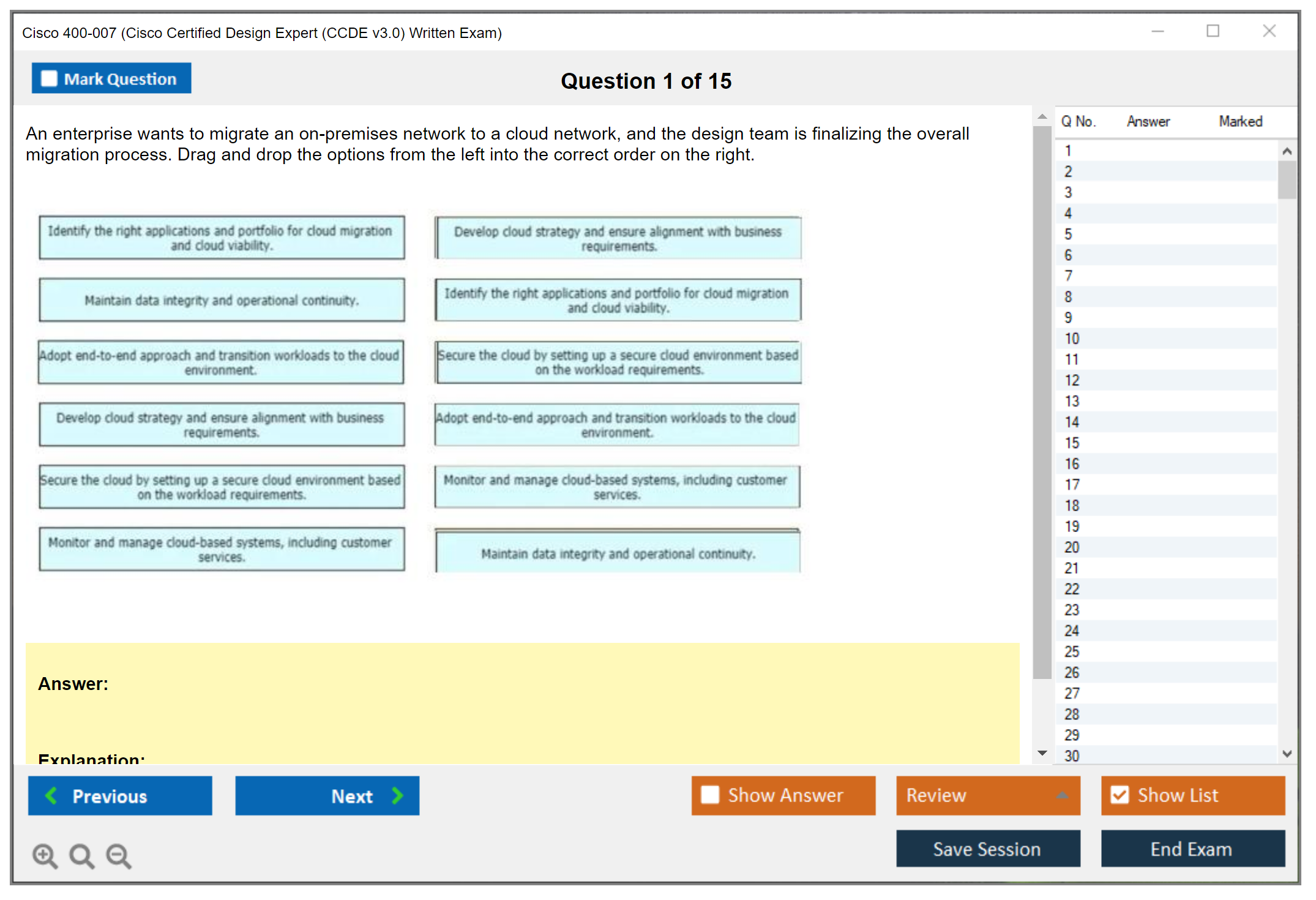
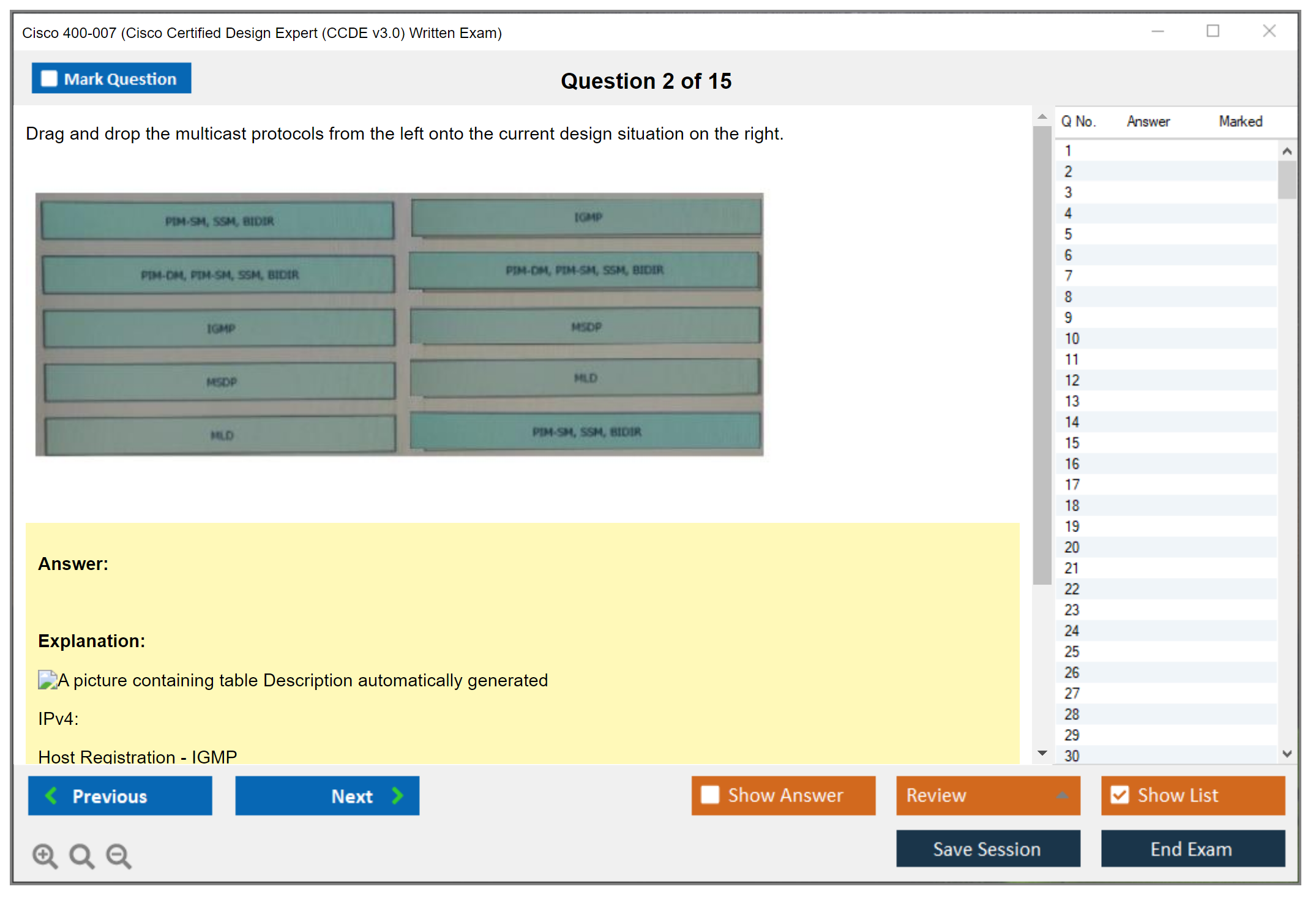
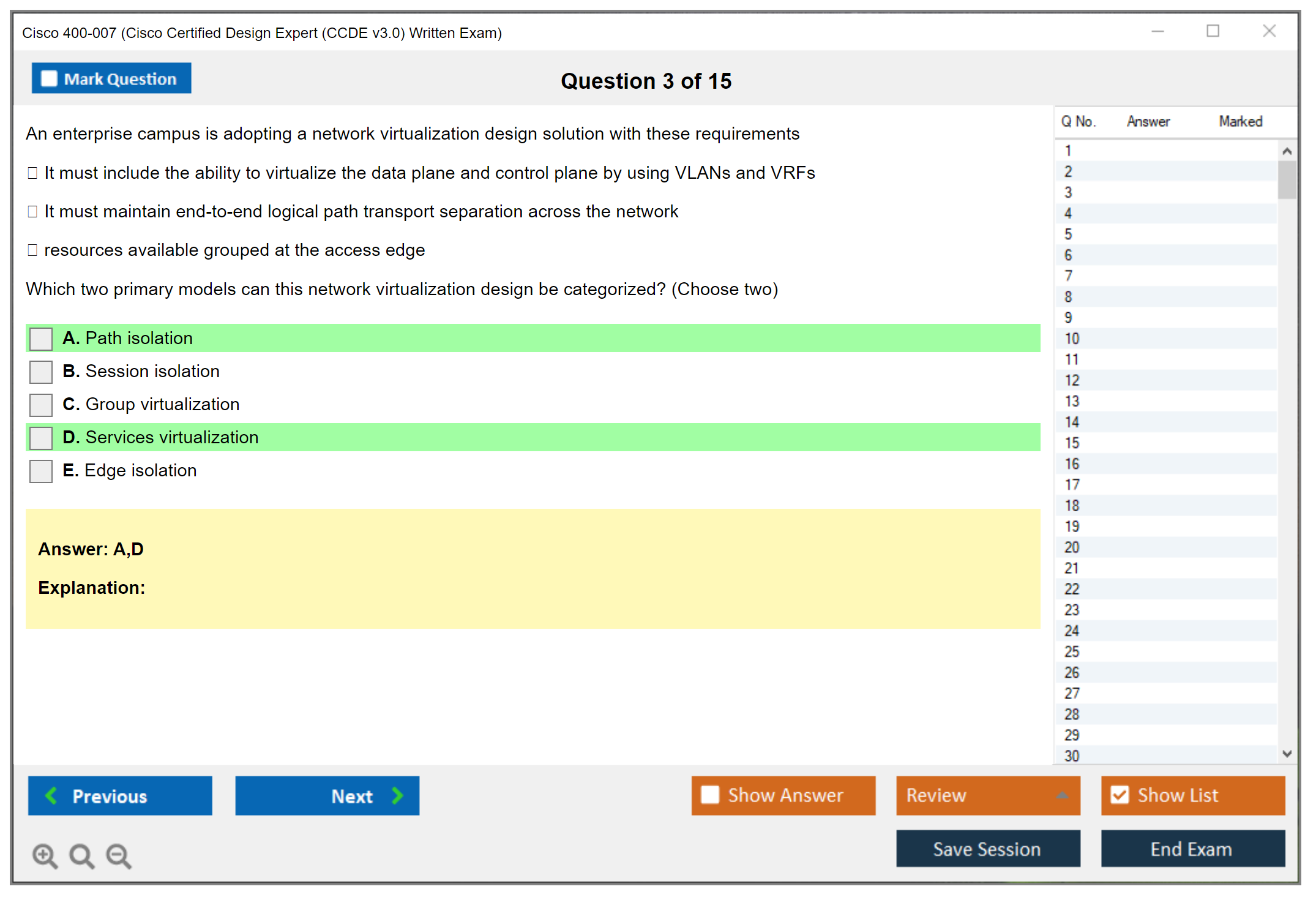
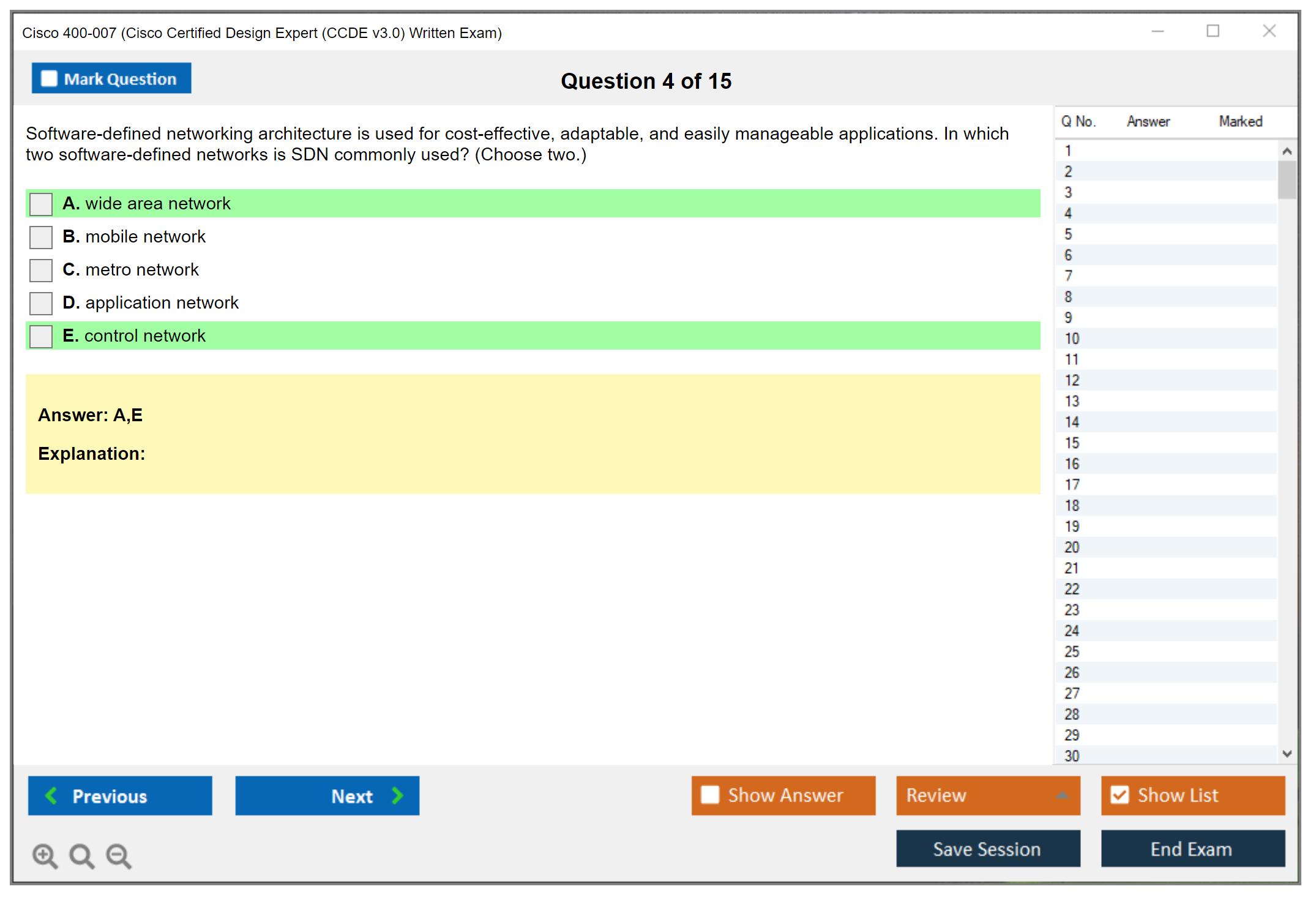
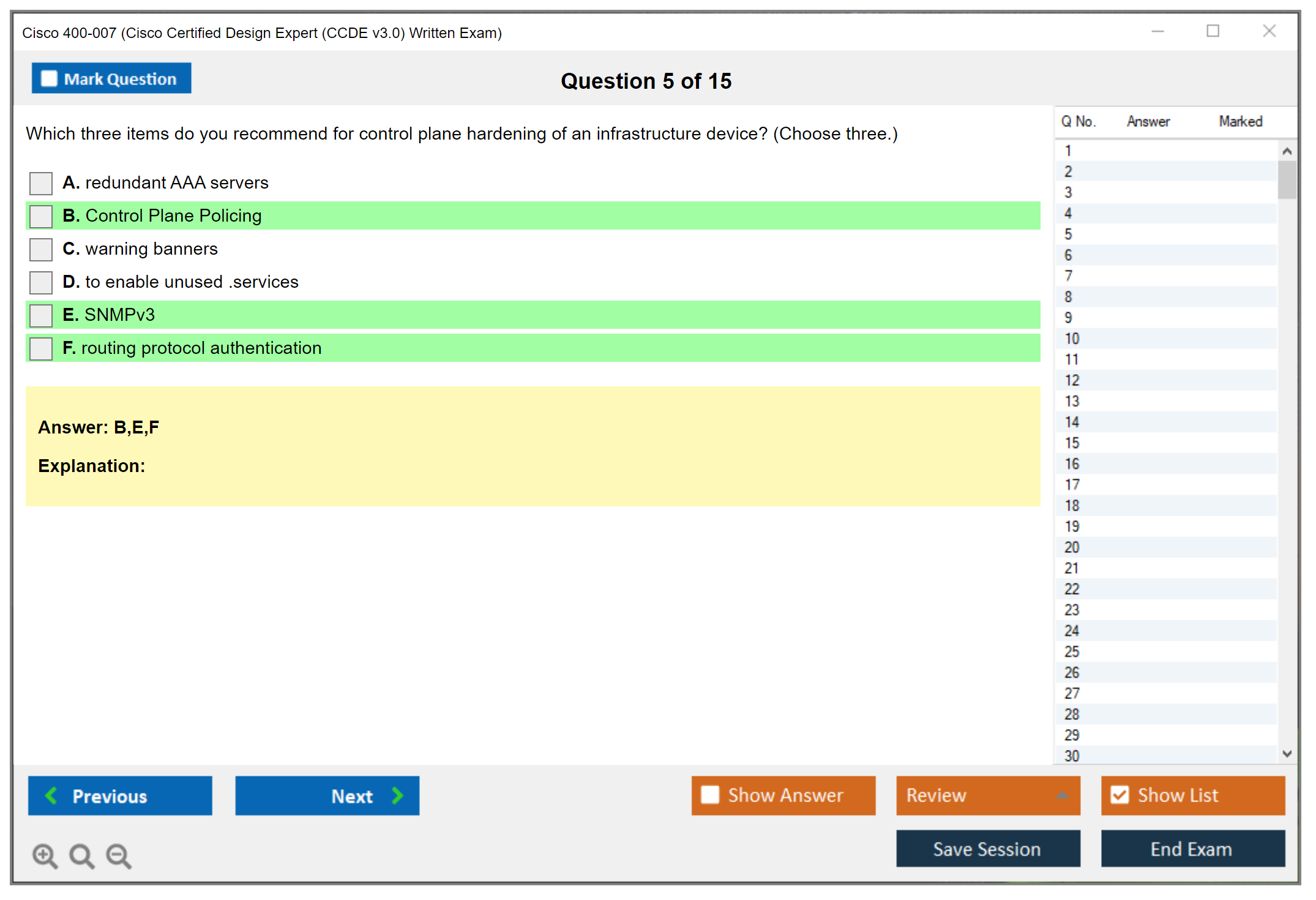
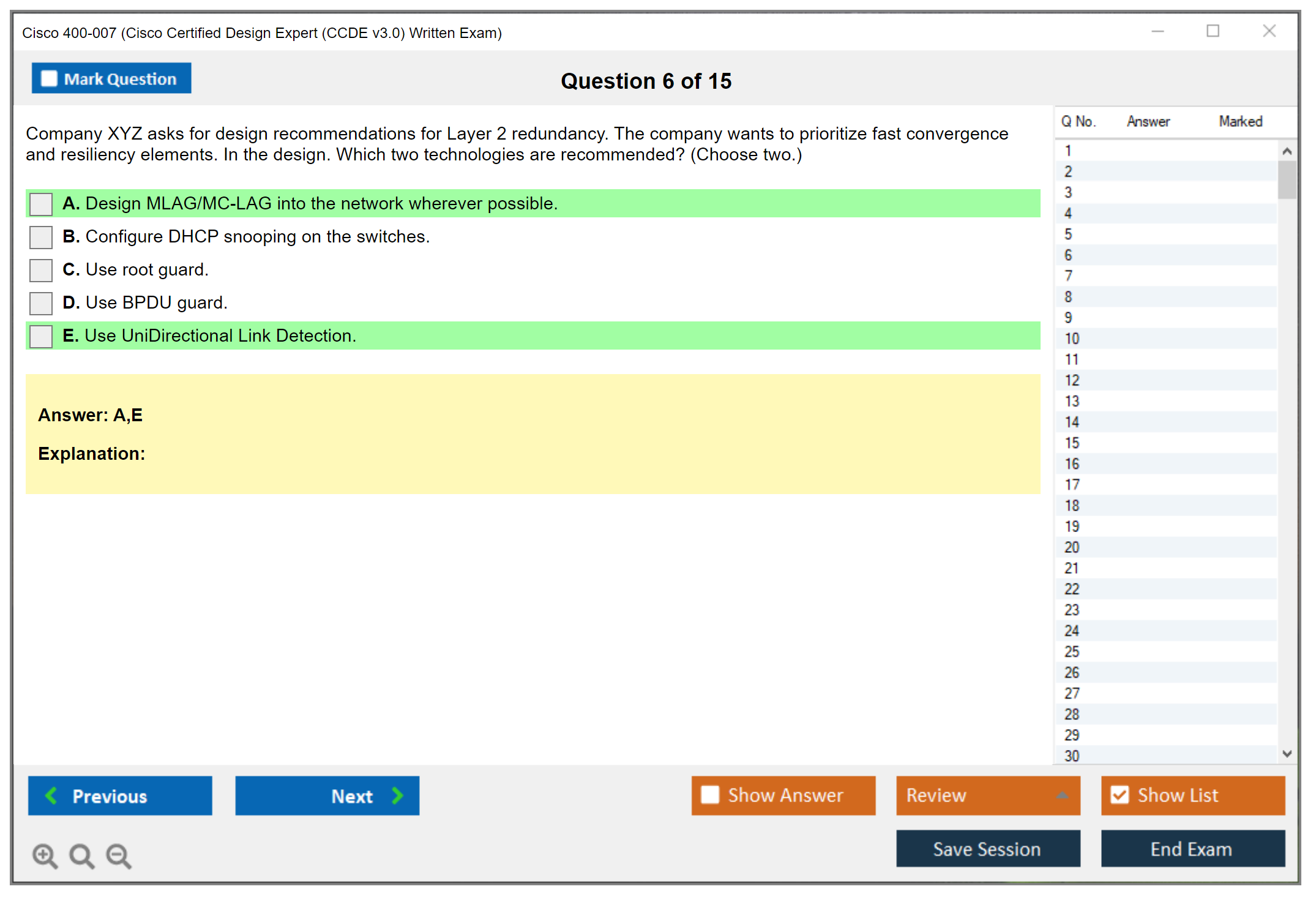
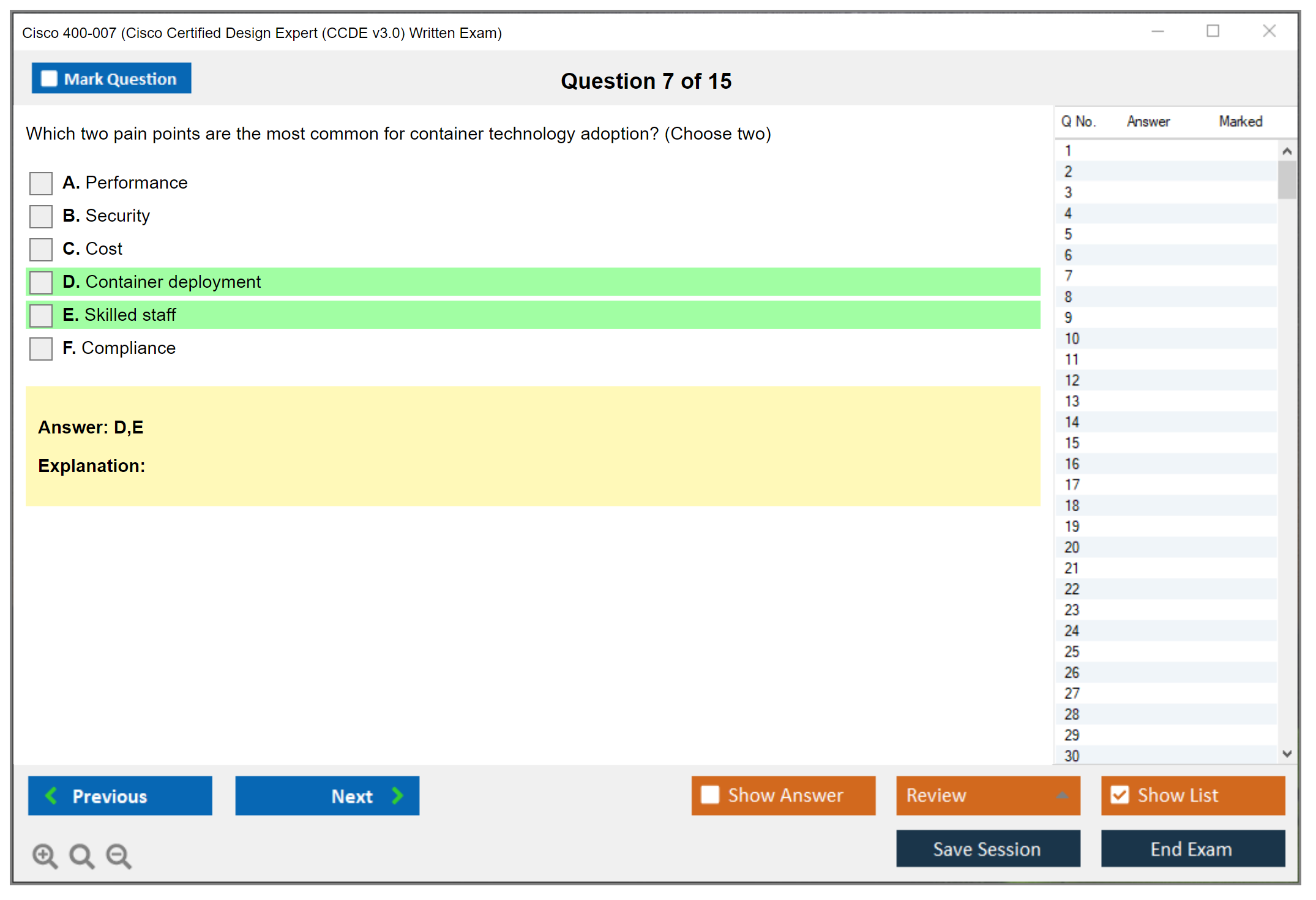
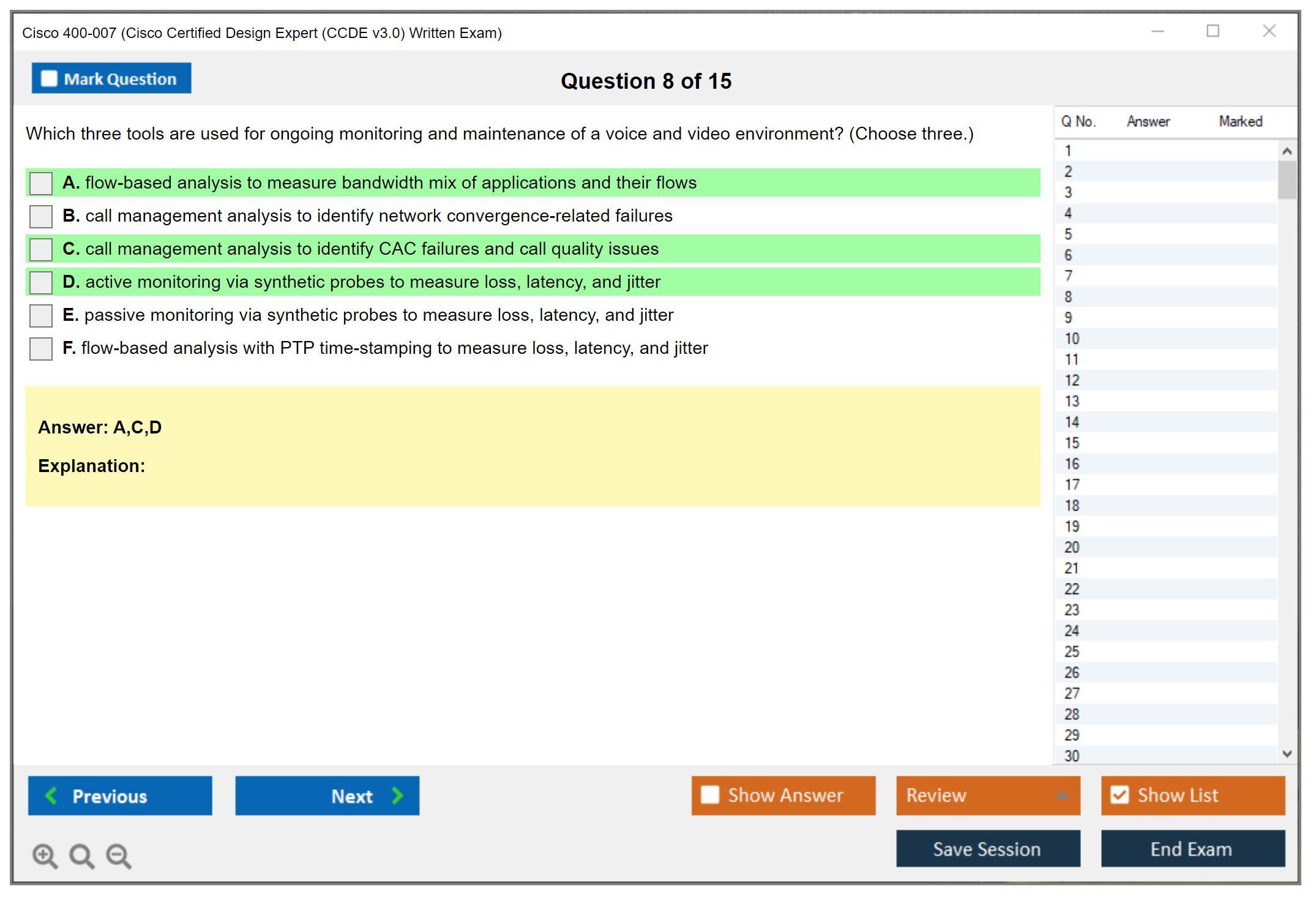
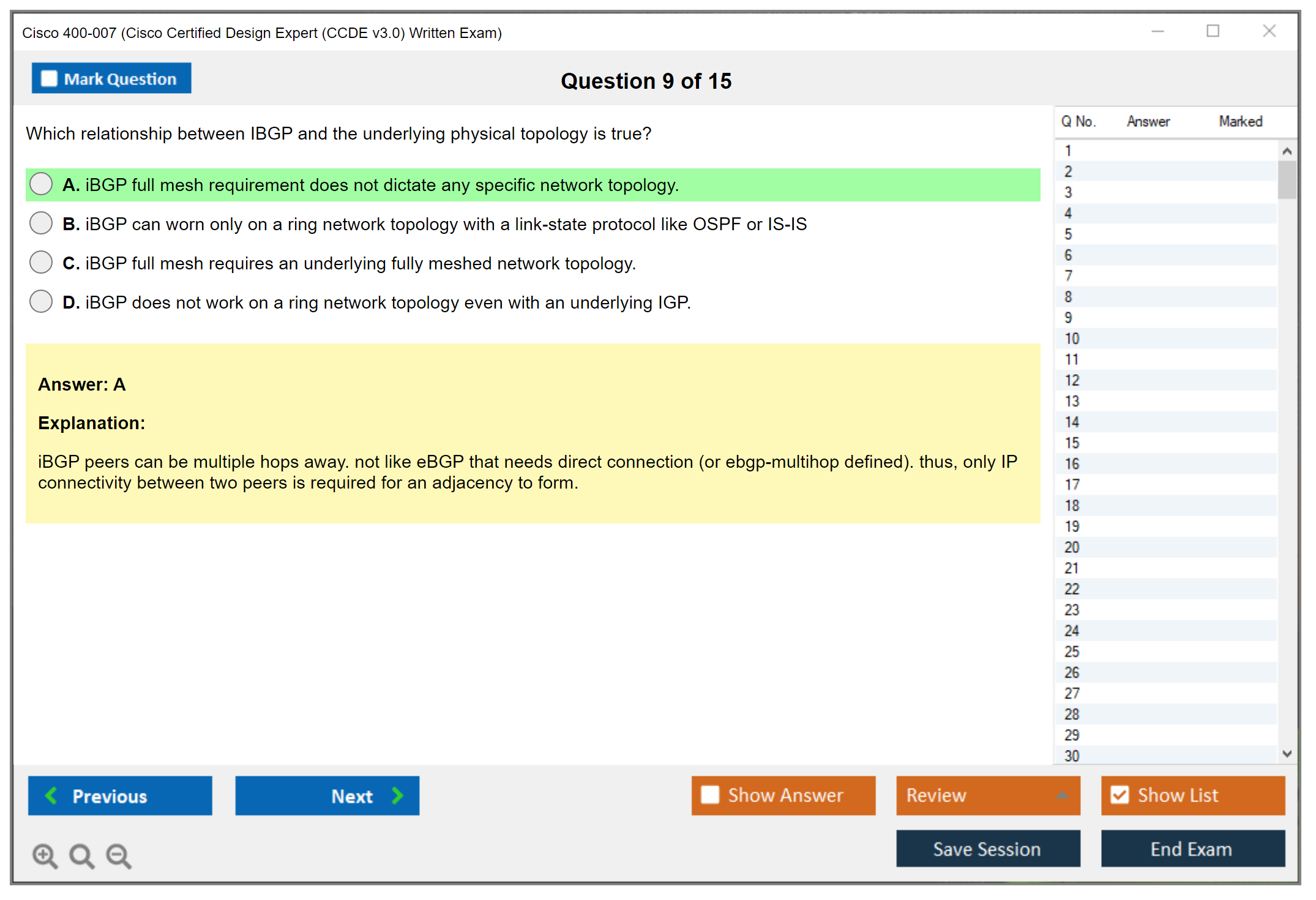
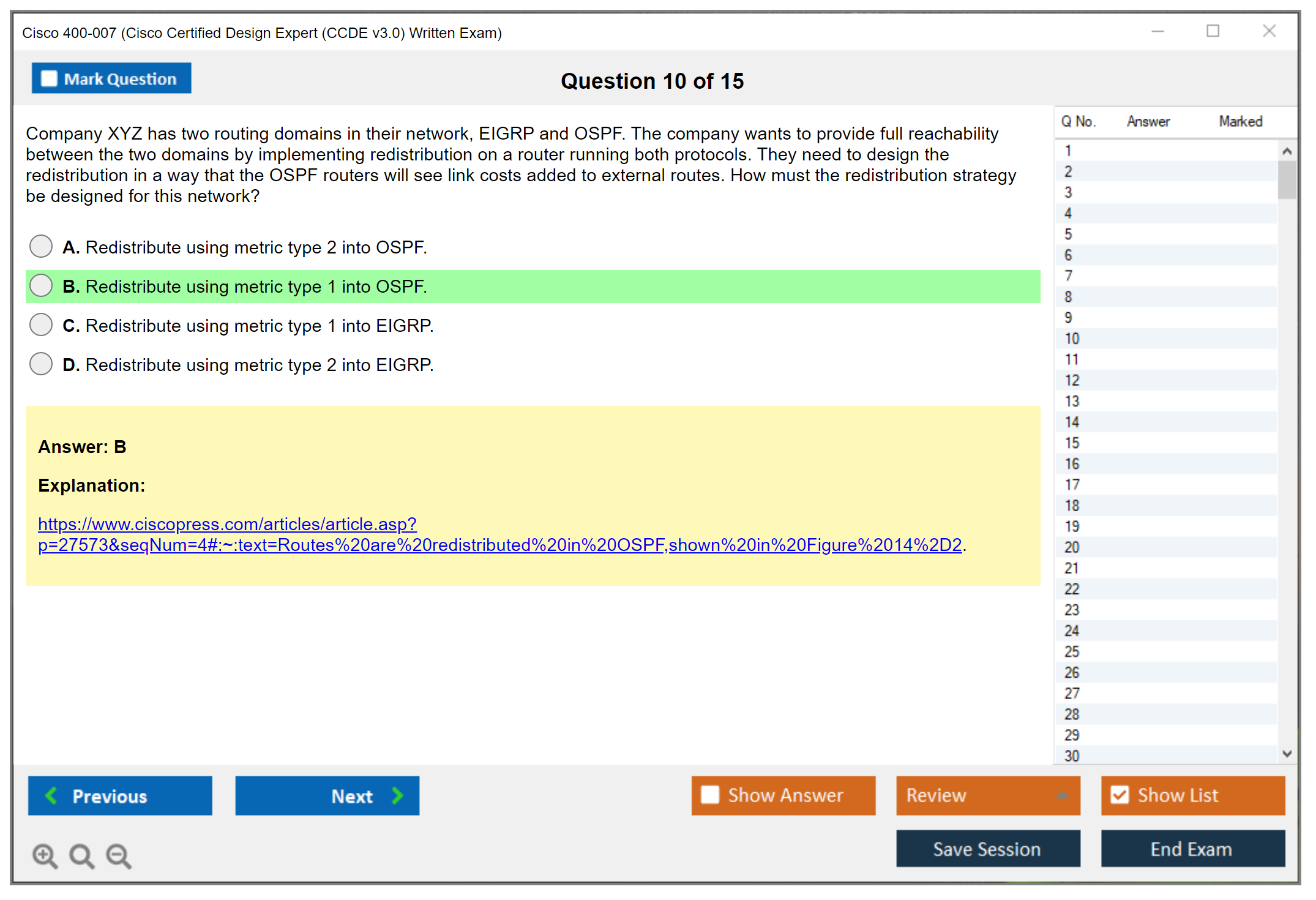
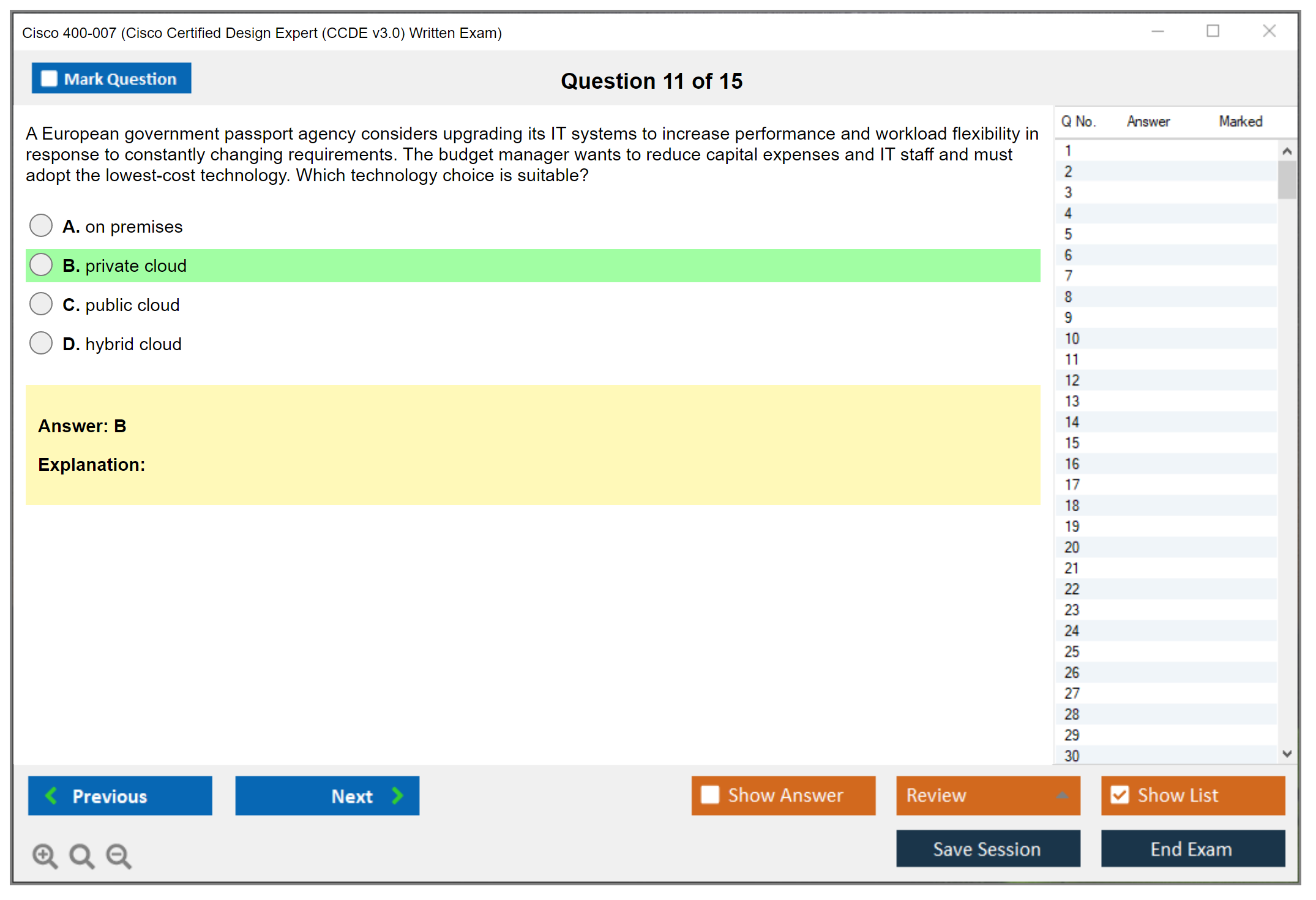
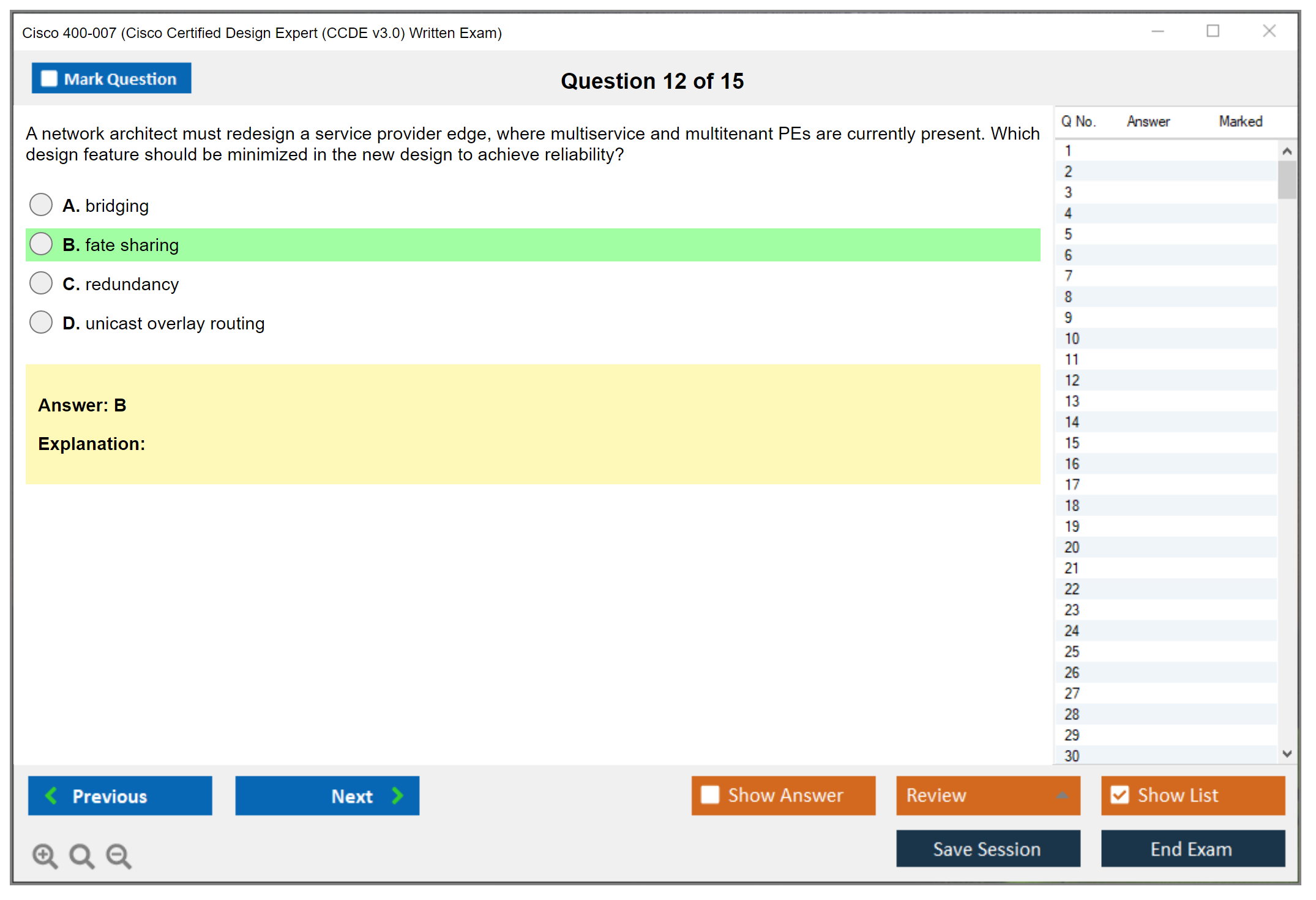
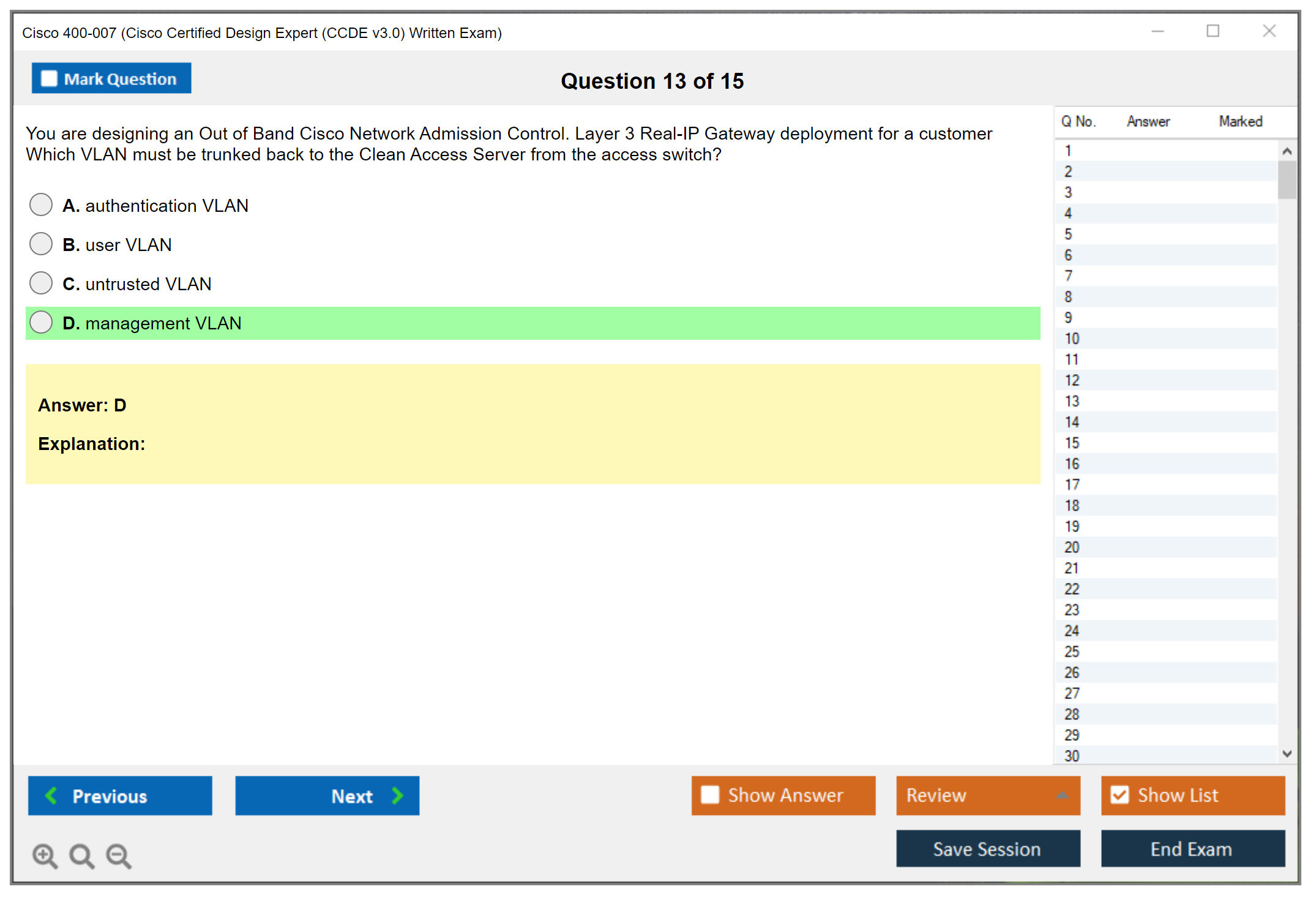
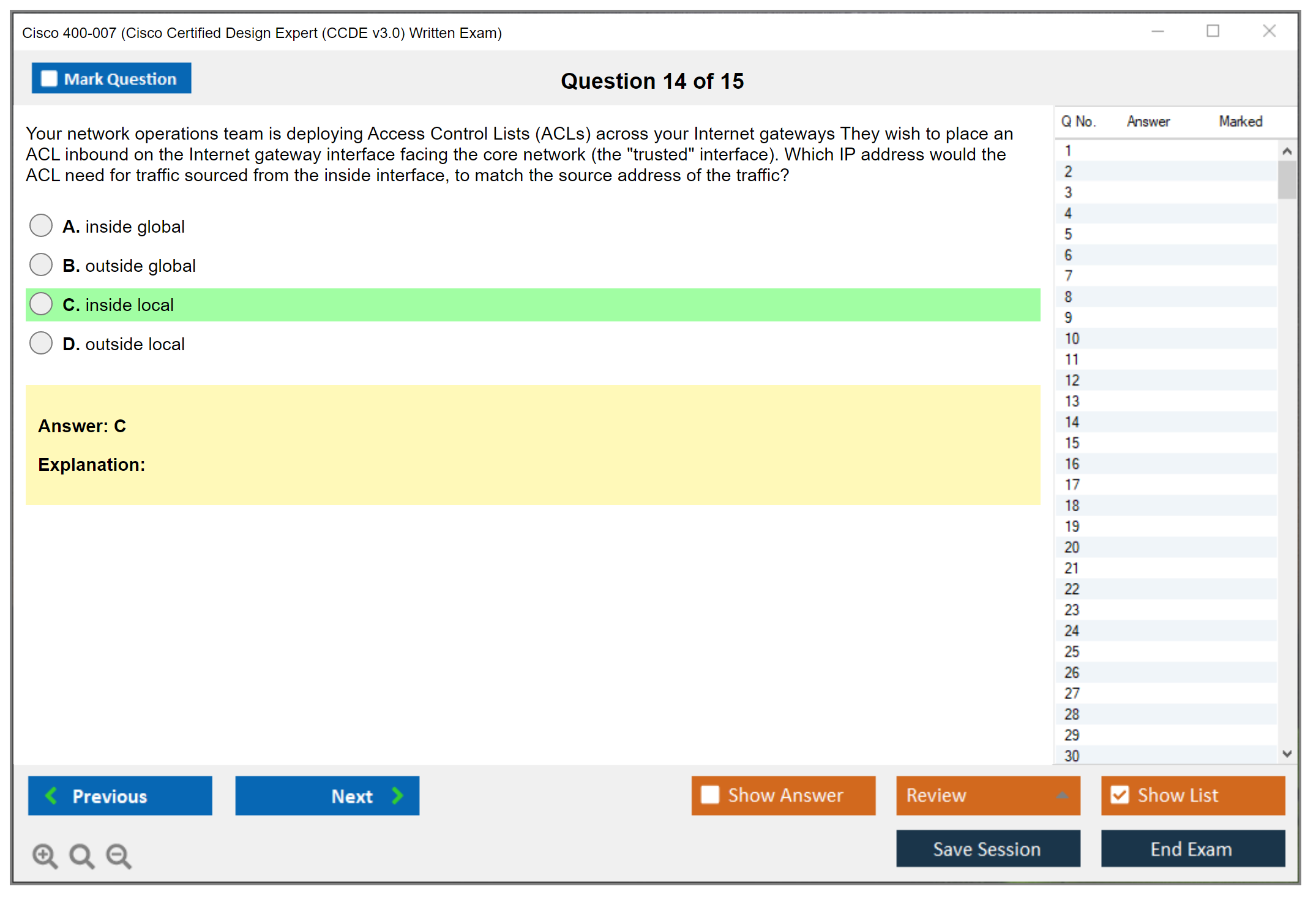
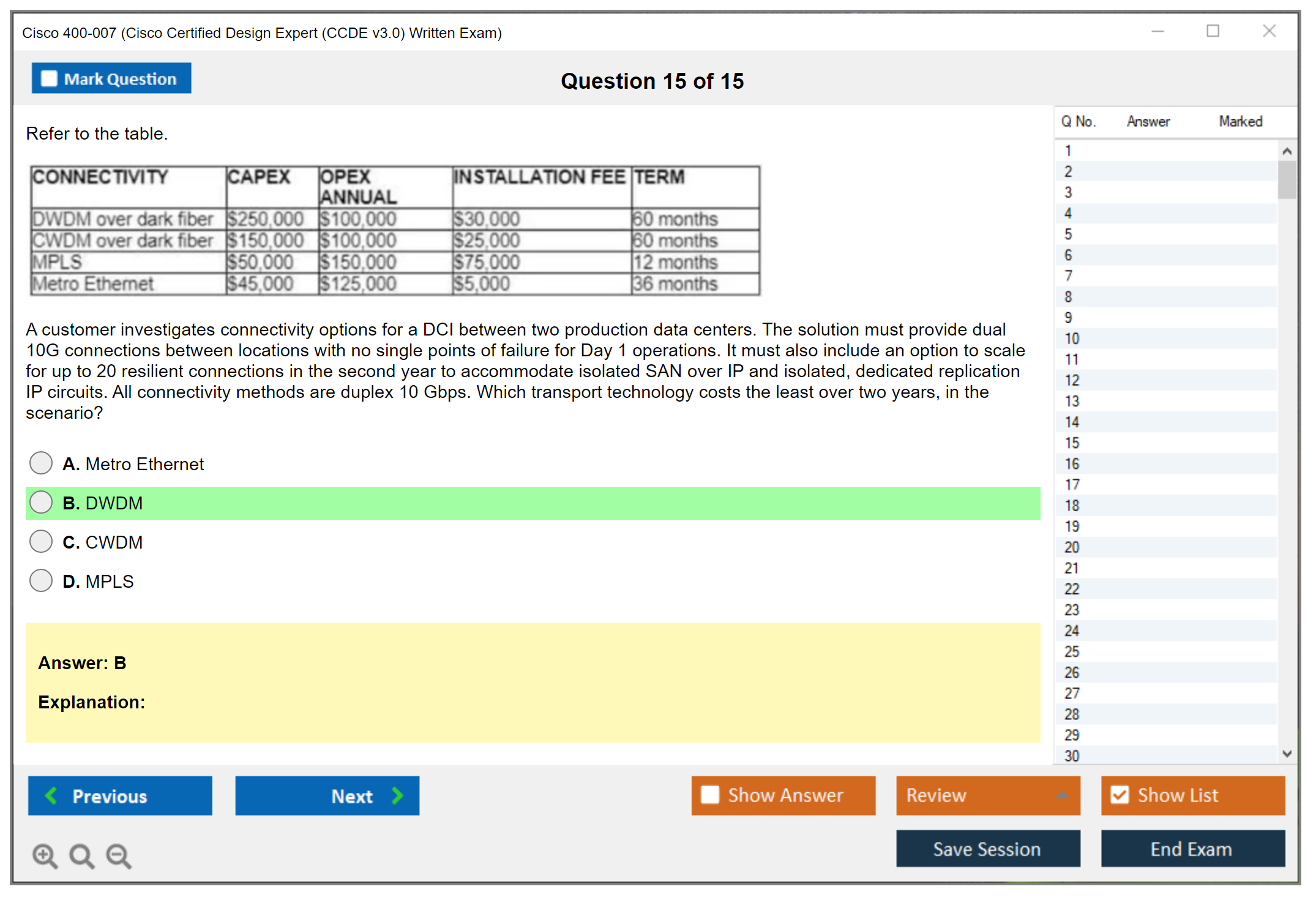
Cisco 400-007 (Cisco Certified Design Expert (CCDE v3.0))
Cisco 400-007 (CCDE v3.0) Exam Overview
Introduction to the Cisco Certified Design Expert (CCDE) v3.0 certification
Look, CCDE's really different. This is Cisco's highest-level design certification, and honestly it's not messing around. While everyone knows about CCIE and its grueling lab exams focused on configuration and troubleshooting, CCDE takes an entirely different approach. It validates strategic design thinking and architecture capabilities rather than how fast you can configure protocols under pressure.
Version 3.0 reflects reality. Where enterprise networks actually are today, not where they were five years ago. We're talking cloud integration that actually matters, SD-WAN deployments that customers are really implementing, automation-aware design principles, and security-first architectures that don't feel like afterthoughts bolted onto legacy thinking.
The 400-007 exam? It's the written component required to achieve CCDE certification, designed for senior network architects, design engineers, and technical leaders who're responsible for enterprise-scale infrastructure. If you're still figuring out basic routing protocols, this exam isn't for you yet. I mean, this targets professionals who've been around long enough to understand that "best practice" depends entirely on business context, customer constraints, and organizational maturity.
What the CCDE v3.0 certification validates
This certification tests your ability to design complex enterprise networks meeting both business and technical requirements. That's the key distinction, really. Anyone can throw technologies at a problem. CCDE validates whether you can translate business objectives into scalable, resilient, and secure network architectures that someone can actually afford and maintain without requiring a team of specialists permanently on standby.
You need proficiency evaluating design trade-offs. Cost versus performance. Security versus usability. Scalability versus simplicity. Every design involves compromise, and CCDE tests whether you understand these tensions and can justify your decisions with sound technical reasoning and business alignment rather than just vendor marketing material.
The exam covers end-to-end network design methodology from requirements gathering through implementation planning. it's about drawing boxes and lines on whiteboards that look impressive but fall apart when operations teams try implementing them. You need competence analyzing existing network environments and proposing optimization strategies that won't destroy the production network during migration phases.
Knowledge of industry best practices matters. But honestly? What matters more is understanding when to deviate from those practices. Design frameworks and architectural patterns give you a starting point, but real-world constraints often require creative solutions that textbooks don't cover. Budget limitations, political considerations, legacy dependencies, skill gaps within operations teams. The exam tests your capability to justify design decisions, not just regurgitate vendor documentation.
Who should take the Cisco 400-007 exam
Network architects with experience? We're talking 7-10+ years designing enterprise or service provider networks. That's the primary audience. I mean, you could attempt it earlier, but you'd be fighting against the scenario-based nature of the questions without that experiential foundation that helps you recognize what actually works versus what sounds good in theory.
Senior network design engineers responsible for multi-site, multi-domain infrastructure will find this certification fits with their daily responsibilities. Technical consultants who develop network solutions for diverse client environments benefit because CCDE forces you to think beyond single-vendor, single-approach solutions that assume unlimited budgets and greenfield deployments.
IT leaders matter here. Technical managers who oversee network architecture teams often pursue CCDE to maintain technical credibility while moving into leadership roles. CCIE-certified professionals frequently seek CCDE to complement implementation skills with design expertise. It's a natural progression distinguishing you from pure hands-on engineers who excel at configuration but struggle with strategic thinking.
Systems engineers transitioning from hands-on roles to strategic architecture positions use CCDE as that bridge. Professionals involved in digital transformation initiatives requiring modern network design find the v3.0 content particularly relevant since it addresses cloud connectivity challenges and hybrid architecture patterns that didn't exist when earlier versions launched.
My old colleague Paul spent three years in the field before even considering CCDE. Smart guy, excellent with routing protocols, could troubleshoot anything. But he told me the exam humbled him because it kept asking "why would you choose this approach given these business constraints?" instead of "how do you configure this feature?" Different muscle entirely.
The CCDE certification path and exam positioning
The 400-007 written exam is now the primary certification requirement. Cisco eliminated the separate practical exam component in 2020, which honestly changed the economics of pursuing this certification significantly, making it more accessible financially though no less demanding intellectually.
You still need experience. Extensive real-world design experience before attempting this expert-level certification, though. There's no shortcut here. The exam tests applied knowledge through scenario-based questions rather than rote memorization, so you won't succeed by memorizing command syntax or protocol specifications without understanding the underlying design implications.
Success requires both. Broad technology knowledge and deep understanding of design principles. This isn't about knowing every feature of every protocol. It's about knowing when to use what and why, understanding the second-order consequences of architectural decisions that might not become apparent until months after deployment.
CCDE certification distinguishes professionals as strategic thinkers rather than just implementers. Companies hire CCIE-certified engineers to make things work. They hire CCDE-certified architects to decide what things should be built in the first place. Different skill set entirely.
How CCDE v3.0 differs from previous versions
Updated content reflecting contemporary technologies makes v3.0 substantially more relevant than earlier versions. SD-WAN isn't some future concept anymore. It's something customers are deploying right now, and the exam reflects that reality.
Cloud connectivity patterns? Network automation considerations? These aren't optional topics anymore. Greater focus on security-integrated design rather than security as an afterthought represents a fundamental shift in how the exam approaches architecture. Previous versions treated security as a separate domain, but version 3.0 recognizes that security considerations must be embedded throughout the architecture, not bolted on afterward when compliance audits reveal gaps.
Greater emphasis on business-driven design and aligning technical solutions with organizational objectives reflects how senior architects actually work. You're not just designing networks anymore. You're enabling business capabilities, reducing operational risk, and justifying capital expenditure to executives who don't care about BGP attributes but definitely care about downtime and security breaches.
The exam scenarios reflect this by presenting business constraints alongside technical requirements. Inclusion of modern architectural approaches including intent-based networking concepts and updated scenarios reflecting hybrid cloud, multi-cloud, and edge computing environments makes this version feel current rather than academic.
Refined question formats better assess design judgment and decision-making processes rather than just technical knowledge recall.
Career value and industry recognition of CCDE certification
CCDE holders are recognized globally as elite network design professionals. The certification often leads to senior architecture roles, consulting positions, and leadership opportunities that simply aren't available to engineers without this credential. It's a signal to employers that you can operate at strategic levels.
Employers value CCDE differently for complex transformation projects, merger integrations, and greenfield designs where getting the architecture right the first time matters because mistakes cost millions and take years to unwind. It demonstrates commitment to professional development and mastery of the design discipline beyond what typical certification paths require.
Not gonna lie? It opens doors to strategic advisory roles and high-impact technical decision-making positions where you're shaping technology direction rather than just implementing someone else's decisions. The thing is, senior leadership tends to trust CCDE-certified architects with consequential decisions that affect entire organizations.
The certification complements other credentials like CCIE, CISSP, and cloud certifications to create a well-rounded expertise profile. While CCNP-level certifications demonstrate solid technical knowledge and specialist certifications show focused expertise, CCDE signals strategic capability that transcends specific technologies or vendor platforms.
Exam format and delivery overview
The computer-based exam? It's administered at Pearson VUE testing centers worldwide, using scenario-driven questions requiring analysis, evaluation, and design judgment rather than configuration recall. There's no hands-on lab component. This is design-focused rather than configuration-focused, which fundamentally changes how you prepare and what skills get tested.
Closed-book format means no external references permitted during examination. You need to internalize design principles and patterns beforehand. Can't Google your way through architectural decisions when you're sitting in the testing center. Results are provided immediately upon completion with pass/fail indication, and detailed score reports become available through Cisco's certification tracking system showing performance across different domains.
The CCDE v3.0 exam cost runs around $1,600 USD, though pricing varies by region and Cisco occasionally adjusts these figures without much notice. Not cheap, but honestly less expensive than the old format that required both written and practical exams. Wait, I should mention the economics changed significantly when they consolidated everything into a single exam, making it more accessible while maintaining rigor.
The exam typically runs about two hours, though exact duration can vary depending on how many questions you receive. Question types focus on multiple-choice scenarios, drag-and-drop design exercises, and simulation-based architectural decisions that require evaluating multiple factors simultaneously. The CCDE v3.0 difficulty level exceeds CCNP but approaches problems differently than CCIE. It's testing judgment rather than speed or memorization, requiring you to demonstrate why one design approach works better than alternatives given specific business and technical constraints.
Is the CCDE 400-007 passing score published? No, Cisco doesn't disclose specific passing scores, which is standard practice for their expert-level certifications.
Cisco 400-007 Exam Cost and Registration
Cisco 400-007 (CCDE v3.0) exam overview
What the CCDE v3.0 certification validates
CCDE's about design judgment. Not CLI speed. Definitely not memorizing knobs.
The Cisco 400-007 CCDE v3.0 exam is basically Cisco asking, "Can you design an enterprise network that won't melt the first time business requirements change?" You're expected to think in tradeoffs: resiliency vs. cost, simplicity vs. feature depth, segmentation vs. operational overhead. Honestly, the thing is you need to do it while reading scenario context, spotting hidden constraints, and choosing the least-bad option, which is what real design work feels like on a Tuesday afternoon when you've got three competing priorities and a stakeholder meeting in an hour.
You'll see tons that maps to end-to-end network design methodology, enterprise architecture design principles, and those network design scenarios and case studies where the "right" answer depends on what the business cares about, what the ops team can support, and what failure domains you're willing to accept. Fragments everywhere. Assumptions. Constraints. It's messy.
Who should take the Cisco 400-007 exam
This exam's for people who already design networks. Period.
If you're mostly configuring devices, you can still get there, but the CCDE v3.0 difficulty level will feel rude until you've spent real time doing architecture reviews, writing HLD/LLD docs, and defending designs to security, app teams, and finance. I mean, Cisco doesn't list hard gates the way some programs do, but CCDE prerequisites and recommended experience is basically "you've been around." If you don't have scars from migrations, mergers, weird routing domains, and politics, you'll build them while studying. That's just how it goes.
Cisco 400-007 exam cost and registration
Exam cost (what to expect and where to verify)
The Cisco 400-007 exam typically costs $1,600 USD (as of 2026). That's the number most candidates should plan around. Still, don't treat any blog, including mine, as the final source for pricing because Cisco and Pearson VUE can change it, and regional pricing can drift based on currency conversion, local taxes, and regional policies. It's annoying but true.
Pricing may vary by geographic region due to local currency conversion and regional policies, so the clean way to verify is to check the official Cisco Learning Network and Pearson VUE websites for current, region-specific pricing. Go to Pearson VUE, pick Cisco as the sponsor, find exam code 400-007, and you'll see your exact price at checkout before payment. That's the number that matters. Not gonna lie, it's annoying, but it's also the only reliable method when money's on the line.
This exam cost is way higher than associate or professional-level certifications, reflecting expert-level positioning. Changes how you prep. Retake policy's simple and painful: full exam fee applies for each attempt, so thorough preparation is financially prudent. If you're budgeting, assume one attempt, then also write a "retake fund" line item anyway, because life happens and design thinking doesn't always click on the first pass.
Cisco occasionally offers promotional discounts during special events or training partnerships. Don't count on it. Watch for it. Also, some employers provide exam vouchers or reimbursement programs for professional development, and if your company's got any kind of learning budget, this is the time to use it because $1,600 isn't pocket change for most folks.
Scheduling and test delivery options
Exams are scheduled through the Pearson VUE testing center network globally. You create an account on Pearson VUE, search for locations, and pick a time slot. Most major cities have multiple testing centers with flexible scheduling options, but the good ones fill up, and the quiet morning sessions go first. That's just reality.
I recommend booking 2-4 weeks in advance to secure the date and location you want, especially if you're trying to line it up with travel, childcare, or a project lull at work. Online proctored exam options may be available depending on regional policies and Cisco guidelines, but don't assume it's offered everywhere, and don't assume your home setup's "good enough" for proctor rules because those folks are strict.
Rescheduling's usually permitted up to 24-48 hours before the appointment, but check the specific policy in your Pearson VUE confirmation. Cancellations inside the restricted window may forfeit partial or full exam fee. That part hurts. Plan like a grown-up.
Registration process step-by-step
Registration isn't complicated, but you can still mess it up by clicking too fast.
Verify your Cisco certification account's active and your profile info's current. Name mismatch is a classic problem, and Pearson VUE won't be sympathetic at the check-in desk. Review the Cisco Certified Design Expert v3.0 blueprint and confirm you're registering for the right version, which is 400-007 v3.0. I've seen people register the wrong thing when they're stressed and sleep-deprived. It happens more than you'd think.
Work through to Pearson VUE, select Cisco as the exam sponsor, then search for 400-007 and follow the prompts for location, date, and time. Complete payment using an accepted method like credit card, voucher, or purchase order, then watch for the confirmation email with appointment details and candidate rules.
The rest's paperwork vibes. Read the testing center policies on identification requirements and prohibited items, because those rules are enforced by humans with checklists, not by your intentions or how nice you are.
Preparation for exam day logistics
Arrive 15-30 minutes early. Seriously. Traffic's random.
Bring two forms of valid, government-issued identification. If one's expired, you're gambling with $1,600 and your sanity. Understand prohibited items too: phones, watches, notes, bags, basically anything that makes you feel like a person, must be secured. Testing centers provide scratch materials, often a whiteboard and marker, sometimes paper and pencil, and you don't get to negotiate or bring your favorite pens.
Plan transportation and parking the day before. Quick win. Also review the Pearson VUE candidate rules document ahead of time, because nothing spikes anxiety like learning a rule while you're already at the front desk trying to check in. I once watched someone get turned away because they brought a smartwatch they forgot to leave in the car. The proctor didn't care that it was an honest mistake. Don't be that person.
Cisco 400-007 passing score and exam format
Is the CCDE 400-007 passing score published?
Cisco typically doesn't publish a fixed Cisco 400-007 passing score in a way you can plan around like "80% and you're good." Scoring can be scaled and can vary by exam form. What you get's pass/fail, plus whatever score report detail Cisco provides at the time. It's frustrating, I know.
So, treat it like a professional exam. Aim for mastery across the CCDE 400-007 exam objectives, not for gaming a threshold you can't even see.
Exam length, question types, and scoring approach
Expect scenario-heavy questions. Long prompts. Competing constraints. Design decisions that feel subjective until you notice the one detail that forces the answer, and then suddenly it clicks.
This is less "what command fixes it" and more "which design aligns to requirements, risk tolerance, and operations." If you're looking for a CCDE written exam preparation guide mindset, it's reading comprehension plus architecture thinking plus time management, all happening at once under pressure.
CCDE v3.0 difficulty level (what makes it hard)
Scenario-based design vs. configuration-focused exams
CCNP and even parts of CCIE can reward muscle memory. CCDE doesn't care about your muscle memory at all.
The hard part's that multiple answers can look reasonable if you don't anchor on the business goal, failure domain, and operational model, and that means you have to stay calm, re-read the scenario, and choose the option that fits the constraints, not the one you personally like or the one that sounds impressive in a vendor presentation.
Common challenges and how to avoid them
The big failure mode's shallow reading. Another's over-designing, where you pick the fanciest solution because it's "cool," even though the scenario wants something supportable and boring that the night shift can actually troubleshoot. Practice summarizing requirements in your own words before you answer. One minute. Worth it every single time.
Cisco 400-007 exam objectives (blueprint)
CCDE v3.0 objectives summary
Start with the CCDE v3.0 exam objectives, straight from Cisco. That blueprint's your map. It tells you what domains Cisco expects you to reason about, and it keeps you from spiraling into random study topics that feel productive but aren't actually on the test.
Mapping objectives to real-world enterprise design domains
Tie each objective to something you've seen in production: segmentation strategy, routing domain boundaries, WAN choices, hybrid connectivity, operational constraints, and security requirements. This is where the "enterprise architecture" part becomes real, because you're not just drawing diagrams in Visio, you're defending why the diagram won't create outages when someone fat-fingers a config at 2 AM or when the business suddenly acquires another company.
CCDE v3.0 prerequisites and recommended experience
Official prerequisites (if any) vs. practical prerequisites
Officially, you can register. Practically, you want years of design exposure. The thing is there's a gap between "allowed to sit" and "likely to pass."
If you're coming from pure operations, build design reps by reviewing reference architectures, writing sample HLDs, and doing postmortems on real incidents so you understand how designs fail, not just how they look in documentation or slide decks.
Recommended background in enterprise network design
Comfort with routing policy, segmentation models, HA patterns, WAN, and security design's assumed. Also, communication. CCDE thinking's "explain the why," not "paste the config" or show off your command-line wizardry.
Best CCDE v3.0 study materials
Cisco official resources (blueprint, training, docs)
Start with Cisco's official blueprint and documentation. Add official training if you can afford it, because official Cisco training courses can range from $3,000-$5,000 for thorough preparation programs, and they do provide structure. Honestly, they're worth it if budget allows, but not everyone's company will pay.
Books, whitepapers, and design frameworks to prioritize
Pick a few solid design references and stick to them. Don't collect PDFs as a hobby. A small library you actually finish beats a giant folder you never open. I've been guilty of this myself, and it doesn't help.
Building a study plan aligned to objectives
Self-study reduces costs but requires discipline and access to quality CCDE v3.0 study materials. Budget 6-12 months of preparation time, because the opportunity cost's real, and you'll be saying no to other projects while you grind through scenarios and notes and fight the urge to procrastinate.
CCDE v3.0 practice tests and exam readiness
What to look for in high-quality CCDE practice tests
Cisco CCDE v3.0 practice tests should feel like design reviews, not trivia. You want long scenarios, ambiguous tradeoffs, and explanations that teach you why an option fails under a stated constraint, not just "answer B is correct" with no context.
Practice strategy for scenario/case-study questions
Do timed blocks. Then do slow review. Write down what you missed: requirement, constraint, assumption. I mean, this is the pattern that changes your accuracy over time, not just doing more questions mindlessly.
Readiness checklist before exam day
Know the blueprint cold. Rehearse reading speed. Sleep. Print your IDs. Confirm location. Small stuff, big impact when you're under pressure.
CCDE certification renewal (recertification)
Renewal options (continuing education vs. exams)
CCDE certification renewal policy typically gives you routes like continuing education credits or passing qualifying exams. The exact options can change, so verify on Cisco's recert pages when you're closer to your renewal window. Don't trust old forum posts from 2019.
Renewal timelines and planning your recert path
Plan for recertification expenses every three years to maintain active status. Put a reminder on your calendar now. Future-you will thank you, and you won't be scrambling while leading a migration or dealing with some fire at work.
CCDE v3.0 FAQs (people also ask)
How much does the Cisco 400-007 CCDE v3.0 exam cost?
Plan for $1,600 USD (as of 2026), then verify your exact region price on Pearson VUE and Cisco Learning Network before you commit.
What is the passing score for the CCDE 400-007 exam?
Cisco doesn't reliably publish a fixed passing score for planning. Prepare across all domains and aim to be consistently right under time pressure. That's the safe play.
How hard is the CCDE v3.0 exam?
Harder than CCNP in a different way. Less memorization, more judgment, more reading, more "what would you do as the designer on call when the VP's breathing down your neck."
What study materials and practice tests work best?
Start with the Cisco Certified Design Expert v3.0 blueprint, then add focused CCDE v3.0 study materials and scenario-based practice tests that explain tradeoffs, not just answers. The why matters more than the what.
How do I renew CCDE after passing 400-007?
Expect a three-year cycle, with renewal via continuing education or qualifying exams depending on Cisco's current policy. Check Cisco's recert page when you're planning it, not the week it expires because that's a recipe for stress.
Cisco 400-007 Passing Score and Exam Format
Is the CCDE 400-007 passing score published?
They don't publish it. Period.
Cisco's kept the 400-007 passing score under wraps forever, and it's not some oversight. This is deliberate policy across their professional-level certifications. When you finish the exam, you'll see pass/fail immediately on that testing center screen, but the actual number? They're not sharing that.
Cisco reports scores on a scaled system, typically 300 to 1000 points. The passing threshold isn't some fixed percentage like 70% or 80%. Would be simpler, right? But it actually floats based on which exam version you get and statistical analysis of question difficulty. This scaled scoring approach means two candidates taking different versions might have different raw passing scores, but the scaled score ensures they're both measured against identical competency standards.
Don't pass? You'll get a detailed score report showing performance by exam domain, breaking down where you stood in each section. Typically labeled "Needs Improvement," "Below Target," "Above Target," stuff like that. Passing candidates don't get this breakdown because you passed. Industry veterans and study forums suggest passing scores usually fall somewhere in the 700-850 range, but that's completely unofficial. Nobody really knows except Cisco's psychometric team.
Why Cisco uses scaled scoring methodology
The scaled scoring system exists for good reasons, even if it frustrates candidates wanting concrete targets.
Different exam versions inevitably have slight difficulty variations. Maybe one version's got three brutally complex BGP design scenarios while another leans heavier on service provider architecture questions. Scaled scoring normalizes these differences so your result reflects actual competency rather than luck of the draw on exam difficulty.
This approach protects exam integrity too. If Cisco published exact passing scores, someone could reverse-engineer which question types matter most and game the system. The 400-007 Practice Exam Questions Pack helps you prepare for the content, but scaled scoring makes sure you can't just memorize patterns.
Cisco updates exam content regularly to keep pace with evolving network design practices. Scaled scoring lets them refresh questions without invalidating previous certifications or creating unfair comparisons between candidates who tested at different times. Someone who passed the 400-007 two years ago faced the same competency bar as someone testing today, even though specific questions differ.
For candidates who don't pass, the domain-level performance feedback's actually more useful than knowing you scored 687 out of 1000. Knowing you're weak in "Service Provider Network Design" or "Enterprise Campus Design" gives clear direction for your next attempt. The score report focuses on actionable intelligence rather than arbitrary numbers. I had a colleague once who obsessed over his exact score on a different Cisco exam for weeks, kept trying to calculate it backwards from the domain feedback, drove himself nuts. Didn't help him pass the second time any faster than just studying the weak areas would have.
Exam length, question types, and scoring approach
You get 120 minutes. That's 2 hours.
The question count isn't officially published and varies somewhat between exam versions, but expect approximately 60-90 questions. That math works out to roughly 1.5-2 minutes per question if you're keeping pace evenly throughout.
Every single question's scenario-based. This isn't like CCNA level exams where you might see straightforward "Which protocol does X?" questions. The 400-007 presents realistic network design situations with business requirements, technical constraints, existing infrastructure details, and asks you to evaluate design options. You'll see network diagrams, requirements documents, and constraint information as part of these scenarios.
Question formats include multiple-choice single answer (pick the ONE best option), multiple-choice multiple answer (select all that apply), and drag-and-drop matching exercises. No simulations. No hands-on configuration tasks. This is pure design assessment, testing your ability to analyze situations and recommend appropriate solutions.
Each question carries weight based on its complexity and importance to overall design competency. Cisco doesn't reveal the specific weighting, but reasonable assumption says complex multi-part scenarios count more than simpler questions. There's no penalty for wrong answers, so educated guessing beats leaving questions blank. If you're stuck, eliminate obviously wrong choices and make your best selection rather than skipping entirely.
Scenario-based question structure and expectations
Scenarios present realistic challenges you'd face as a network architect.
Picture this: you get a network diagram showing a multi-site enterprise with MPLS connectivity, branch offices, data centers, and cloud integration. The scenario describes business drivers like merger integration timelines, application performance requirements, budget constraints, and security compliance needs. Questions ask you to evaluate design proposals, identify potential issues, or recommend improvements.
Some scenarios span multiple related questions. You might analyze the same network situation from different angles. First addressing the WAN design, then tackling redundancy requirements, then evaluating security controls. Each question stands alone for scoring purposes, but they're thematically connected.
Questions test your ability to balance competing objectives. Real network design involves trade-offs between cost and performance, simplicity and redundancy, standardization and customization. The "correct" answer often depends on prioritizing the stated business requirements over technically interesting alternatives. If a scenario emphasizes rapid deployment and cost control, the most elegant technical solution might be wrong if it's expensive and complex.
Not gonna lie, the difficulty level's substantial. The Cisco 400-007 CCDE v3.0 exam assumes you're already an experienced network professional. Questions expect familiarity with enterprise and service provider environments, understanding of design principles beyond just protocol mechanics, and ability to apply knowledge to novel situations. This isn't about memorizing RFCs. It's about demonstrating design judgment.
Time management during the examination
With 120 minutes for potentially 90 questions, time pressure's real.
You can't afford to spend 10 minutes analyzing every scenario, no matter how interesting. Read each scenario completely before looking at answer choices. Jumping straight to options without understanding the full context leads to mistakes.
Complex scenarios legitimately need 3-5 minutes. Simpler questions might take 30 seconds. The key's recognizing which questions deserve deep analysis versus which ones you can handle quickly. Flag difficult questions for review rather than getting stuck. The exam software lets you mark questions and return to them later. Use this feature.
Reserve 10-15 minutes at the end for reviewing flagged questions. Some candidates blow through the exam in 90 minutes, but if you finish with tons of time remaining, you're probably rushing and missing details. Better to use your full time allocation thoughtfully.
Process of elimination works wonders on tough questions. Cross out obviously wrong answers first. Often you can eliminate 2-3 choices quickly, making your decision easier even if you're not completely certain. Design questions usually have one clearly best answer, one defensible alternative, and two weaker options.
Understanding your score report
Pass or fail appears immediately.
That moment's either awesome or crushing, depending on results. Detailed score reports become available through your Cisco certification tracking account within 24-48 hours. These show performance across exam domains like "Layer 2 and Layer 3 Technologies," "Virtualization and Automation," "Network Services," "Security," and others.
Each domain gets a performance rating. Failed attempts show exactly where you struggled, which's valuable for focused study before retaking. If you crushed the security section but bombed network services, you know where to concentrate effort. Passing candidates get their official certification within 3-5 business days, with digital badges and certificates available for download.
The performance feedback uses descriptive categories rather than numerical scores by section. You'll see "Above Target," "Near Target," "Below Target," or similar labels. This approach pushes you to address genuine knowledge gaps rather than gaming specific point values.
For those pursuing related certifications, you might check out resources for Advanced Collaboration Architecture or Cisco Enterprise Network implementation paths. The CCDE represents the pinnacle of design-focused certification, but the path continues with recertification and staying current with evolving technologies. The 400-007 Practice Exam Questions Pack at $36.99 provides realistic preparation scenarios to help you gauge readiness before scheduling your actual exam attempt.
CCDE v3.0 Difficulty Level (What Makes It Hard)
Cisco 400-007 (CCDE v3.0) exam overview
What the CCDE v3.0 certification validates
Cisco 400-007 CCDE v3.0? Design judgment.
That's it.
It validates you can take messy requirements, translate business intent into technical direction, and pick an architecture that won't blow up when the company doubles, gets acquired, or moves half the apps to cloud. This is enterprise architecture design principles with actual consequences: resiliency choices, segmentation strategy, routing domain boundaries, migration sequencing, and how operations will live with your choices for the next five years.
Who should take the Cisco 400-007 exam
This exam's for people who already design networks. Not people who "helped" on a design. If you're the one writing the HLD/LLD, arguing with security, pushing back on budget, and getting blamed when latency spikes, you're the target.
CCDE prerequisites and recommended experience matter here even if Cisco doesn't gatekeep with formal prerequisites. Honestly, if your background's mostly ticket work or device bring-ups, you'll feel lost fast. The exam assumes you've seen real trade-offs and you've been forced to pick one imperfect option and own it.
Cisco 400-007 exam cost and registration
Exam cost (what to expect and where to verify)
CCDE v3.0 exam cost changes, so don't trust random blog posts forever (including mine). Cisco's exam pricing pages and Pearson VUE are the places to verify the current number before you budget it, and yeah, it's not cheap. Add retake planning to your math too. With this exam's difficulty level, many strong candidates don't pass on the first attempt.
Scheduling and test delivery options
Scheduling's the usual Cisco flow through Pearson VUE. Pick a date, pick a test center or online option if available in your region, and then treat it like a real project milestone, not a "maybe I'll try Saturday" thing. Time pressure's part of the experience, so you want a day where your brain's fresh and your calendar's quiet.
Cisco 400-007 passing score and exam format
Is the CCDE 400-007 passing score published?
Cisco 400-007 passing score isn't reliably published as a single fixed number you can plan around. Cisco exams often use scaled scoring and can change question weights, so the practical answer is: aim to be strong everywhere. "I'll make it up in section X" is a risky fantasy on a scenario exam.
Exam length, question types, and scoring approach
Expect scenario-heavy questions. Diagrams, constraints, incomplete info.
That's what real design work feels like.
You're graded on decisions and prioritization, not CLI muscle memory. Not gonna lie, the scoring can feel unforgiving because two answers can look "reasonable" until you notice one violates an operational constraint buried in the scenario text.
CCDE v3.0 difficulty level (What makes it hard)
CCDE v3.0 difficulty level's high enough that I put it in the "career exam" bucket. It's widely considered one of the most challenging IT certifications globally, and that reputation isn't just marketing. Unofficial industry estimates put first-time pass rates around 30 to 40%, and that tracks with what I hear from serious engineers who've taken it and came out humbled.
Main reason it's hard?
Simple: it rewards deep design thinking rather than memorization, and you can't grind flashcards and expect a win. The exam assumes extensive real-world experience designing complex enterprise networks. Then it pushes you into network design scenarios and case studies where you have to synthesize routing, security, WAN, cloud connectivity, and operations while also respecting business stuff like cost, timelines, and organizational politics.
Time pressure makes everything worse. You're reading long scenarios, scanning network diagrams, noticing constraints, comparing "good" options, and trying not to overthink. That last part's brutal. Many candidates with CCIE or equivalent certs still find CCDE challenging because the skill focus is different. Implementation confidence can actually hurt you if you start treating design questions like config questions.
I once watched someone argue about a routing decision for fifteen minutes in a study group. The answer was in the second paragraph of the scenario, hidden between two capacity numbers. Reading discipline beats technical depth when you're racing a clock.
Scenario-based design vs. configuration-focused exams
CCDE tests "why" and "which", not "how".
That's the whole vibe.
Configuration knowledge's assumed but not directly tested. You need to know what technologies do, their failure modes, and where they fit, but you're not being asked to type the commands or remember obscure defaults. Instead, you're evaluating multiple valid solutions and selecting the optimal approach, which is annoying in the exact way real architecture meetings are annoying.
A lot of scenarios don't have a single "correct" answer in the way people expect from lower-level exams. There's usually a best fit for the given constraints, and the constraints are the trap: cost versus performance, security versus usability, complexity versus manageability. And then the business throws a chair through the window: "we need it in 90 days, with staff that's never run BGP at scale." So you're being tested on end-to-end network design methodology and your ability to pick the least-wrong plan that'll survive contact with reality.
Common challenges and how to avoid them
Breadth of knowledge's the obvious one. You need routing and switching, security, wireless, data center, WAN, and cloud connectivity. Mentioning SD-WAN, segmentation, identity, and DC interconnect casually is easy. Doing trade-off evaluation under time pressure? Not.
Scenario complexity's the next gut punch. The questions are multi-layered with incomplete information, mirroring real projects where nobody hands you perfect requirements. One thing that helps is building a repeatable reading pattern: identify business drivers first, then constraints, then current-state pain, then what "success" looks like. Fragments help. Drivers. Constraints. Risks. Migration too.
Time management's where people bleed points. You can't spend eight minutes falling in love with one option. Pick a systematic approach to eliminate suboptimal solutions fast. For example, if the scenario screams "operational simplicity" and "small team", cut the options that add new protocols, new control planes, or fancy multi-domain complexity unless there's a clear payoff that the business actually asked for. Keep moving.
The lack of hands-on component also messes with candidates. You can't "test" a design like you would in a lab, so you have to rely on principles and experience, not trial-and-error. Abstract thinking matters. Vendor-neutral logic matters. Cisco Certified Design Expert v3.0 blueprint language matters too, because it hints at what kind of reasoning Cisco expects, even when the scenario feels open-ended.
Cisco 400-007 exam objectives (Blueprint)
CCDE v3.0 objectives summary
CCDE 400-007 exam objectives are published as a blueprint.
Read it.
Then read it again.
The Cisco Certified Design Expert v3.0 blueprint pushes you toward architecture, not feature trivia: requirements analysis, design choices across domains, resiliency, security integration, and operational considerations. It's less "what knob exists" and more "what outcome do we need".
Mapping objectives to real-world enterprise design domains
Map each objective to something you've designed or at least supported end-to-end. WAN edge and internet breakout. Campus segmentation and identity. Data center connectivity patterns. Cloud on-ramp designs. If you can't tie an objective to a real incident or a real constraint you've lived through, that's a study gap, and it'll show up in the scenarios.
CCDE v3.0 prerequisites and recommended experience
Official prerequisites (if any) vs. practical prerequisites
Cisco doesn't require a formal prerequisite exam the way some tracks do, but CCDE prerequisites and recommended experience are basically "be a designer already". You can sit the exam whenever, but the exam'll sit you right back down if your experience is narrow.
Recommended background in enterprise network design
You want years. Multiple domains.
At least a couple projects where you owned the design, defended it, and dealt with the operational aftermath. Implementation-only backgrounds struggle because implementation experience doesn't automatically translate to design expertise, especially when the exam asks you to justify trade-offs instead of showing that you can configure a feature.
Best CCDE v3.0 study materials
Cisco official resources (blueprint, training, docs)
Start with the blueprint and Cisco docs. That's your CCDE written exam preparation guide foundation, even if Cisco doesn't label it that way. The blueprint tells you what to be good at. Cisco documentation tells you what "good" looks like when you have to defend a design decision.
Books, whitepapers, and design frameworks to prioritize
Prioritize design frameworks, reference architectures, and whitepapers that explain why designs succeed or fail operationally. Not gonna lie, the best reading's often postmortems and lessons learned. CCDE questions smell like "what went wrong last time and how do we prevent it".
Building a study plan aligned to objectives
Build your plan from the CCDE 400-007 exam objectives outward. Don't just collect CCDE v3.0 study materials and hope the pile turns into knowledge. Tie every week to a domain and force yourself to write short design justifications, like you're replying to a cranky architecture review board.
CCDE v3.0 practice tests and exam readiness
What to look for in high-quality CCDE practice tests
Cisco CCDE v3.0 practice tests should feel like scenarios, not trivia. If a "practice test" is mostly definition questions, it's not preparing you for CCDE's decision-making. You want prompts with constraints, diagrams, and options that are all tempting.
If you want a quick way to pressure-test your thinking under a clock, the 400-007 Practice Exam Questions Pack is one of those tools that can expose weak spots fast, especially around reading discipline and option elimination. Price's $36.99, which is cheaper than learning time management on an actual attempt.
Practice strategy for scenario/case-study questions
Do timed runs. Review wrong answers by writing the constraint you missed, then rewrite your decision logic in two sentences. Keep it tight. This is how you build speed without getting sloppy.
Also, talk through scenarios with other candidates. Study groups work because you're forced to defend your reasoning, and CCDE's basically a defense exam disguised as multiple-choice.
Readiness checklist before exam day
You should be able to explain your design choices out loud without hiding behind product names. You should be comfortable balancing competing requirements quickly. You should've practiced reading long scenarios under time pressure.
And yeah, doing another pass with the 400-007 Practice Exam Questions Pack right before your date can help you find the last few recurring mistakes, because everyone's got patterns. Price's $36.99, and if it saves you one retake, the math is obvious.
CCDE certification renewal (Recertification)
Renewal options (continuing education vs. exams)
CCDE certification renewal policy follows Cisco's recert rules for expert-level tracks, usually via continuing education credits or passing qualifying exams. Check Cisco's current policy pages because the program details can change, and you don't want to guess wrong and lose status.
Renewal timelines and planning your recert path
Plan renewal early. Don't wait until the last month. If you're active in design work, continuing education can be the less painful route, but you still need to track credits like an adult.
CCDE v3.0 FAQs (People Also Ask)
How much does the Cisco 400-007 CCDE v3.0 exam cost?
CCDE v3.0 exam cost varies by region and can be updated, so verify on Cisco's pricing pages or Pearson VUE before you register.
What is the passing score for the CCDE 400-007 exam?
Cisco 400-007 passing score isn't consistently published as a fixed number. Treat it like you need strong coverage across the blueprint, not a target percentage you can game.
How hard is the CCDE v3.0 exam?
Very hard.
Widely viewed as one of the toughest certs in IT, with unofficial first-attempt pass estimates around 30 to 40%. It's hard because it tests design judgment under constraints, not memorization.
What study materials and practice tests work best?
Use the Cisco Certified Design Expert v3.0 blueprint, Cisco docs, design whitepapers, and scenario-heavy practice. For timed drilling, the 400-007 Practice Exam Questions Pack can be a practical add-on, especially if you struggle with speed and reading accuracy.
How do I renew CCDE after passing 400-007?
Follow the current CCDE certification renewal policy through Cisco, typically via continuing education credits or a qualifying exam route. Confirm timelines and requirements on Cisco's recertification pages so you don't miss the window.
Cisco 400-007 Exam Objectives (Blueprint)
Understanding the CCDE v3.0 exam blueprint and its structure
Thinking about taking it?
So you're considering the Cisco 400-007 exam. Let's get real about what you're walking into here, because this isn't one of those cert exams where you just memorize a bunch of configs the night before and pray the questions match what you crammed.
The CCDE v3.0 objectives? They're basically Cisco's way of laying out exactly what they'll quiz you on, and the thing is, you should treat this blueprint like it's your personal roadmap through the whole study process. Cisco publishes the official exam blueprint right on the Cisco Learning Network, and I'm not just being formal here: that document needs to be your primary study guide reference. Like seriously. Everything you've gotta know lives somewhere in there.
The exam objectives get organized into major domains with percentage allocations attached to each. Not random at all. Those percentages? They're telling you exactly where Cisco's gonna hit you hardest when you're sitting in that testing center sweating through the actual exam. If a domain's weighted at 25-30%, you better believe roughly a quarter to a third of your questions'll come straight from that area. It's pretty straightforward math when you're planning how much study time goes where, honestly.
Here's the thing about the blueprint, wait, I should mention, it gets updated periodically to reflect what's actually happening in enterprise networks right now, not five years ago. Version 3.0 reflects modern enterprise requirements including cloud connectivity, automation integration, and security that's baked directly into the design rather than just bolted on afterward like some afterthought. This isn't your father's network design exam, I mean really. The days of pure on-prem, isolated network design? Basically over, and the v3.0 blueprint acknowledges that reality head-on.
Must master everything.
Each domain contains specific topics and subtopics you've gotta master. Not "should probably know" or "might wanna review," must master, period. The blueprint isn't vague about this stuff. When it lists something, that's fair game for exam questions, and CCDE questions aren't multiple choice with those obviously wrong answers that make you laugh. They're scenario-based design questions where three answers might technically work but you need to pick the best one given specific constraints that matter.
Network design fundamentals and methodologies
Domain 1 typically represents about 25-30% of the exam, which makes it the heaviest weighted section you'll encounter. Network design methodologies and frameworks? That's your foundation here.
Requirements gathering and analysis techniques matter way more than you'd think. I mean, you can't design a network if you don't actually know what the business needs, right? The exam'll present scenarios where you need to extract design requirements from business objectives that aren't always clearly stated. Top-down design approach versus bottom-up implementation comes up repeatedly throughout the test. Top-down means starting with business needs and working your way toward technical implementation, while bottom-up's when you start with existing infrastructure and try to make it work, which honestly happens more often in real life but isn't always the right answer when you're taking the exam, if that makes sense.
Modular and hierarchical design principles are literally everywhere in CCDE territory. Access, distribution, core. These aren't just buzzwords people throw around at conferences. The exam expects you to know when to use a collapsed core versus a full three-tier architecture, and there's real reasoning behind each choice. When does it make sense to flatten the hierarchy? When do you need clear separation between layers? These decisions have consequences that ripple through the entire design in ways that aren't always obvious at first.
Cisco loves this framework.
The design lifecycle follows the PPDIOO framework: plan, design, implement, operate, optimize. Cisco loves this model, not gonna lie. It shows up in various forms throughout the exam in ways you wouldn't necessarily expect. You need to understand what happens in each phase and how they connect to each other, because questions'll test whether you know which phase certain activities belong in. I once spent an hour arguing with a colleague about whether capacity planning belonged in the plan or design phase. Turns out the exam cares about these distinctions more than you'd think, even when real projects blur the lines constantly.
Enterprise architecture patterns and scalability
Enterprise network architecture patterns cover campus, data center, WAN, and cloud connectivity across the board. Campus network design includes collapsed core, three-tier, and increasingly fabric architectures that're becoming standard. The Cisco Certified Design Expert (CCDE v3.0) exam doesn't just ask you to identify these patterns, it asks you to choose the right one given specific business and technical constraints that sometimes conflict with each other.
Data center network topologies have evolved considerably in recent years, honestly. Leaf-spine's the modern standard for a reason that goes beyond just hype, but multi-tier designs still exist in certain scenarios that make sense. You need to know why leaf-spine works for east-west traffic patterns and when you might still use traditional multi-tier approaches instead.
It's complicated now.
WAN and branch design models are complicated by SD-WAN and cloud connectivity entering the picture. Hybrid cloud and multi-cloud architectures aren't edge cases anymore, they're the norm in most enterprises. The blueprint expects you to design connectivity that works smoothly across traditional WAN, internet, and direct cloud connections without creating bottlenecks or security gaps.
Scalability and growth planning separates good designs from great ones in the real world. Capacity planning methodologies mean understanding current requirements and projecting future growth without just guessing wildly. Addressing and summarization strategies aren't just about making routing tables smaller, they're about creating a design that can grow over time without requiring complete redesigns every two years. Modular design enabling incremental expansion's huge in this context. Can you add a new building without touching the core? Can you expand data center capacity without downtime? Technology refresh and migration planning recognizes that networks evolve constantly, and your design needs to accommodate that reality from day one.
Network technologies domain coverage
Domain 2 covers about 20-25% of the exam and digs into specific technologies you'll use. Routing protocol design considerations include OSPF, EIGRP, and BGP design and scalability at enterprise scale. You need to know more than just how these protocols work, you need to know when to use each one and how to design for scale without creating problems. Route summarization and filtering strategies impact both routing table size and failure domain scope in ways that matter. Redistribution design patterns come with pitfalls you need to understand deeply, because they'll catch you if you don't. Routing protocol selection criteria change based on whether you're designing for campus, data center, or service provider environments with different requirements.
Still matters, honestly.
Switching and Layer 2 design still matters despite all the Layer 3 to the access layer hype you hear at every conference. VLAN design and segmentation strategies balance security, broadcast domain size, and operational complexity that real network teams deal with. Spanning-tree alternatives and design have evolved. MST, RPVST+, and fabric approaches that eliminate spanning-tree entirely each have their place depending on circumstances. EtherChannel and link aggregation design affects both capacity and redundancy in ways that aren't always intuitive. Layer 2 domain sizing and failure domain containment prevent localized failures from cascading into network-wide disasters.
Network services design covers the supporting services that make networks functional beyond just moving packets. DHCP and DNS architecture for enterprise environments need redundancy and scale that goes beyond basic setups. Network Time Protocol design matters more than people think, authentication depends on accurate time being distributed everywhere. Quality of Service design principles and models are critical when voice, video, and data compete for bandwidth on the same links. Multicast design considerations and protocols come up in specific scenarios like video distribution or financial trading environments where it actually matters.
Security integration and threat mitigation
Domain 3 focuses on security design, usually 15-20% of the exam weight. Security-integrated network design means defense-in-depth architectural approach where multiple layers provide protection instead of relying on perimeter firewalls alone. Network segmentation and microsegmentation strategies limit blast radius when something gets compromised, because let's be honest, breaches happen. Zero-trust network design principles assume breach and verify everything instead of trusting internal traffic. Security policy enforcement points in network architecture define where you inspect and control traffic without creating bottlenecks.
Access control and identity services include 802.1X and network access control design that actually works in practice. Identity services engine integration architecture connects authentication, authorization, and policy enforcement across the network. Role-based access control implementation in network design means different users get different network access based on who they are and what they need, not just everyone getting everything.
Threat mitigation design includes DDoS mitigation architecture that can detect and respond to attacks without impacting legitimate traffic flowing through. Firewall placement and high-availability design balances security with performance and availability requirements that sometimes conflict. Intrusion prevention system integration needs careful design to avoid becoming a bottleneck that kills performance. Secure network management design protects the management plane that controls everything else. Lose that and you've lost the whole network.
WAN connectivity and service provider integration
Options have exploded.
Domain 4 addresses connectivity and WAN design, another 15-20% chunk of exam content. WAN connectivity options have exploded beyond traditional MPLS in recent years. You need to understand the tradeoffs between MPLS, internet VPN, SD-WAN, and direct cloud connectivity approaches. Each has different cost, performance, security, and availability characteristics that make them right for certain situations and wrong for others.
The exam expects you to design WAN solutions that meet business requirements while managing costs that executives actually care about. Branch connectivity might use multiple transport types for redundancy without breaking the budget. Data center interconnect designs need to handle both replication traffic and failover scenarios that happen when sites go down.
This blueprint represents what Cisco considers necessary knowledge for expert-level network designers working today. The percentages guide your study time allocation, but honestly, everything's fair game when you sit down for the exam. The Advanced Collaboration Architecture Field Engineer certification takes a different approach entirely, but CCDE? Pure design thinking.
The v3.0 blueprint acknowledges that modern networks integrate cloud, automation, and security from the start of the design process. You can't design networks in 2024 the way you did in 2014. Different world now. The exam tests whether you understand that reality and can design accordingly when presented with real-world scenarios.
Conclusion
Wrapping up your CCDE v3.0 path
Here's the deal. The Cisco 400-007 CCDE v3.0 exam? Not a weekend thing. It's legitimately one of the toughest certifications out there in networking, and you're getting tested on architecting complete enterprise networks under messy, real-world constraints. Not just regurgitating commands or fixing configs. The CCDE v3.0 difficulty level shows this reality. You'll need years of hands-on network design experience, a rock-solid understanding of end-to-end network design methodology, plus the mental endurance to power through complex case studies that mimic actual client scenarios. Political drama, budget limitations, and technical constraints all stacked on top of each other at once.
The CCDE 400-007 exam objectives are massive. Truly massive. You're tackling enterprise architecture design principles, security integration, network services, transport technologies, and business requirements analysis all at the same time. That's why a structured approach matters so much. You can't improvise your way through this thing. Build your study roadmap around the Cisco Certified Design Expert v3.0 blueprint first, then pile on whitepapers, design frameworks, and network design scenarios and case studies from Cisco Live sessions or industry publications.
I remember spending three weeks on just the transport technologies section alone, thinking I had it nailed, only to realize I'd been approaching Layer 2 design decisions completely backwards when constraints got layered in. Humbling.
Not gonna sugarcoat it. The CCDE v3.0 exam cost is brutal ($1,600 just for the written portion), and Cisco won't publish the precise Cisco 400-007 passing score, which cranks up the anxiety. But here's the thing: when you've actually done the work, internalized the design thinking, and drilled realistic scenarios, you'll feel it when you're ready. The CCDE certification renewal policy grants you three years before recertification kicks in. Seems fair given how deep this knowledge goes.
For CCDE v3.0 study materials, go quality over quantity every time. Official Cisco resources first. Focused books second. Then, and this matters, Cisco CCDE v3.0 practice tests replicating the scenario-based format. You need practice materials challenging your design judgment, not your memorization muscles.
If you're really committed to passing on attempt one and want exam-realistic questions actually prepping you for the scenario-driven nature of this monster, check out the 400-007 Practice Exam Questions Pack at /cisco-dumps/400-007/. It's built around the CCDE v3.0 written exam preparation guide methodology, zeroing in on design decisions under constraint. Exactly what you'll encounter on exam day.
You've got this.
Just respect the exam, invest the hours, and treat it like the design challenge it actually is.
