

Python Institute PCAP-31-03 (Certified Associate in Python Programming)
What Is the Python Institute PCAP-31-03 Certification?
The PCAP-31-03 certification is your proof that you know Python beyond just basic scripts. It's the Certified Associate in Python Programming credential issued by the Python Institute (OpenEDG), and it sits right in that sweet spot between beginner and professional-level certifications. You're looking at validation of intermediate Python skills like object-oriented programming, exception handling, working with modules and packages, and actually understanding the standard library instead of just copying Stack Overflow answers.
Second tier. That's where it lands.
Below it you've got PCEP-30-02 (PCEP - Certified Entry-Level Python Programmer), which covers the absolute basics. Above it? The PCPP-32-101 (PCPP - Certified Professional in Python Programming 1) and PCPP2 certifications that get into really specialized territory like design patterns and network programming.
The "31-03" part? Version code. It replaced earlier versions like the PCAP-31-02 (Certified Associate in Python Programming) and fits with Python 3.x standards, because let's be real, Python 2's dead and we need to move on.
What PCAP-31-03 actually proves
This certification demonstrates you can write, debug, and maintain production-level Python code. Not just toy programs or tutorial exercises. We're talking about programs that could actually run in a business environment without immediately breaking or causing your senior dev to send you passive-aggressive code review comments.
You'll show proficiency in Python fundamentals, data structures (lists, tuples, dicts, sets), functions, modules, exceptions, and OOP principles. The Python Institute designed this for programmers with around 150-200 hours of Python experience. That translates to roughly six to twelve months of hands-on coding if you're working with it regularly.
The certificate doesn't expire.
Once you pass, you're certified for life. The Python Institute recommends staying current with newer versions as Python evolves, but they're not gonna revoke your credential if Python 3.15 comes out and you haven't retaken anything. Though honestly, if you let your skills stagnate for five years while Python adds major features, that certificate on your resume starts looking more like participation trophy than actual proof of competency.
Who the PCAP (Certified Associate in Python Programming) is for
Junior Python developers with six to twelve months of coding experience are the primary audience here. You've built some projects, maybe contributed to a codebase at work, but you want formal validation of your skills that goes beyond "I have a GitHub account."
Software engineers transitioning from other languages like Java, C++, or JavaScript find this certification useful. You might already understand programming concepts deeply, but you need to prove you know Python's specific idioms and quirks. Employers see PCAP on your resume and they know you're not just guessing your way through Python syntax.
Computer science students and bootcamp graduates use PCAP to enhance their resumes before job hunting. Self-taught programmers especially benefit because it's third-party validation. When you learned from YouTube tutorials and personal projects, PCAP tells hiring managers "yes, this person actually knows their stuff."
Data analysts and scientists who use Python regularly but came from statistics or math backgrounds also pursue this. You might be great at pandas and numpy, but PCAP shows you understand core Python beyond just importing libraries and following documentation examples.
IT professionals expanding into Python automation? They're in too. DevOps folks writing infrastructure scripts, testers building automation frameworks. They all find value here.
The certification helps you stand out in competitive job markets. Many employers specifically list PCAP in job postings for mid-level Python developer positions. It's become shorthand for "this candidate has moved past beginner status."
PCAP vs PCEP vs PCPP (Certification path)
The Python Institute offers a clear progression path.
PCEP is foundational. Basic syntax, data types, simple control flow, loops and conditionals. It requires maybe 50-75 hours of Python experience and costs around $59-71. The exam's 30 questions in 40 minutes with a 70% passing score. It's really entry-level stuff.
PCAP builds on that foundation significantly. You're getting into advanced topics like OOP with inheritance and polymorphism, proper exception handling patterns, working with modules and packages beyond just importing them, file handling with context managers. The exam's 40 questions in 65 minutes, costs $295, and requires the same 70% passing score. But those questions are way harder. You're analyzing code snippets, identifying bugs, understanding scope issues, and demonstrating you can design solutions.
PCPP1 and PCPP2 are the professional tier. PCPP1 covers advanced OOP concepts, GUI programming with tkinter, network programming, and sophisticated file processing. PCPP2 dives into design patterns, testing frameworks, and software development lifecycle considerations. These exams cost $195 each, have 45 questions in 65 minutes, and they're for people who are already working as professional Python developers and want to prove advanced expertise.
Recommended path? PCEP, then PCAP, then PCPP1, then PCPP2.
But here's the thing. You don't technically need PCEP before taking PCAP. If you already have solid Python fundamentals from work experience or self-study, you can jump straight to PCAP. Why pay for a beginner cert if you're past that stage?
Many people skip PCEP entirely and go straight to PCAP-31-03 (Certified Associate in Python Programming) because it's the certification that actually opens doors. Employers care way more about intermediate competency than entry-level credentials. PCEP's great for absolute beginners building confidence, but PCAP's where career progression really starts.
The certification path aligns nicely with typical career progression too. Junior developers often hold PCEP or are working toward PCAP. Mid-level developers typically have PCAP and are considering PCPP1. Senior developers pursuing technical leadership or specialized roles go for PCPP2. It's a roadmap that actually makes sense instead of just being arbitrary certification levels.
Why employers recognize PCAP
PCAP really has international credibility. The Python Institute's a non-profit dedicated to promoting Python education worldwide, so they're not just some vendor trying to monetize certifications. Their credentials show up in job postings across North America, Europe, Asia. Pretty much everywhere Python's used professionally.
Employers value PCAP. Why?
Because it demonstrates specific competencies. When someone lists PCAP on their resume, hiring managers know this person can design programs using best practices, implement proper error handling instead of just letting things crash, write maintainable code with functions and modules, and actually understand object-oriented principles instead of just cargo-culting class definitions from tutorials.
It proves problem-solving ability too. The exam questions aren't just "what's the syntax for a for loop?" They're scenario-based. You're reading code with subtle bugs. Identifying scope issues. Predicting output from complex operations. Understanding inheritance hierarchies. Passing PCAP means you can think through Python problems systematically.
The certificate remaining valid indefinitely is both a benefit and a limitation. You don't have to worry about renewal fees or retaking exams just to maintain your credential. But technology moves fast. Python 3.8 introduced walrus operators and positional-only parameters. Python 3.10 brought pattern matching. If you certified in 2018 and haven't kept learning, your PCAP might not reflect current best practices even though it's technically still valid.
That's why staying current matters even without mandatory renewal. The Python Institute keeps releasing updated exam versions (hence 31-03 vs 31-02) that incorporate newer language features and modern development practices. Your old certificate doesn't become invalid, but pursuing newer versions or advancing to PCPP shows you're actively maintaining your skills rather than coasting on credentials earned years ago.
PCAP-31-03 Exam Overview
what is the Python Institute PCAP-31-03 certification?
The PCAP-31-03 certification is Python Institute's associate-level badge for people who can actually read Python, reason about it, and make decent choices under pressure. Not "I watched a tutorial once." More like: you can debug, predict behavior, and explain why a snippet throws TypeError instead of ValueError.
It's aimed at early-career devs, QA folks moving into automation, sysadmins doing Python glue code, and students who want a credential that's more serious than entry-level but not full-on professional. Career changers too. Lots of them.
who the PCAP (Certified Associate in Python Programming) is for
If you've built a few scripts, touched functions and classes, and you're comfortable reading other people's code, you're the target. If for/else still feels like sorcery, you may want a bit more runway first.
Look. This isn't a "definitions" exam. You're expected to think.
PCAP vs PCEP vs PCPP (certification path)
Python Institute's path is basically PCEP → PCAP → PCPP. PCEP is entry-level fundamentals, PCAP is intermediate code reasoning, and PCPP is where things start feeling like professional-level depth. If you're deciding where you fit, check PCEP-30-02 (PCEP - Certified Entry-Level Python Programmer) first, then compare to PCAP-31-03 (Certified Associate in Python Programming), and later you can step up to PCPP-32-101 (PCPP - Certified Professional in Python Programming 1).
PCAP-31-03 exam overview
Computer-based exam through Pearson VUE.
Either testing centers or online proctoring.
You get 40 questions total, a mix of single-select and multiple-select, and you have 65 minutes. That's about 1.6 minutes per question, which sounds fine until you hit a 15-line snippet with a tricky try/except flow and suddenly time gets loud.
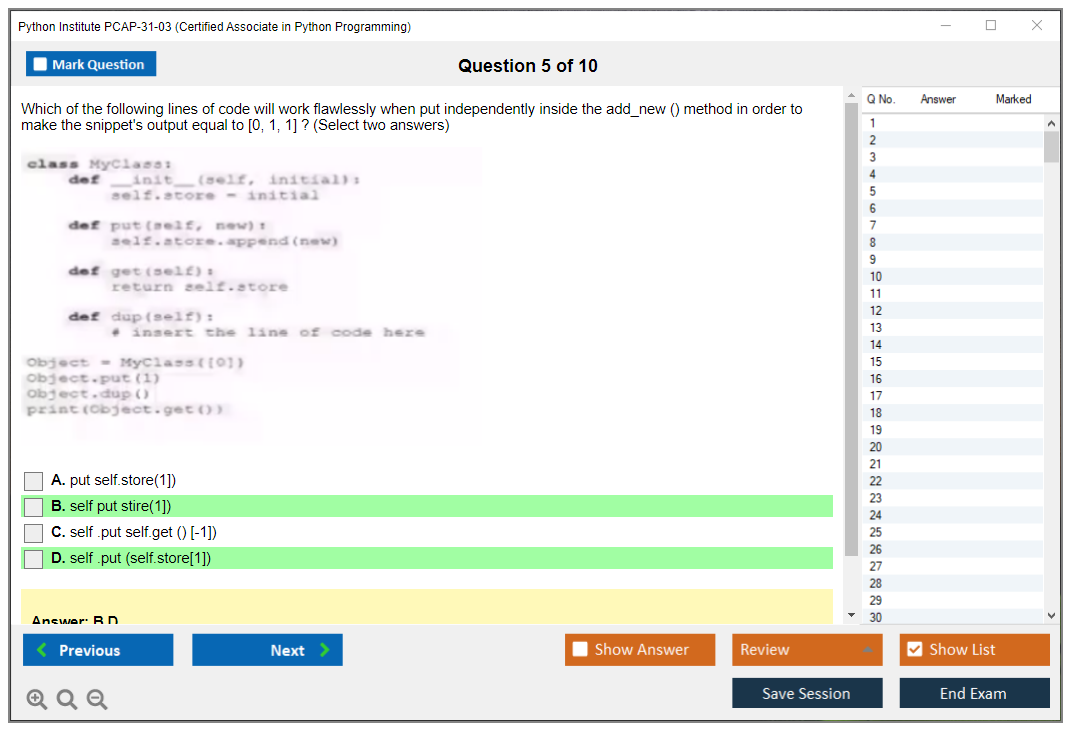
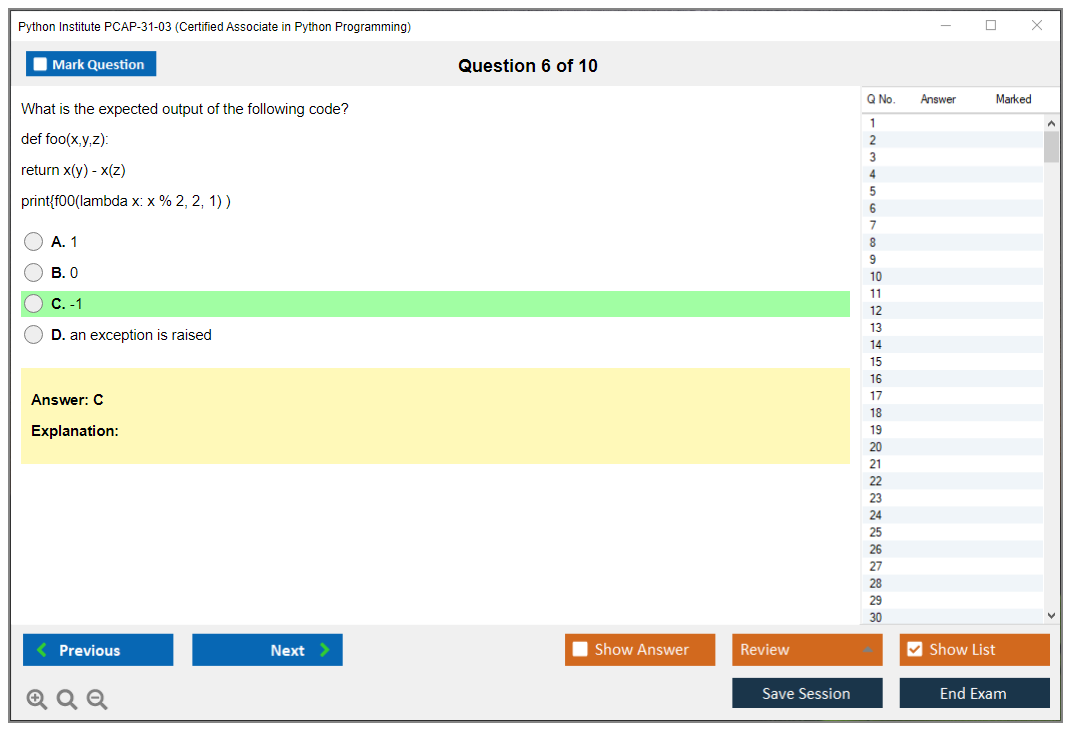
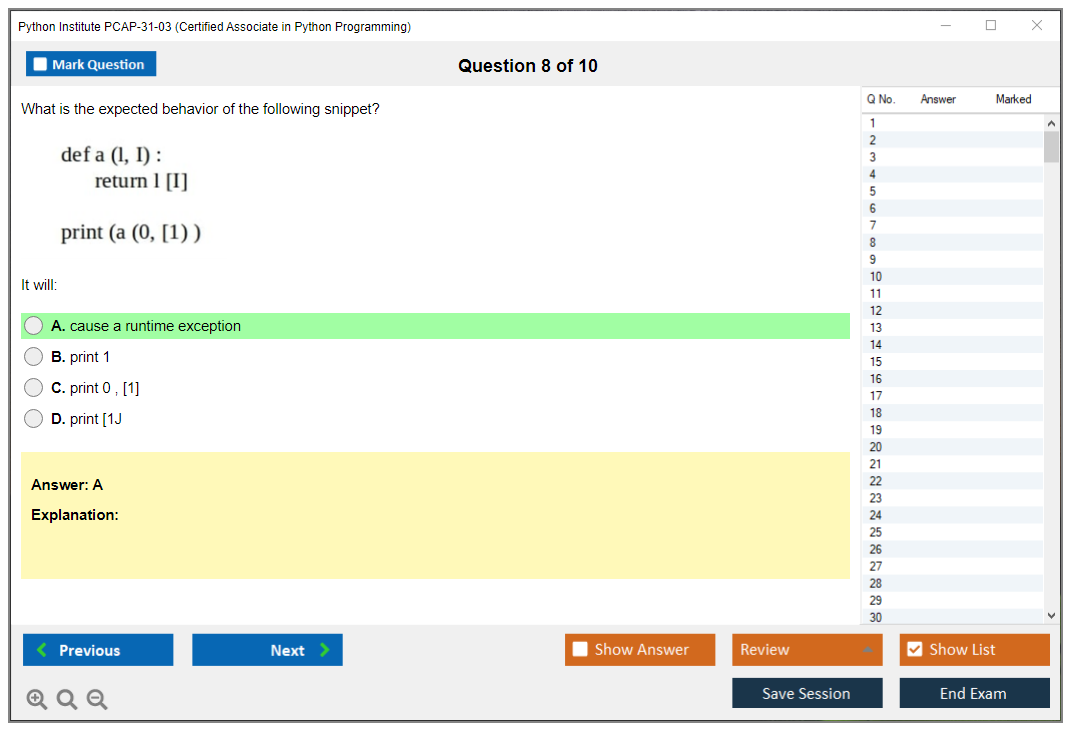
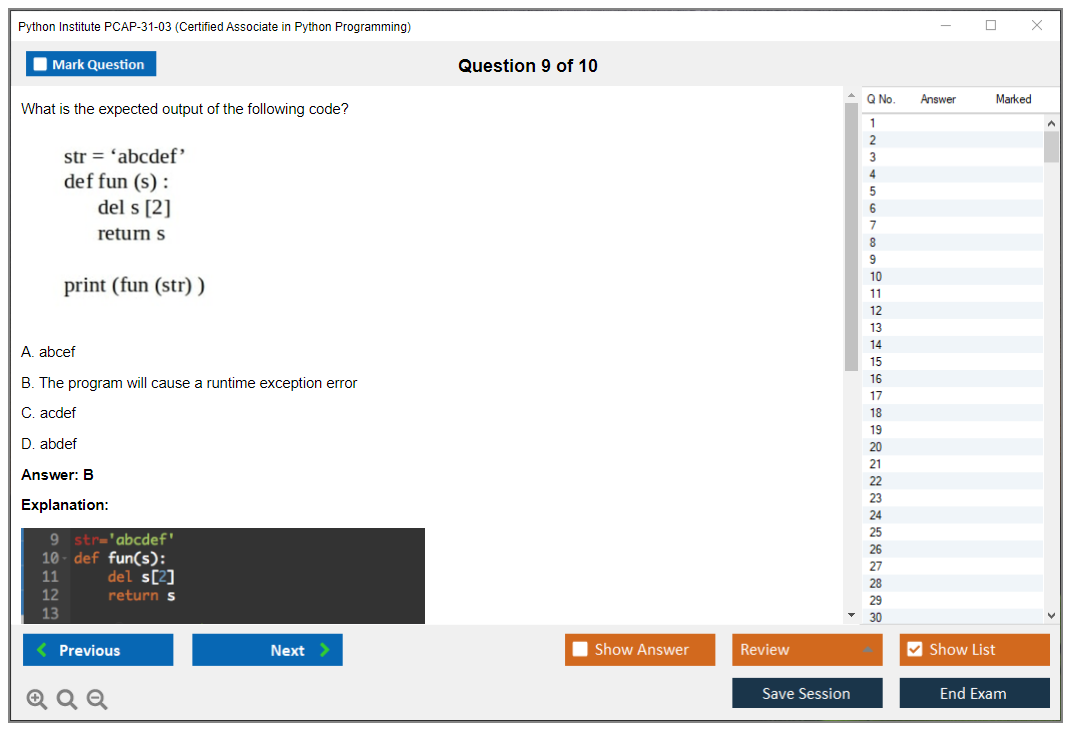
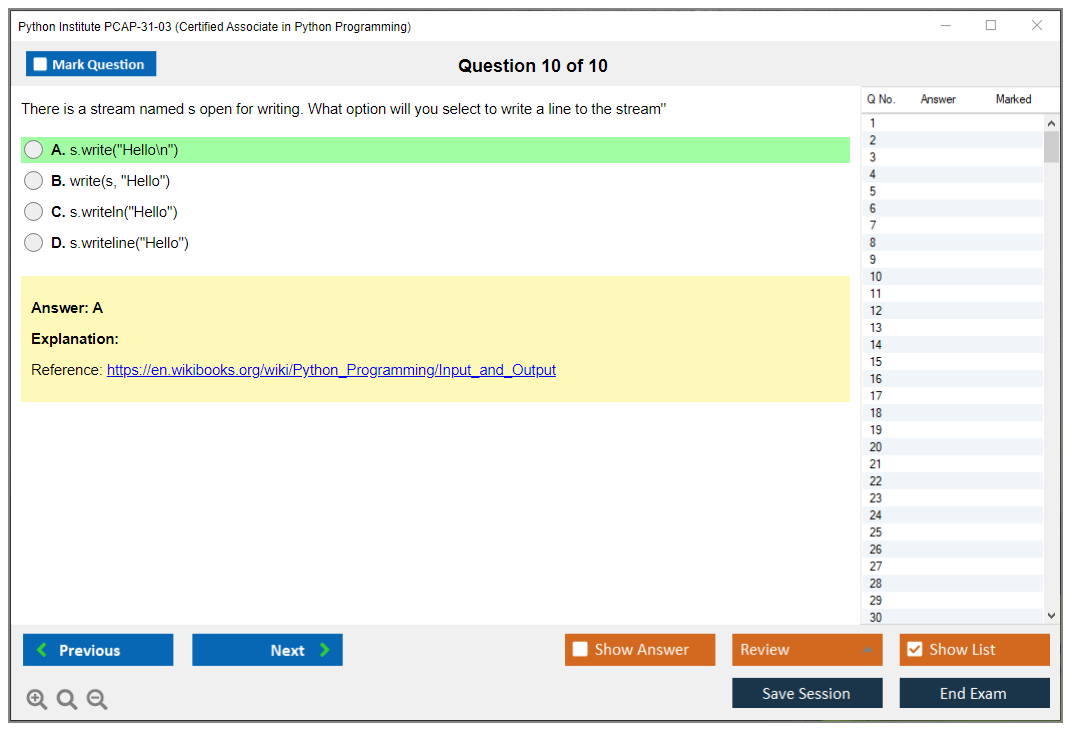
Questions are scenario-based. Code snippets. Output prediction. Error spotting. Picking the right method. Understanding what Python will do, not what you wish it would do.
exam format (questions, time limit, delivery)
40 questions total. Multiple-choice and multiple-select. Each question may have one or multiple correct answers, and multiple-select items will say things like "Select all that apply" or "Choose two correct answers." No partial credit whatsoever. If you miss one option, the whole thing's wrong. That's what makes multi-select feel spicier than it should.
The interface shows one question at a time, a progress counter like "Question 15 of 40," and navigation to move forward/back or jump around. There's also a flag or bookmark feature so you can mark stuff for review and come back later before you submit.
No negative marking.
Unanswered is incorrect.
So yeah, attempt every question. Even a wild guess has upside.
PCAP-31-03 cost (exam fee)
Standard PCAP certification cost is $295 USD, though the local currency conversion can make it look a little different depending on country. That price includes one attempt, immediate scoring, and a digital certificate if you pass. Vouchers can be bought via Python Institute or Pearson VUE, and discounts sometimes show up through promos, schools, or training partners. Student discounts can be a thing if your institution runs Python Institute Academy programs.
Retakes require a new voucher at full price. No multi-attempt bundle deals like some other cert programs. Corporate bulk buying may get volume discounts, but if it's just you paying out of pocket, plan for the full fee.
Rescheduling's usually allowed up to 24 hours before your appointment, but the exam fee is non-refundable and fees may apply. I'd schedule when you can show up rested, preferably not the day after you stayed up debugging someone else's nested list comprehensions at 2 AM.
languages, proctoring, and test center options
The exam is English only. Every prompt, button, and scenario. So technical English matters a lot more than people admit, because "choose the best explanation" questions can hinge on wording.
Pearson VUE has 5,000+ testing centers in 180 countries for in-person delivery. Online proctoring is through Pearson VUE OnVUE and can be scheduled 24/7, which is great if you're not near a testing center or you work weird hours.
Online proctoring requires Windows 10/11 or macOS, a webcam, microphone, and stable internet (minimum 1 Mbps recommended). You'll do a system check plus a proctor check-in that often takes 15 to 30 minutes, and that's before the 65-minute timer starts. During the exam, the proctor watches via webcam. Talking, leaving the camera view, or having someone walk in can get your exam terminated. Testing centers avoid most of that stress, plus they give you a controlled environment and lockers for your stuff.
You'll need valid government-issued photo ID, and the name must match your registration exactly. Show up 15 minutes early for in-person. Phones, watches, bags: all banned in the room.
Scratch paper may be provided at test centers. Online you get a digital whiteboard tool. Calculator, notes, books, and external resources aren't allowed either way.
PCAP-31-03 passing score and scoring
Results show immediately after you finish, with pass/fail and domain-level performance. You also get an official score report with percentage scores by objective domain, which is useful for figuring out what to fix if you didn't pass, or what you're oddly weak in even if you did.
passing score (what you need to pass)
People ask about PCAP passing score constantly. Pearson VUE shows pass/fail immediately, but the exact passing threshold can vary by exam version and policy, so I'm not going to pretend there's one magic number that never changes. What matters for prep is acting like every domain counts, because it does.
how the exam is scored (percent/points, domains)
No partial credit on multi-select. That's the big scoring "gotcha." Also, questions come from a large pool, so each candidate gets a different mix. You can't count on the same balance of topics your friend saw yesterday.
PCAP-31-03 difficulty: how hard is it?
Compared to PCEP, PCAP's harder in the way that matters: it tests practical reasoning, not a trivia contest.
Short questions exist.
Some are brutal.
Time is the enemy.
difficulty level (beginner vs intermediate)
Intermediate, really. You'll see Python 3.x content (currently Python 3.10+), and there's no Python 2.x at all. A lot of the challenge is reading code quickly and noticing small details like mutability, scope, exception flow, and what a method returns.
common challenges (OOP, exceptions, modules)
Python OOP and exceptions topics show up in ways that punish sloppy thinking. Like: what actually happens when you override a method, what super() does in a simple inheritance chain, when an exception is caught vs re-raised, or why except Exception as e behaves differently than catching something specific. Modules and imports also trip people because the exam likes real-world patterns, not just import math.
how long to study for PCAP-31-03
If you're already writing Python weekly, 2 to 4 weeks of focused review plus PCAP practice tests can be enough. If you're coming from "I did PCEP months ago and then stopped coding," plan 4 to 6 weeks and build small stuff while you study. Reading alone won't stick.
PCAP-31-03 exam objectives (official topics)
This section's basically your PCAP exam objectives map. The exam wants you comfortable with the language core plus practical patterns.
data types, variables, operators, and I/O
Know numeric types, conversions, boolean logic, comparison quirks, and basic input/output behavior. Also what prints vs what returns.
control flow (conditionals, loops)
Expect for and while, loop control, and reading nested logic without losing your place.
functions, scope, and lambdas
Parameters, returns, default args, scope rules, and basic lambda usage. Nothing too fancy, but easy to mess up when you're rushing.
data structures (lists, tuples, dicts, sets)
Mutability's the trap here. Also iteration patterns and choosing the right structure for a scenario.
modules, packages, and imports
Import styles, namespaces, and common standard library awareness. Python modules, packages, and standard library knowledge shows up in "which import works" style questions.
exceptions and error handling
Try/except/else/finally flow, built-in exceptions, and reading error messages. Some questions are basically "spot the exception type" plus "where does it occur."
object-oriented programming (classes, inheritance)
Classes, attributes, methods, inheritance basics, and simple polymorphism. This is where PCAP feels like an actual Python associate certification instead of a beginner quiz.
strings, files, and common built-ins
String operations, slicing, formatting basics, reading code that processes text, and file handling concepts. Built-ins like len, range, enumerate, zip, and friends. You should know what they do when embedded in a snippet.
PCAP-31-03 prerequisites and recommended experience
There are no formal prerequisites. No enforced prior cert. That said, PCAP prerequisites in the real world are basically "you've written enough Python that you don't panic when you see code."
formal prerequisites (what's required)
Nothing required officially beyond registering and meeting Pearson VUE ID rules.
recommended skills before taking the exam
Comfort reading 10 to 15 lines of code and predicting output. Comfort debugging mentally. Comfort with OOP basics, exceptions, and imports. If you need docs open for every method call, you're not ready yet because you won't have docs in the exam.
should you earn PCEP first?
If you're brand new, yes, PCEP first is a clean ramp. If you're already doing automation at work, you can skip it. If you want a reference point, see PCAP-31-02 (Certified Associate in Python Programming) for the older track context.
best PCAP-31-03 study materials
You want PCAP study materials that force code reading, not passive watching.
official Python Institute resources
Start with Python Institute's objective list and any official learning resources they publish for PCAP. Align your notes to the objectives so you're not wandering.
courses and training providers
Pick one course if you need structure. Don't stack five. Course fatigue is real.
books and documentation (Python docs, OOP, standard library)
Python docs are great for clarifying edge cases, especially exceptions and built-ins. For OOP, any intro Python OOP book works, as long as you actually type the examples.
hands-on labs and projects (what to build)
Build one small CLI tool that reads a file, parses text, and outputs results. That single project forces strings, files, exceptions, functions, and a bit of structure. The rest, like a tiny module package or a basic class-based model, you can do if you have time.
PCAP-31-03 practice tests and exam prep strategy
Practice tests matter because the exam's timed and scenario-heavy.
where to find PCAP practice tests
Official sources first if available, then reputable training providers. Be careful with "dump" style sites. Aside from ethics, they're often wrong, and wrong answers train you to fail.
what to look for in high-quality mock exams
Explanations. Not just answers. Also mixed single-select and multi-select, because multi-select with no partial credit changes your risk tolerance a lot.
study plan (2,6 weeks) + topic-by-topic checklist
Do a fast first pass through objectives, then drill weak areas with short daily coding. Two long mock exams per week near the end. Track misses by domain so your review matches the score report format.
exam-day tips (time management, eliminating answers)
Spend 45 to 50 minutes on the first pass. Flag anything that takes longer than 90 seconds. Then use the last 15 to 20 minutes to revisit flagged questions, especially multi-select where one wrong choice kills the point. Bathroom breaks count against your 65 minutes. Plan accordingly.
PCAP-31-03 renewal, validity, and retake policy
People also ask if it expires. As of current Python Institute policy for these certs, PCAP's generally treated as not requiring renewal, but always verify on the official site because policies can change.
does PCAP expire? (renewal requirements)
Typically no renewal requirement. Still, your skills can get stale fast if you stop writing Python.
retakes, waiting periods, and voucher rules
Failing means buying another voucher at full price. Reschedule rules depend on Pearson VUE timelines, usually at least 24 hours ahead.
keeping skills current (next cert: PCPP)
If PCAP goes well and you want the next step, PCPP's the natural move, especially if your job's trending toward bigger codebases and architecture choices.
FAQ
PCAP-31-03 cost vs value (is it worth it?)
If you need a hiring signal for Python-heavy junior roles, QA automation, or internal promotion conversations, the $295 can be worth it. If you already have a strong GitHub and real work experience, it's optional, but still a clean way to validate fundamentals under exam conditions.
passing score and what happens if you fail
You'll see pass/fail immediately and get domain percentages. If you fail, you rebuy the voucher and retake. Use the domain breakdown to focus, not to spiral.
best study materials + practice tests (quick picks)
Use the official objectives, Python docs for clarification, one structured course if you need it, and realistic timed mocks. Then write code every week. I mean, that's the part people skip, and it's the part the exam punishes.
PCAP-31-03 Passing Score and Scoring
What you actually need to pass PCAP-31-03
The passing score? 70%. That's it.
You need to correctly answer at least 28 of the 40 questions on the exam, and you walk away with the Certified Associate in Python Programming credential. No complicated grade scale. No distinction levels. No honors designation whatsoever, just the straightforward pass or fail that the Python Institute cares about.
This simplicity is refreshing compared to some other certification programs that have multiple tiers and complicated scoring rubrics you'd need a PhD to understand. If you get 70%, you pass. If you get 100%, you also pass, and both certificates look exactly the same, so nobody's gonna know whether you barely scraped by or aced the thing. Takes some pressure off if you're the type who obsesses over perfect scores (though let's be real, most of us do anyway).
The 70% threshold translates directly to 28 correct answers out of 40 total questions. That gives you a 12-question buffer for mistakes, uncertainty, or those tricky OOP questions that always seem to throw people off. Having that margin helps with test anxiety because you know you can miss a few and still be fine.
How automated scoring works
Once you submit your exam, the scoring happens immediately through an automated system. No human grader reviews your answers, no waiting around for results. Each question is worth exactly one point, so all 40 questions carry equal weight, which means you can't strategically focus on "high-value" questions because they don't exist on this exam.
The system calculates your percentage score using a straightforward formula: (correct answers / 40) × 100. Simple math. If you nail 32 questions, you get 80%. If you only get 27 right? You're sitting at 67.5%, and you've failed, unfortunately.
What's interesting is that there's no penalty for wrong answers whatsoever. You should attempt every single question even if you're completely guessing, because a blank answer definitely counts as incorrect while a guess at least gives you a chance. I've seen people leave questions unanswered thinking it somehow helps their score, but that's not how this works at all.
Domain-level breakdown and what it tells you
Your score report shows more than just the overall percentage, which is nice. You also get a breakdown showing your performance in each of the five exam domains. These domains roughly align with the major topic areas: Modules and Packages, Functions, Object-Oriented Programming, Exceptions, and Data Structures.
The domain scores appear as percentages showing how you performed within each topic area. If the exam included 10 OOP questions and you answered 6 correctly, your OOP domain score would show 60%. This is useful if you fail and need to retake because it pinpoints exactly where you struggled.
Here's the thing though. You don't need to pass each domain individually. Your overall score just needs to hit 70%. You could theoretically bomb the Exceptions section with 40% but crush Data Structures with 90%, and as long as your total score reaches the passing threshold, you're certified, no questions asked. The domain weights vary based on how many questions come from each topic, with Data Structures getting the heaviest weighting at roughly 33% of the exam and Modules and Packages the lightest at around 12%.
Look, this means you can be strategic about your preparation in ways most people don't think about. If you're weak on OOP (which accounts for about 25% of questions), improving that domain will have a bigger impact on your overall score than obsessing over module imports. Actually reminds me of when I was prepping for a different cert and spent like two weeks perfecting a topic that ended up being maybe 5% of the exam. Felt pretty dumb about that. Anyway, focus your study time on high-weight domains to maximize your score potential.
Multiple-choice mechanics and partial credit myths
No partial credit. Period.
For questions with multiple correct answers, you either get it completely right or completely wrong. There's no partial credit for selecting some but not all of the correct options, which trips people up because they assume marking two out of three correct choices will earn them something, but the scoring system doesn't work that way.
The automated system evaluates each question as binary: correct or incorrect. It doesn't matter if you were close. This makes multi-select questions riskier than single-answer questions because you need to identify every correct option and avoid every incorrect one to earn the point.
Time management becomes critical here because unanswered questions count as incorrect. If you run out of time with five questions left blank, those five automatic zeros could drop you from 73% to 60% real fast. That's a nightmare scenario. The PCAP-31-03 practice materials help you develop pacing strategies so you're not scrambling in the final minutes like some kind of panicked squirrel.
What your score report reveals (and what it doesn't)
Immediately after passing, you receive a digital certificate showing your name, the certification title, exam code (PCAP-31-03), and the date you passed. The certificate doesn't display your numerical score. Whether you scored exactly 70% or a perfect 100%, the credential looks identical, which is kinda nice for people who don't test well under pressure.
Your score report, which lives in your Python Institute account, shows the overall percentage and the domain-level percentages. What it won't show is which specific questions you got wrong, and this is intentional for exam security. If failed candidates could review exactly which questions they missed, the question pool would eventually leak all over the internet within months.
For people who fail, seeing the exact percentage helps gauge how close they came. Scoring 68% feels different from scoring 52% in terms of how much additional preparation you need. The domain breakdown becomes your roadmap for focused studying before the retake.
Retake policies and what happens when you fail
There's no mandatory waiting period if you fail PCAP-31-03, which is both good and bad. You can immediately purchase another exam voucher and reschedule for the next available slot. I've known people who failed on a Monday and retook it that same Friday after cramming their weak domains, though whether that's advisable depends on how close you were to passing and whether you've actually learned the material or just memorized question patterns.
The score report from your failed attempt shows exactly where you struggled. If you bombed OOP with 45% but did fine everywhere else, you know what to study. This targeted approach beats just re-reading everything and hoping for better luck like some kind of superstitious test-taker.
Most candidates who prepare thoroughly score between 75-85%, which is comfortably above the passing threshold. If you're consistently hitting 80%+ on quality practice tests, you should have no problem with the real exam even accounting for test-day nerves. I recommend using the PCAP-31-03 Practice Exam Questions Pack to gauge your readiness since it simulates the actual scoring and question formats.
Strategic considerations for maximizing your score
Since all questions carry equal weight, speed matters as much as accuracy in a very real way. You can't afford to spend 10 minutes agonizing over one difficult question while leaving easier ones unanswered. Skip hard questions, mark them for review, and circle back if time permits.
Aim higher than 70%.
The 12-question buffer means you can miss nearly one-third of the exam and still pass, but aiming for exactly 70% is risky because one miscalculation or misread question drops you below the threshold. You should target 80%+ in your preparation to build a comfortable safety margin that accounts for test-day brain fog.
Domain weighting matters for study efficiency. Data Structures accounts for roughly a third of your score, so mastering lists, tuples, dictionaries, and sets gives you the biggest scoring advantage. OOP comes next at about 25%, making classes, inheritance, and polymorphism critical topics you can't ignore. Functions and Exceptions each represent around 15%, while Modules and Packages only make up about 12% of the exam.
Candidates moving up from PCEP-30-02 often struggle with the intermediate-level OOP questions on PCAP-31-03. The difficulty jump is real. If you're planning to continue toward PCPP-32-101 eventually, PCAP is necessary foundation work you shouldn't skip.
The certification itself and what it represents
Once you pass, the PCAP-31-03 certification is valid indefinitely. No expiration date whatsoever. The Python Institute doesn't require renewals or continuing education to maintain the credential, so your certificate from 2024 is just as valid in 2030, though obviously your practical skills might need updating as Python evolves.
The binary pass/fail scoring means everyone certified has demonstrated at least 70% proficiency across the exam objectives. There's no way to distinguish top performers from barely-passed candidates based on the certificate alone, which levels the playing field in some ways. Employers see the certification as proof you understand intermediate Python concepts like OOP, exceptions, and standard library modules.
Immediate results. The immediate scoring and digital certificate delivery means you know your results within minutes of finishing the exam. No waiting weeks for a grading committee to convene. If you pass, you can update your resume that same day, which is pretty satisfying.
PCAP-31-03 Difficulty: How Hard Is It?
What is the Python Institute PCAP-31-03 certification?
The PCAP-31-03 certification from Python Institute is basically the "you can actually code" checkpoint in their certification path (PCEP to PCAP). It's the Certified Associate in Python Programming (PCAP), and honestly, it targets people who've moved past copy-pasting tutorial snippets and can write real programs without totally panicking.
Not advanced stuff. Also not beginner. Kinda the middle ground.
Who the PCAP (Certified Associate in Python Programming) is for
Look, if you're comfortable writing small-to-medium scripts, understand functions, basic data structures, and you've at least touched classes, you're probably the target audience. The thing is, PCAP targets intermediate Python programmers (not absolute beginners or advanced developers), and the exam assumes you've gone beyond those "Hello World" programs and can build functional applications where stuff reads files, handles errors, and doesn't completely explode the second input changes.
Self-taught folks definitely can pass. But they often struggle more, honestly. Structure really matters here.
People who went through a structured course or bootcamp tend to have fewer gaps, especially around OOP and exceptions, because those topics are super easy to dodge when you're learning on your own and just trying to "make it work."
PCAP vs PCEP vs PCPP (certification path)
PCAP-31-03 is considered intermediate difficulty, way harder than PCEP but more accessible than PCPP certifications. PCEP is mostly vocabulary plus basics. PCPP involves deeper design, architecture, and harder real-world thinking. PCAP's where they start checking whether you understand how Python actually behaves, not just what you wish it did.
PCAP-31-03 exam overview
Exam format (questions, time limit, delivery)
The Python Institute PCAP-31-03 exam's 40 questions in 65 minutes. Time pressure's definitely real. That's about 1 minute and 37 seconds per question, and a bunch of questions are code-tracing problems where you've gotta mentally execute the program without running it, so if you're slow at reading Python, you'll feel the clock immediately.
No IDE available. No quick print debugging. Just you and the code.
PCAP-31-03 cost (exam fee)
PCAP certification cost's typically $295 (USD). Prices can vary a bit by country, taxes, or voucher deals, but $295's the number most candidates plan around, and yeah, it's enough money that "I'll just wing it" becomes a pretty bad strategy.
Languages, proctoring, and test center options
Delivery options depend on region and the testing partner Python Institute's using for your voucher, but you're generally looking at either a test center or an online proctored setup. I mean, read the rules early. Nothing like learning on exam day that your webcam angle's "wrong."
PCAP-31-03 passing score and scoring
Passing score (what you need to pass)
The PCAP passing score's 70%. That's the number candidates plan for, and it matches what Python Institute publishes for PCAP.
How the exam is scored (percent/points, domains)
Scoring's domain-based behind the scenes, tied to PCAP exam objectives, and you feel that in the question mix: plenty of core Python, with heavier weight on OOP, exceptions, and modules than many casual learners expect. Questions are designed to test understanding rather than memory. Knowing syntax alone isn't gonna cut it.
PCAP-31-03 difficulty: how hard is it?
Difficulty level (beginner vs intermediate)
The PCAP-31-03 certification is intermediate. I mean, it's not "hard" like building production microservices under load, but it's more challenging than typical online Python tutorials because it tests edge cases and nuanced behavior that casual Python users may not encounter in typical projects.
It's a thinking exam. Not a typing exam. Still practical, though.
Difficulty's comparable to other intermediate programming certifications like Oracle Certified Associate Java Programmer, mostly because both expect you to read code precisely and not hallucinate what the language "probably" does.
Pass rates aren't officially published by Python Institute, but community estimates suggest a 60-70% first-attempt pass rate. Treat that as vibes, not science, but it lines up with what I see: prepared people pass, half-prepared people get surprised.
Common challenges (OOP, exceptions, modules)
Most challenging aspects include object-oriented programming concepts, exception handling hierarchies, and module/package mechanics.
OOP's the big one. Inheritance, method resolution order (MRO), super(), polymorphism. Also the classic confusion: when methods override versus extend parent class functionality. And yes, class attributes versus instance attributes and their interaction with inheritance shows up a lot, because it's exactly the kind of thing that "works" until it doesn't, and the exam loves that.
Exceptions are the second pain point. Understanding exception hierarchy, custom exceptions, and proper try-except-else-finally usage is expected, plus knowing which exceptions to catch in specific scenarios and understanding exception propagation. Stack traces. Error messages. What happens when an exception's raised inside a finally. Stuff you only learn by breaking programs repeatedly.
Modules and packages are sneakily annoying. Import variations like import, from .. import, import .. as, and understanding init.py behavior. Also distinguishing between module-level variables, name == "main", and package structure. Not gonna lie, people who only ever wrote single-file scripts get wrecked here.
Also on the "you should be comfortable" list: generator expressions, list comprehensions, lambda functions, scope rules (LEGB), dictionary and set operations (get(), setdefault(), update()), strings and formatting (f-strings, format(), %), and file handling with context managers (with) including modes and encoding.
How long to study for PCAP-31-03
Candidates with solid programming fundamentals and 150+ hours of Python practice typically find the exam challenging but manageable, and that number makes sense because the exam requires practical coding knowledge plus the ability to trace execution quickly without running anything, and that speed comes from repetition more than reading.
Recommended study time varies by background: 40-60 hours for experienced programmers, 80-120 hours for beginners. If you already know Java, C++, or C#, you can cut prep time by maybe 25-30% because OOP and exceptions transfer pretty well, but Python's module behavior and little gotchas still need focused practice.
Daily practice beats cramming. Weekend marathons fade fast. Consistency totally wins.
A plan I like: 40% hands-on coding practice, 30% reading docs/tutorials, 30% PCAP practice tests. If you're coming from PCEP, 4-6 weeks at 10-15 hours per week's realistic. Self-taught programmers without formal training should plan for 8-12 weeks, because you probably have blind spots you don't know you have.
Worth mentioning: a buddy of mine tried cramming the entire syllabus in three days before his exam. Didn't sleep. Drank maybe four Red Bulls. He passed, somehow, but swears he blacked out during the last ten questions and woke up with a passing score and no memory of how he answered the OOP section. Don't be that person.
PCAP-31-03 exam objectives (official topics)
Data types, variables, operators, and I/O
Core types, conversions, truthiness, numeric behavior, and input/output basics. Easy points if you've coded for real, weirdly tricky if you only watched videos.
Control flow (conditionals, loops)
if/elif/else, for, while, loop else, break/continue, and reading nested logic without losing the plot.
Functions, scope, and lambdas
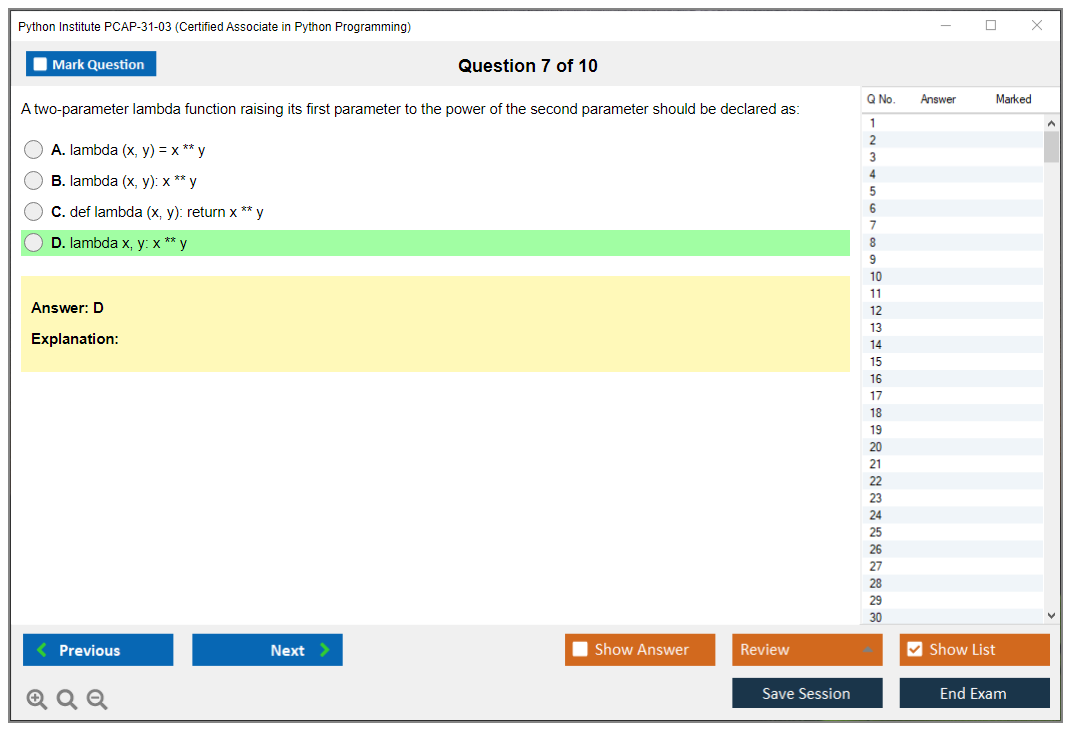
Parameters, return behavior, default args, and scope rules (LEGB). Lambdas show up less as "write lambda" and more as "what does this do."
Data structures (lists, tuples, dicts, sets)
Comprehensions, mutability, copying, dictionary methods, set operations. Edge cases really matter.
Modules, packages, and imports
Imports, name, package layout, and what happens when you import something that imports something that (wait, I'm getting distracted) imports something else. Yep. That.
Exceptions and error handling
Hierarchy, propagation, custom exceptions, and correct try-except-else-finally.
Object-oriented programming (classes, inheritance)
Where most failures come from: MRO, super(), overriding, attributes, polymorphism.
Strings, files, and common built-ins
Formatting edge cases, file modes, encoding, and built-ins you should recognize on sight.
PCAP-31-03 prerequisites and recommended experience
Formal prerequisites (what's required)
PCAP prerequisites are basically none. No required prior cert. You can schedule it whenever.
Recommended skills before taking the exam
Intermediate difficulty means you should comfortably write 100-500 line programs independently, debug code, read error messages, and understand stack traces without freezing. The exam also assumes familiarity with Python's standard library, built-in functions, and common idioms.
Should you earn PCEP first?
If you're a complete beginner, yes, consider earning PCEP first, then studying 6-8 weeks for PCAP. If you already code in another language, you can skip PCEP and go straight to PCAP with focused prep.
Best PCAP-31-03 study materials
Official Python Institute resources
Start with the official PCAP exam objectives and any learning paths Python Institute links. Use them like a checklist, not a suggestion.
Courses and training providers
Structured courses help self-taught candidates a lot. You want someone forcing you to confront OOP and exceptions, not letting you dodge them.
Books and documentation (Python docs, OOP, standard library)
Python docs are great, but reading alone isn't enough. Candidates who underestimate preparation time or rely solely on reading documentation typically struggle, because you can "understand" a page and still miss how code behaves in a timed scenario.
Hands-on labs and projects (what to build)
Build small apps that force modules and errors: a CLI tool with subcommands, a package with multiple modules, a file parser that throws custom exceptions, a simple class-based model with inheritance. Make it break. Fix it. Repeat.
PCAP-31-03 practice tests and exam prep strategy
Where to find PCAP practice tests
Practice tests matter because you need speed plus accuracy. If you want targeted drilling, the PCAP-31-03 Practice Exam Questions Pack is $36.99 and can help you identify weak domains fast, especially if you review every wrong answer by recreating the behavior in a scratch file later.
What to look for in high-quality mock exams
You want code-tracing questions, tricky imports, exception hierarchy traps, and OOP scenarios that force you to reason about attribute lookup and method calls. If a mock test feels like "what's the syntax for..", it's too easy.
Study plan (2-6 weeks) + topic-by-topic checklist
Even experienced devs should give this 3-4 weeks minimum to cover all PCAP exam objectives. Week-by-week, I'd front-load OOP and exceptions, then alternate modules with timed mixed sets. Keep a notebook of "rules I keep forgetting," like MRO order or when else runs on a try.
If you want one paid resource, fine. Use something like the PCAP-31-03 Practice Exam Questions Pack and treat it as feedback, not fortune telling.
Exam-day tips (time management, eliminating answers)
Skip and return. Don't argue with the code. Track the clock.
Mentally run code line by line, watch for mutation, and if you're stuck between two answers, pick the one that matches Python's actual behavior, not the one that "feels reasonable." Time pressure adds difficulty, so practice under time limits before the real thing.
PCAP-31-03 renewal, validity, and retake policy
Does PCAP expire? (renewal requirements)
As of Python Institute's current model, PCAP doesn't typically require renewal like some vendor certs. Always verify on the official site, though, because policies can change.
Retakes, waiting periods, and voucher rules
Retake rules depend on voucher terms and testing partner policies. Read the fine print before you click buy, especially since $295's not pocket change.
Keeping skills current (next cert: PCPP)
If PCAP felt fair but intense, PCPP's the logical next step. More depth. More design thinking. More "you should build software" energy.
FAQ
PCAP-31-03 cost vs value (is it worth it?)
If you need a credential on a resume for a Python associate certification and you're early-career, the PCAP-31-03 certification can be worth it. It signals you can read and reason about Python, not just follow a tutorial.
Passing score and what happens if you fail
PCAP passing score's 70%. If you fail, you retake under the program's rules and your budget's patience. Most failures come from weak OOP understanding, shaky exception handling knowledge, and not enough practice with modules, so fix the root cause instead of just taking more quizzes.
Best study materials + practice tests (quick picks)
Use the official objectives, build small projects, and take timed mocks. If you want a focused question bank to pressure-test readiness, the PCAP-31-03 Practice Exam Questions Pack is a decent add-on for $36.99, assuming you actually review and reproduce the tricky behaviors afterward.
PCAP-31-03 Exam Objectives (Official Topics)
Data types, variables, operators, and I/O
The Python Institute PCAP-31-03 exam objectives start with fundamentals, but they expect mastery. You'll face questions on numeric types (int, float, complex), strings, booleans. Standard stuff. But it's "what's a variable?" They test whether you actually understand type conversion, operator precedence, the difference between // and /, and how bitwise operators function in real scenarios.
Most developers skip bitwise operators entirely when writing code for actual projects, but guess what? The exam absolutely tests you on them. Same story with string formatting. You need to know f-strings, .format(), and yeah, even that ancient % formatting because legacy codebases still use it everywhere. Input and output operations cover print() with all its parameters (sep, end, file) and input() for getting user data. You should understand how Python handles stdin/stdout.
Control flow (conditionals and loops)
Conditionals and loops? Huge chunk. The if/elif/else structures seem straightforward until the exam throws nested conditionals with multiple logical operators at you and asks what actually executes. Short-circuit evaluation matters. Python stops evaluating an and or or chain once it already knows the answer.
For loops the exam covers both while and for extensively, digging into iteration over sequences, the range() function with all its parameters, and how break/continue/else clauses behave. That else clause on loops? Trips people up constantly. I've seen experienced developers completely forget that else on a loop executes when the loop completes normally without hitting a break. It's one of those Python quirks you don't use often enough to remember.
Loop control gets tested heavily. They'll give you code snippets combining break, continue, pass, and nested loops, then ask what prints or what the final variable value is after some convoluted nested structure. Sometimes I wonder if anyone actually writes loops that complicated outside of certification exams, but here we are.
Functions, scope, and lambdas
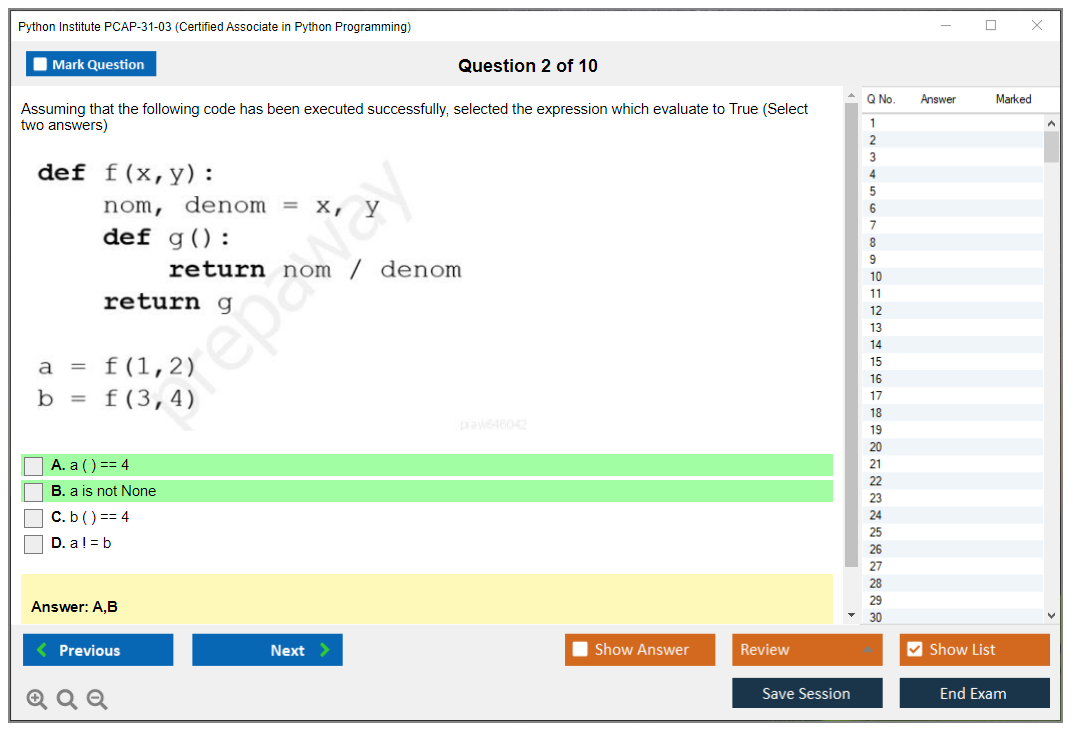
Functions get deep coverage in the PCAP-31-03 certification objectives. Really deep. You need to know how to define functions with positional arguments, keyword arguments, default parameters, and args/*kwargs. The exam tests whether you understand what happens when you mix these parameter types and in what order they must appear.
Scope is huge. You need to understand LEGB rule (Local, Enclosing, Global, Built-in) and when variables shadow each other. The global and nonlocal keywords show up in exam questions, especially in tricky scenarios where you're modifying variables from outer scopes. Return values, returning multiple values as tuples, functions returning None by default..all fair game.
Lambda functions appear throughout the objectives, particularly combined with map(), filter(), and sorted(). The exam tests whether you can read lambda syntax and understand when lambdas are appropriate versus just defining a regular function.
Recursion gets tested too. Usually straightforward scenarios, though. Not crazy deep recursion that'd actually blow the stack.
Data structures (lists, tuples, dicts, sets)
This domain? Probably heaviest weight. Lists get extensive coverage including indexing, slicing with start:stop:step notation, list methods like append/extend/insert/remove/pop, list comprehensions, nested lists. Slicing especially. The exam loves questions where you predict what my_list[2:7:2] returns or what happens with negative indices.
List comprehensions are tested both for reading existing ones and knowing how to write them, including the syntax with optional if conditions and even nested comprehensions (though those get ugly fast). Tuples cover immutability, tuple packing/unpacking, using tuples as dictionary keys, and that single-element tuple syntax (item,) with the trailing comma.
Dictionaries include creating them, accessing values, dict methods (keys/values/items/get/update), dictionary comprehensions, and understanding that dict iteration order is guaranteed in Python 3.7+ but the exam probably won't rely on that assumption.
Sets and frozensets show up testing set operations (union, intersection, difference), set methods, and when you'd use a frozenset. Set comprehensions are included.
Modules, packages, and imports
The PCAP exam objectives dedicate serious attention to Python's module system, and for good reason. You need to understand the difference between a module and a package, how import statements work with different syntax variations (import x, from x import y, from x import *, import x as y), and what actually happens when you import something.
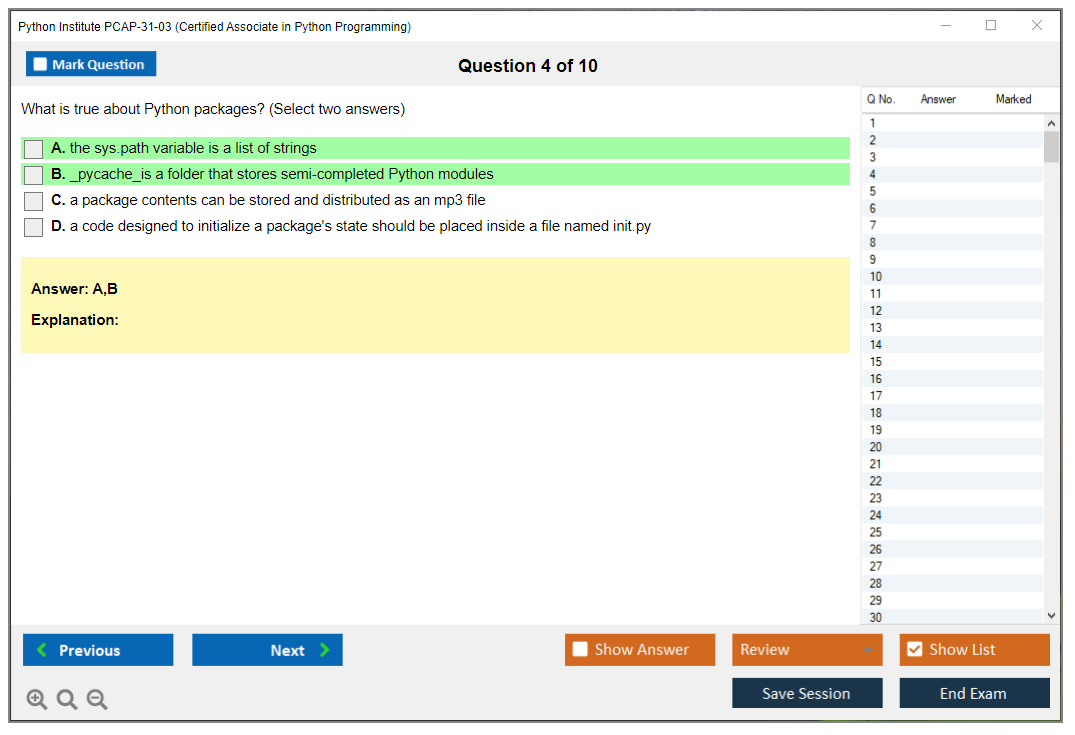
The exam tests knowledge of the name variable and the if name == "main": pattern for making modules that can run as scripts or be imported. You should know about init.py files in packages, how Python searches for modules using sys.path, the difference between absolute and relative imports.
Standard library modules appear throughout. Especially math, random, platform, and os/sys basics. You won't need to memorize every function but you should know what these modules do and recognize common functions.
Exceptions and error handling
Exception handling is critical for PCAP-31-03 certification. No way around it. The objectives cover try/except/else/finally blocks extensively. You need to understand the order these clauses execute, what happens when exceptions occur in different parts of the block, and how finally always executes even if you return from the try block.
The exam tests specific built-in exceptions. ValueError, TypeError, IndexError, KeyError, ZeroDivisionError, FileNotFoundError. You should recognize when each gets raised. Exception hierarchy matters because catching a base exception catches all its subclasses.
Raising exceptions with raise, re-raising exceptions, and creating custom exception classes by inheriting from Exception all appear in the objectives. The assert statement shows up too.
Object-oriented programming (classes and inheritance)
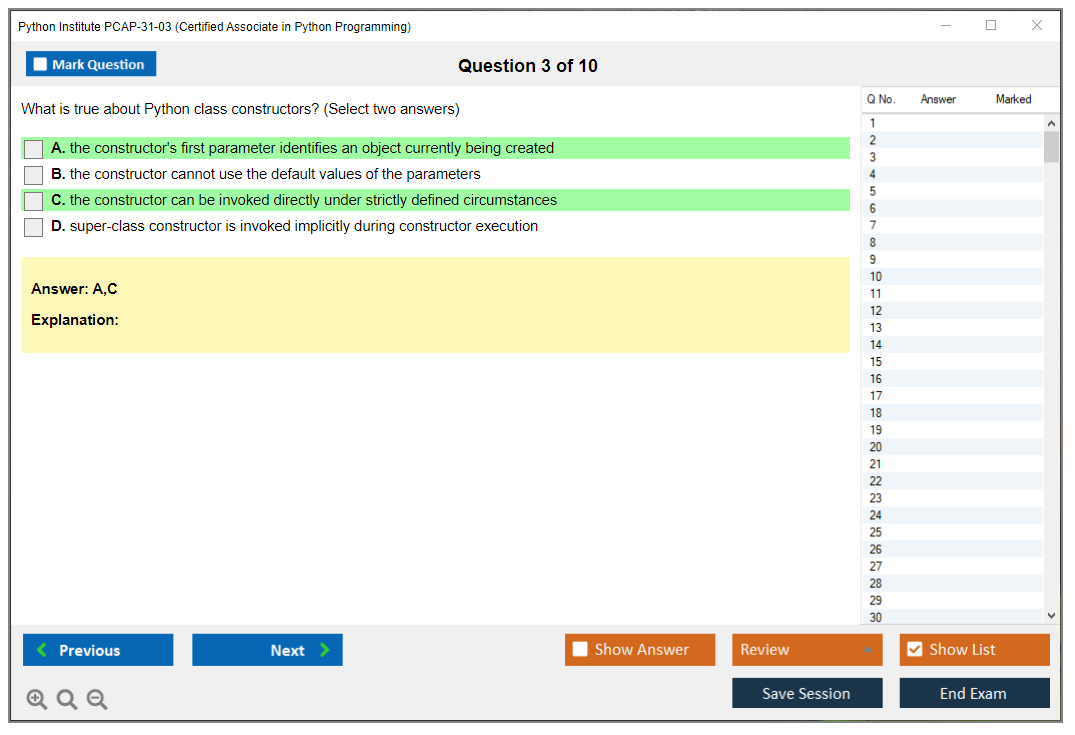
OOP represents probably the hardest section. Most people taking the PCAP exam learned Python procedurally first, which is common but leaves gaps. The Python Institute expects you to understand class definition, instance vs class variables, methods including init, instance methods vs class methods vs static methods, and the self parameter.
Inheritance gets deep coverage. Single inheritance, method overriding, calling parent methods with super(), understanding method resolution order (MRO). You should know about isinstance() and issubclass() for checking types and inheritance relationships.
The exam tests special methods (dunder methods) like str, repr, add, len and others. There are so many dunder methods and they're all potentially testable, which is a lot to keep straight. Encapsulation concepts including name mangling with double shows show up. Properties using the @property decorator are in scope.
The OOP section is where people struggle most. The PCAP-31-03 (Certified Associate in Python Programming) exam really separates those who just write scripts from those who understand Python's object model.
Strings, files, and common built-ins
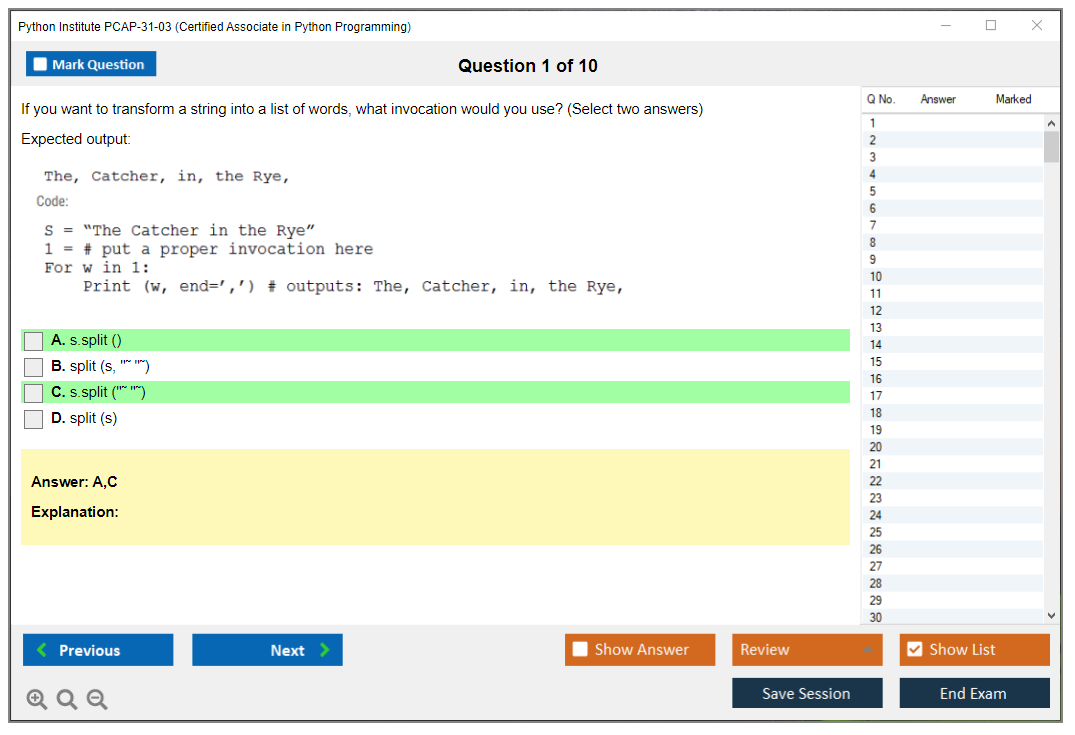
String operations go beyond basics. Methods like split/join/strip/replace/find, string immutability implications, working with string formatting. The exam includes questions on escape sequences, raw strings with r"", multi-line strings.
File I/O covers opening files with open() and the mode parameter (r/w/a/r+/etc), reading with read/readline/readlines, writing, and the importance of closing files or using context managers with the with statement. Text vs binary mode matters. Basic file object methods? Know them.
Built-in functions like len, range, enumerate, zip, sorted, reversed, any, all, max, min get tested. The exam expects you to recognize what these do and predict their output given various inputs.
The objectives align strictly with Python 3.x. No Python 2 quirks like print statements or old-style division. If you're coming from the PCEP-30-02 (PCEP - Certified Entry-Level Python Programmer) exam, the PCAP digs much deeper into OOP, modules, and exception handling while assuming you've mastered entry-level topics.
Conclusion
Wrapping it all up
Okay, real talk here. The PCAP-31-03 certification? It's not gonna magically land you a six-figure salary tomorrow, but it's a solid checkpoint proving you've graduated past printing "Hello World" and can actually build functional stuff. If Python's your serious career move (not just weekend tutorial browsing), this cert provides a benchmark recruiters actually notice, especially when you're up against folks with similar portfolios but zero formal proof they know what they're doing.
The Python Institute PCAP-31-03 exam sits right in that Goldilocks zone. Not beginner fluff. Not advanced wizardry either. You're tackling genuine concepts here. OOP principles, exception handling that won't make you chuck your laptop out the window, working with modules and packages like real developers actually do. The thing is, the exam objectives are thorough enough that prepping for them uncovers knowledge gaps you didn't realize existed. Most folks invest 4-6 weeks studying if they're already coding regularly. Maybe 8-10 weeks if programming's newer territory.
Certification cost runs about $295.
Not exactly pocket change when you're starting out, I'll give you that. But stack it against bootcamps demanding thousands or university courses, and suddenly it's looking pretty reasonable. A globally recognized credential that never expires, testing actual hands-on skills instead of theory regurgitation. Passing score's set at 70%, so there's wiggle room for mistakes, though questions get tricky with their focus on code analysis and debugging scenarios rather than straightforward memorization.
My cousin spent three months "studying" for this last year, which mostly meant watching YouTube tutorials at 1.5x speed and telling everyone he was "grinding." Failed twice before he actually sat down with proper practice material.
Here's my recommendation for your final prep. You need practice exams mirroring the actual test format, not random Python quizzes scraped from wherever. The PCAP-31-03 Practice Exam Questions Pack at /python-institute-dumps/pcap-31-03/ delivers that realistic simulation. Questions testing identical domains, matching difficulty levels, those answer choices making you second-guess everything. Working through quality PCAP practice tests the week before your exam? Way more valuable than rereading documentation for the tenth time, honestly.
Study smart, code daily, tackle those practice questions until patterns click.
You've got this.
