Understanding CIMA BA2 Fundamentals of Management Accounting
Look, if you're starting your CIMA path or switching into management accounting, BA2 is where things get real. This exam teaches you how businesses actually figure out what stuff costs, how to build budgets that don't fall apart by March, and why your manager keeps talking about variances during monthly reviews. Honestly, you'll hear about variances a lot.
What BA2 actually is and why it matters in your CIMA path
CIMA BA2 Fundamentals of Management Accounting sits as the second exam in the CIMA Certificate in Business Accounting pathway. This exam focuses specifically on core management accounting principles that businesses use every single day to make decisions about pricing, production, and whether they're making or losing money on that product line nobody's sure about. it's another accounting test.
The Certificate level has four exams total: BA1, BA2, BA3, and BA4. You'll typically hit BA2 after completing BA1 Fundamentals of Business Economics. Once you knock out all four Certificate exams, you unlock the gateway to the Operational level, then Management, then Strategic. BA2 builds the foundation for higher-level papers like P1 Management Accounting and eventually P2 Advanced Management Accounting. The techniques you learn here aren't throwaway knowledge. You'll use absorption costing, variance analysis, and relevant costing concepts throughout your entire CIMA qualification and, honestly, throughout your entire career if you end up in management accounting.
The core skills you'll actually walk away with
BA2 equips you with practical costing and budgeting skills that translate directly to workplace tasks. You're not learning theory for theory's sake here. You'll master how to classify costs by nature (materials, labor, expenses), by function (production, administration, selling), and critically by behavior. Fixed, variable, semi-variable.
Understanding cost behavior? Huge deal. It determines how your business reacts when sales volume changes.
You'll learn both absorption costing (where you load all production costs into product costs) and marginal costing (where you only include variable costs). Different situations call for different approaches, which is something you pick up through practice more than textbooks. Break-even analysis and cost-volume-profit calculations become second nature. This means you can tell management exactly how many units they need to sell before they stop bleeding money.
Budget preparation is another massive chunk. You'll construct functional budgets for different departments and pull them together into master budgets. Then comes variance analysis, comparing what you planned against what actually happened and explaining why there's a £50,000 gap in material costs. Material price variance, material usage variance, labor rate, labor efficiency. Variable overhead, fixed overhead. It sounds like alphabet soup at first but these calculations identify exactly where operations went off-plan.
The short-term decision-making section uses relevant costing to teach you how to evaluate make-or-buy decisions, special orders, and product-mix optimization when you've got limited resources. Not gonna lie, this section trips people up because you have to identify which costs actually matter for each specific decision. Hint: sunk costs don't.
Where management accounting diverges from financial accounting
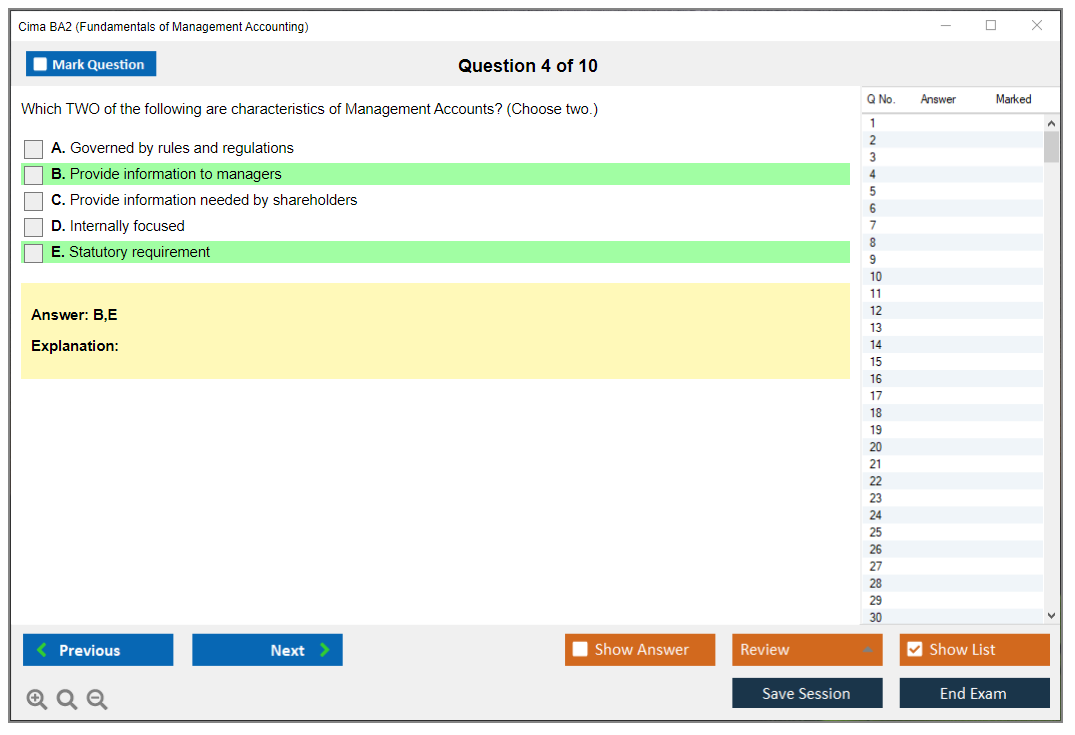
Here's something that clicks for some people immediately and confuses others for weeks: management accounting serves a completely different purpose than financial accounting. Financial accounting, which you'll see more in BA3, produces standardized statements for external users like shareholders and tax authorities.
Management accounting? Totally different beast.
BA2 focuses on forward-looking planning and control rather than just recording what happened last quarter. The information goes to managers who need to make operational decisions. Should we launch this product? Should we outsource production? Why did our costs spike in July? Formats are flexible. You're not bound by accounting standards, which feels liberating after financial accounting rules. I remember spending way too long on one variance report trying to make it "look proper" before realizing my manager just wanted a simple table. If a manager needs cost data presented in a weird custom format because that's how they think about the business, you do it that way.
Who actually takes BA2 and why
The target audience is broader than you might think. Sure, accounting students beginning their professional path in management accounting make up a big chunk. Recent graduates pursuing the chartered management accountant (CGMA) designation often start here.
But career switchers from non-finance backgrounds are increasingly common. I've seen former engineers, operations managers, and even marketing people take BA2 because they realized they needed structured knowledge of how costs work and how budgets get built. Finance administrators seeking formal qualifications in costing and budgeting take it to level up from bookkeeping roles. Business analysts who keep running into costing questions they can't answer properly need this knowledge.
Professionals already working in manufacturing, service, or retail sectors often take BA2 to formalize expertise they've picked up on the job. Having the CIMA credential carries weight when you're trying to move from cost clerk to management accountant. No question about it.
Real businesses using BA2 concepts every single day
Manufacturing companies use standard costing systems for production control. They set standard costs for materials, labor, and overheads, then compare actuals against standards to spot inefficiencies. Service businesses apply activity-based approaches to figure out which services actually make money and which ones lose money once you properly allocate overhead costs. Retail organizations use marginal costing for pricing decisions and figuring out optimal product mix when shelf space is limited.
Budget managers in both public and private sectors prepare departmental budgets using the techniques BA2 teaches. Management accountants analyze those variances we talked about to identify operational problems before they become disasters. Business consultants advising on make-or-buy decisions or special-order pricing lean heavily on relevant costing principles from BA2.
Career doors that BA2 opens
Passing BA2 makes you credible for junior management accountant positions in corporate finance departments. Cost accountant roles in manufacturing environments specifically look for this knowledge. Budget analyst positions in government agencies and nonprofits want candidates who can construct and monitor budgets properly.
Financial analyst roles requiring costing and profitability analysis become accessible. And obviously, BA2 is your stepping stone toward the full CIMA professional qualification and CGMA designation, which opens senior management accounting positions. I've seen people use their Certificate completion, including BA2, to push for internal promotions to finance management roles even before finishing the full qualification. Honestly smart if you can pull it off.
How much time you're actually looking at
Study time varies wildly based on your background. Average candidates invest 60-100 hours total. If you've got basic accounting background, plan for 8-12 weeks of study. Experienced finance professionals who already work with budgets and variances can potentially prep in 4-6 weeks of intensive study. That's aggressive, though.
Self-study is totally viable if you're disciplined. Quality study materials matter more than tuition for BA2 in my opinion, though tuition provider courses typically span 6-10 weeks with structured learning if you want that external accountability. Whatever your approach, practice and revision should eat up 40-50% of your total study time. Doing practice questions reveals gaps in understanding faster than rereading textbooks.
The exam itself? Computer-based. Objective questions. You need to be comfortable with a basic calculator and ideally have some spreadsheet skills since BA2 expects you to understand how costing and budgeting tools work in practice, not just theory.
Linking forward in your CIMA path
Once you clear BA2, you'll move through BA3 and BA4 to complete your Certificate, then progress to Operational level papers. The management accounting strand continues through P1 and P2, building on exactly what you learn in BA2. Papers like E2 Managing Performance and E3 Strategic Management also reference costing and budgeting concepts you first encounter here.
BA2 doesn't expire or require renewal. Once you pass, it's permanent. Your completion contributes to the Certificate, and CIMA maintains your transcript showing all passed exams. Employers can verify your qualification status through CIMA directly.
The thing is, the practical value of BA2 knowledge extends beyond just passing an exam. Understanding how costs behave, how to build realistic budgets, and how to analyze variances makes you immediately useful in finance roles. That's the real value proposition. You're not just collecting a credential, you're building skills that businesses actually need and will pay for.
CIMA BA2 Syllabus and Exam Objectives Breakdown
Where BA2 sits in the certificate
CIMA BA2 Fundamentals of Management Accounting is the part of the CIMA Certificate in Business Accounting BA2 track where things stop being "bookkeeping-ish" and start being "manager questions". You're not just recording costs, you're explaining what they do, predicting how they change, and using them to plan and decide.
BA2's also where people realise management accounting is its own skill, honestly. Different vibe from financial accounting, more assumptions, more "best answer" territory rather than one definitive right way that some textbook carved in stone a hundred years ago. I spent way too long in my first attempt trying to make the numbers perfectly "correct" like in financial accounting, when really the exam wanted me to pick the most useful answer for a manager trying to decide something. Took failing a mock to figure that out.
Who BA2 is for
If you're a student, a career switcher, or you already sit near finance in an admin, ops, or analyst job, BA2's a solid signal that you can talk cost, budgets, and performance without panicking. It's also a nice bridge if you've done BA1 and thought "okay I get debits and credits, now what does a business actually do with numbers?"
Beginners can pass. But you need reps.
How the syllabus is structured (and what the exam actually cares about)
The CIMA BA2 syllabus and objectives are basically six buckets, but the exam emphasis isn't equal. You'll see integrated questions a lot, where one scenario quietly tests two or three topics together, like inventory valuation plus overhead absorption plus what happens to profit under marginal costing. That's normal. Expect it, because that's how they separate people who memorised from people who understand.
Here's the weighting you should build your study plan around:
- Cost classification and behaviour: about 20%. This is the language of the whole paper, so even when it's "only" 20%, it shows up everywhere. If you can't spot fixed versus variable, CVP and budgeting get ugly fast.
- Materials, labour, overheads: about 25%. This is the mechanics section. Inventory methods, labour schemes, overhead absorption, and the absorption versus marginal argument.
- Budgeting and budgetary control: about 25%. Lots of questions. Often time-consuming. Usually very learnable, though.
- Standard costing and variances: about 20%. This is where people lose time because they memorise formulas but can't interpret what the numbers mean.
- Short-term decision-making: about 10%. Smaller slice, but high value because it's very "manager brain" stuff.
What the computer-based test feels like
BA2's a computer-based objective test CIMA BA2 style exam. That means no long written answers. It's quick-fire questions, often with a mini scenario, and you're picking the best option. Time pressure's real, because even when each question looks short, you still have to set up a calculation, keep units straight, and not misread a sentence like "closing inventory" buried at the end of a paragraph.
Read the requirement twice.
Cost classification basics you must be fluent in
This is Section A territory: costing techniques and cost behaviour fundamentals. You need to classify costs in multiple ways, and the exam loves mixing them.
By element's the simple one: materials, labour, expenses. By nature's direct versus indirect, where direct costs trace to a unit and indirect costs become overheads. By function's where costs sit in the organisation: production, administration, selling, distribution. Then behaviour's the big one: fixed, variable, semi-variable, and stepped costs.
Behaviour drives everything.
Cost behaviour, high-low, and the relevant range
High-low method's classic BA2. Two activity levels, two total costs, you calculate variable cost per unit from the change in cost divided by change in activity, then back-solve fixed cost. Easy when it's clean. Messy when the question gives weird units or throws in stepped costs.
Graph questions pop up too. Fixed's a flat line, variable starts at zero and slopes up, semi-variable starts above zero and slopes up, stepped looks like stairs. Don't overthink it. Just match patterns.
The relevant range matters because the fixed cost assumption only holds within a normal operating band. This is one of those concepts people memorise and then ignore, but the exam can ask you what happens if production doubles and you need another supervisor or another machine, which turns "fixed" into "stepped" real quick.
Cost estimation techniques for planning also sit here. High-low's one, scattergraphs and regression get mentioned in some materials, but BA2 tends to keep it accessible. The point is: you're estimating, not proving truth.
Materials accounting: valuation methods and why they change profit
Section B starts with inventory valuation: FIFO, LIFO, weighted average. You need to know the mechanics, but also the impact on profit when prices change.
FIFO usually gives lower cost of sales when prices are rising, so profit looks higher and closing inventory looks higher. LIFO does the opposite in inflationary times, pushing newer higher costs into cost of sales, lowering reported profit and leaving older cheaper inventory on the balance sheet. Weighted average smooths it out.
Watch the direction.
And yes, you should be able to calculate it quickly from a stores ledger style table or a short list of purchases and issues. The exam loves making it feel "real" with dates and transaction descriptions that look messier than they are.
EOQ's also in this section. You don't need to become an operations researcher, but you do need the idea: balancing ordering costs and holding costs to find the order quantity that minimises total inventory cost. Sometimes they ask what happens to EOQ if ordering cost rises or holding cost falls. That's more logic than math.
Labour and overhead: where students start guessing
Labour cost accounting splits direct versus indirect labour, and then adds remuneration methods. Time-based pay's straightforward. Piecework ties pay to output. Bonus schemes can be framed as "standard hours saved" or similar setups, so you have to read carefully and calculate pay based on the scheme rules.
Labour efficiency and productivity measurements show up as ratios or variance-style thinking. Output per hour, hours per unit, that kind of thing.
Overheads are where BA2 becomes less intuitive, honestly. Predetermined absorption rates're usually based on labour hours, machine hours, or units. Traditional volume-based methods're simple. Activity-based absorption's more accurate in theory because it uses cost drivers like setups, inspections, or orders, but it takes longer to calculate and interpret.
Over-absorption and under-absorption're common exam asks. If absorbed overhead exceeds actual, you over-absorbed. If absorbed's less than actual, under-absorbed, then you adjust profit. That's the bit people mess up, because they flip the direction.
Absorption costing versus marginal costing's another regular. Absorption includes fixed production overhead in inventory, so profit can change when inventory levels change. Marginal treats fixed production overhead as a period cost, so profit tracks sales volume more directly. The reconciliation question shows up a lot, and it's usually about fixed overhead carried forward in closing inventory versus released from opening inventory.
CVP and break-even: fast marks if you're calm
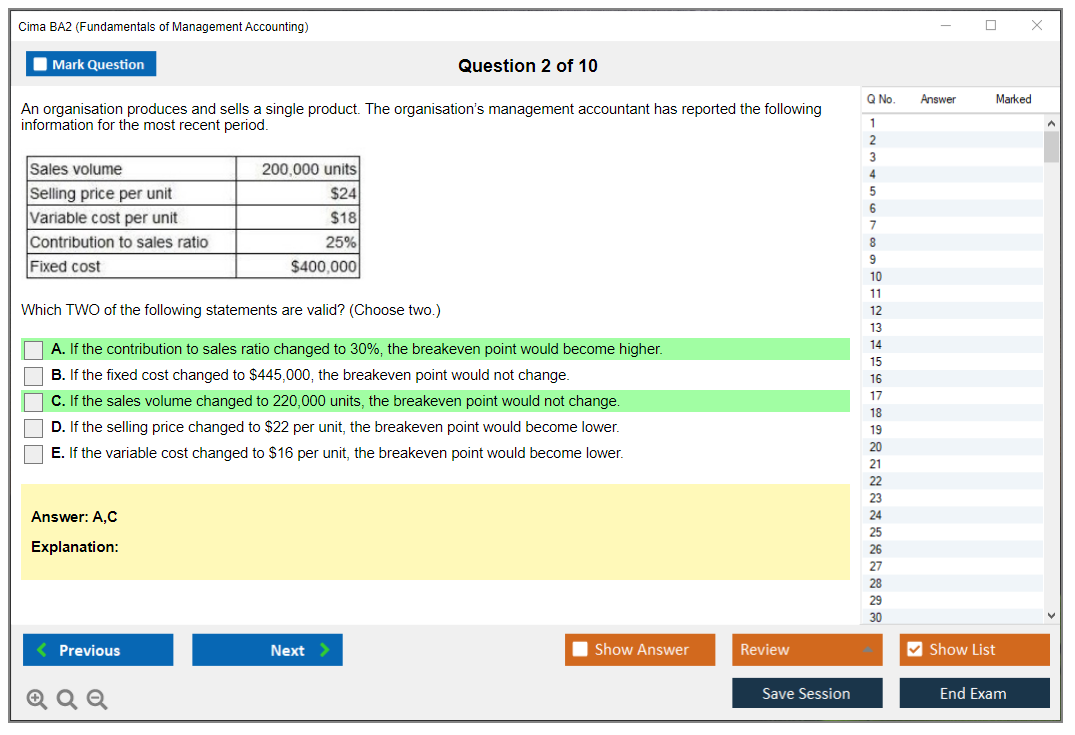
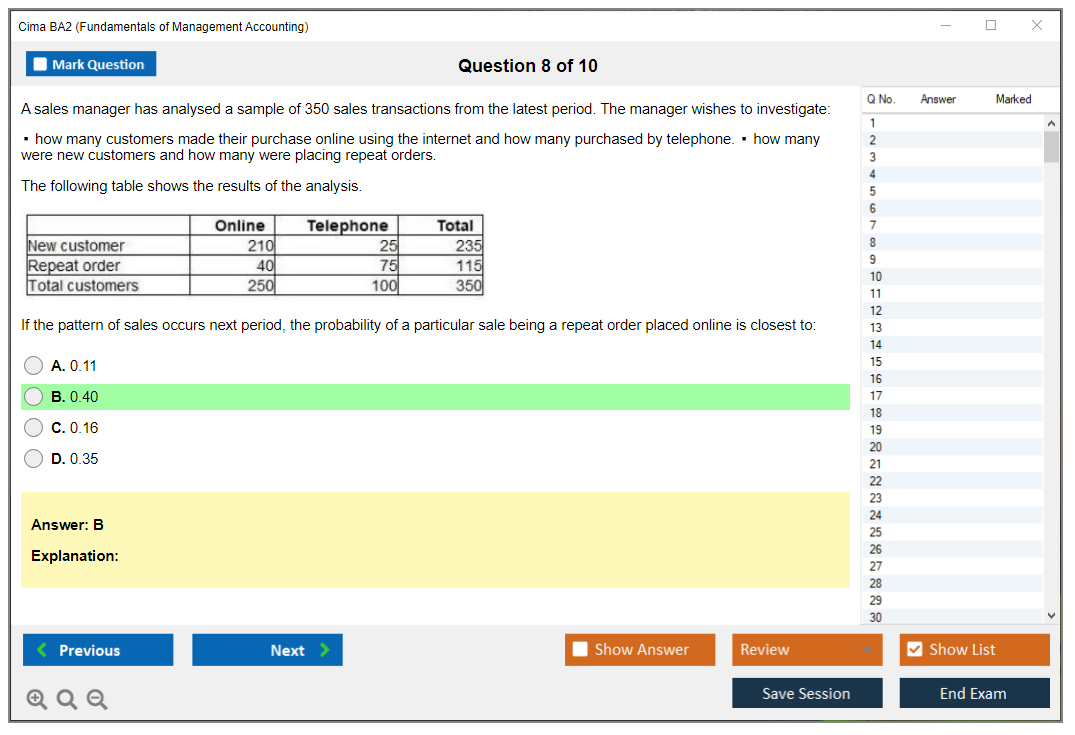
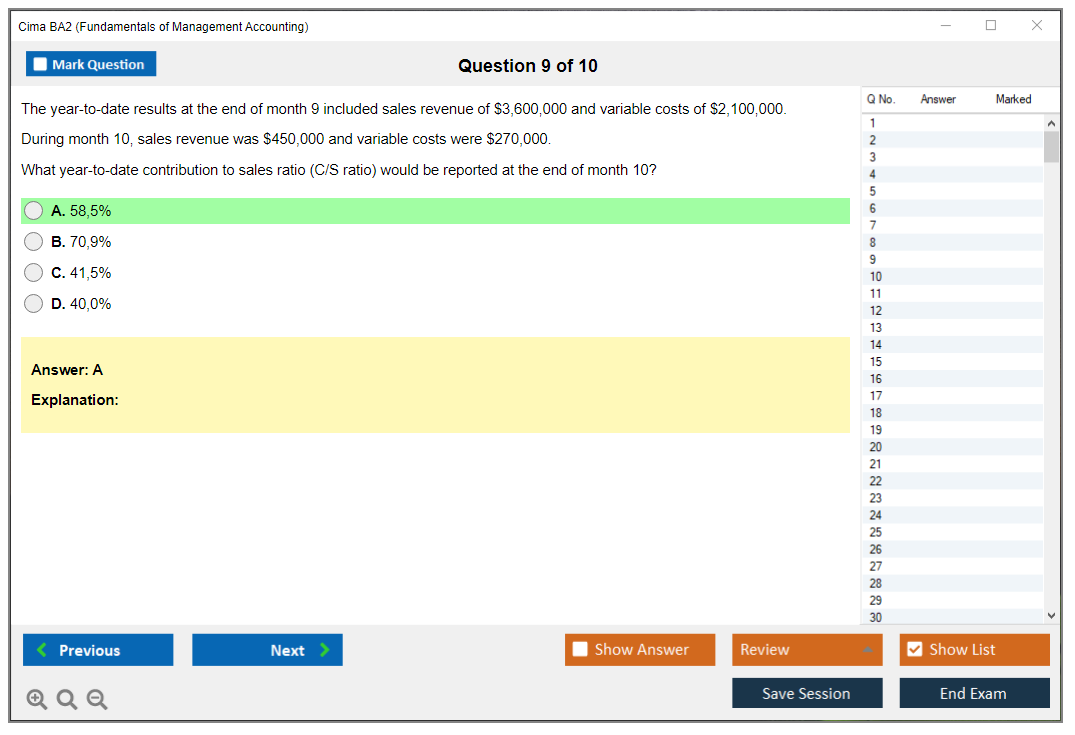
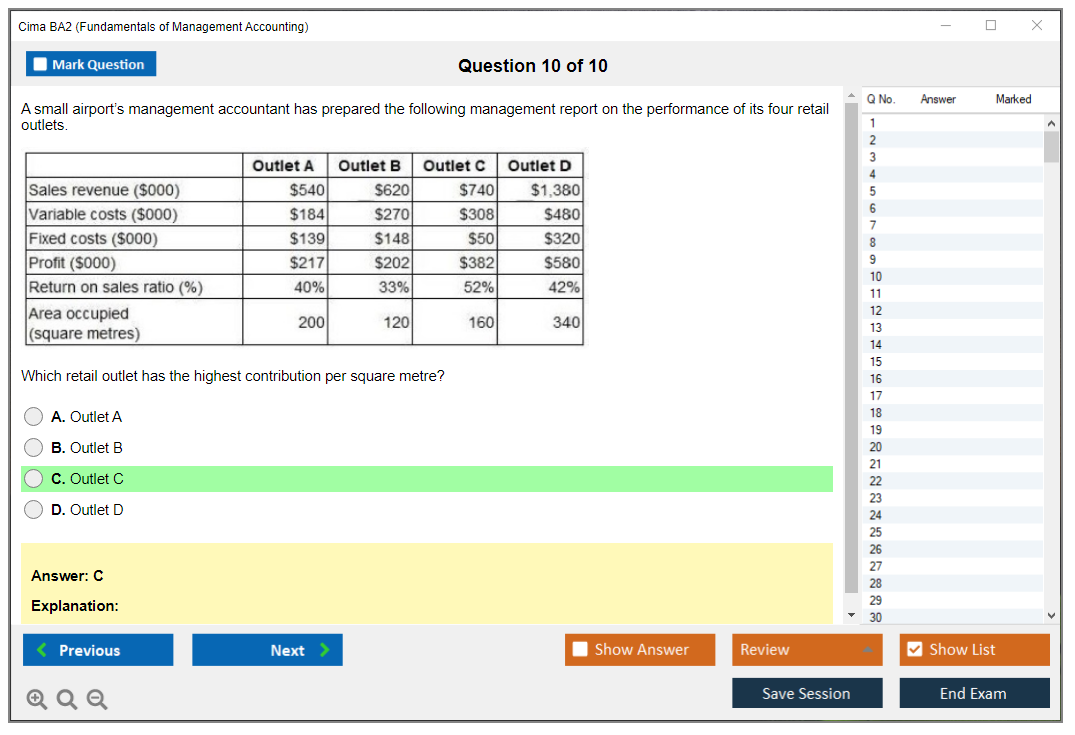
Cost-volume-profit analysis's basically Section C. Contribution's sales minus variable costs, contribution per unit and contribution margin ratio're just different ways to express the same idea.
Break-even in units's fixed costs divided by contribution per unit. In revenue terms, fixed costs divided by contribution margin ratio. Then charts: break-even chart and profit-volume graph. You should know what the axes're and what the intercepts mean, because the exam can ask interpretation without heavy calculation.
Margin of safety's actual sales minus break-even sales. It's a risk indicator, bigger's safer.
Target profit just adds profit to fixed costs in the numerator. Multi-product break-even uses weighted average contribution based on sales mix, and the exam will absolutely test whether you can keep the mix consistent while scaling up.
Assumptions and limitations matter too: linear costs and revenues, constant selling price, constant efficiency, single product or constant mix. CVP's a model, and the exam wants you to know where it breaks.
Sensitivity analysis comes in when they tweak price or variable cost and ask what happens to break-even. Service sector CVP's also fair game, like consulting hours as the "volume" driver.
Budgets: the section that rewards method
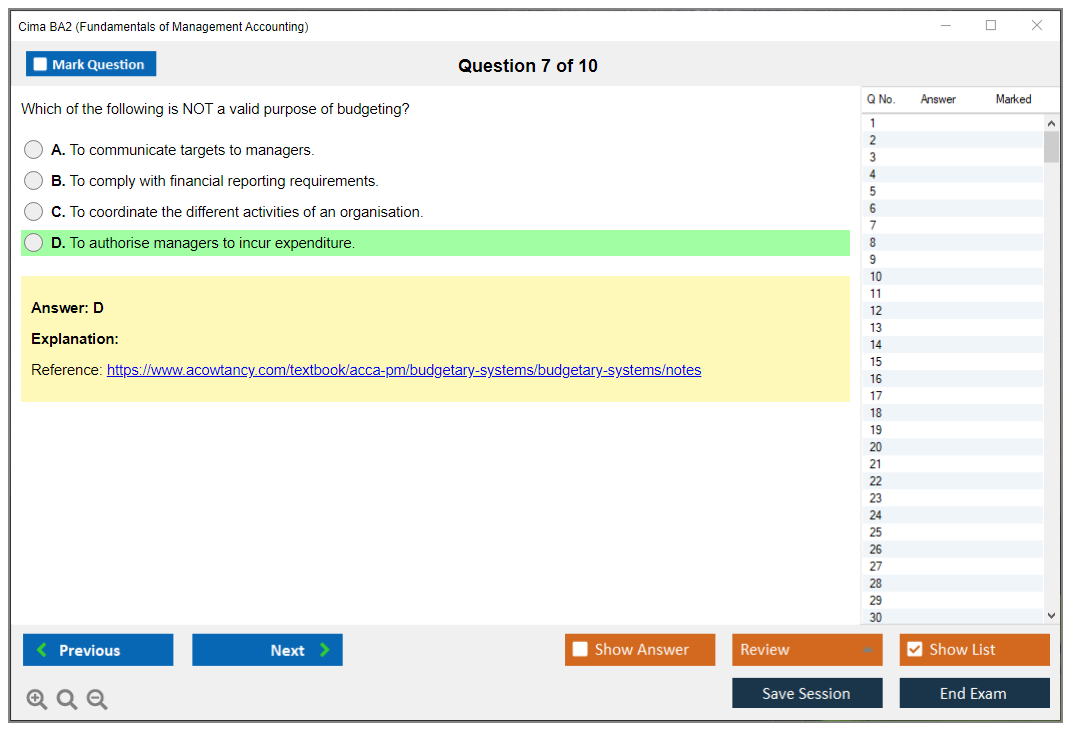
Section D's budgeting, and it's heavy. Purpose of budgets's planning, control, coordination, communication. The budget committee exists because budgeting's political and cross-functional, and someone's gotta force consistency.
The principal budget factor, also called the limiting factor, is the constraint that drives the whole plan: sales demand, production capacity, material supply, labour availability. Find it first, because it changes the sequence.
Sales budget's usually the starting point. Then production budget, which's sales plus closing inventory minus opening inventory. Then materials usage and purchases budgets, labour budget, overhead budgets split variable and fixed, admin budgets, selling budgets, distribution budgets. Cash budget pulls it all together, and the master budget wraps into budgeted income statement and balance sheet.
Flexible budgets versus fixed budgets matters for control. Flexing a budget means recalculating allowed costs for the actual activity level, so you can compare like with like. This is where people think they're doing variance analysis already, but budgeting flex's just getting to a fair baseline.
Standard costing and variances: learn the story, not only formulas
Section E's budgeting and variance analysis territory. Standard costing's about setting expected costs and then comparing actuals to spot problems and manage performance. You need to know types of standards: ideal, attainable, current, basic. Attainable's the normal "motivating but realistic" one.
Standard cost card prep's a favourite, because it forces you to set standards for materials, labour, variable overhead, fixed overhead absorption.
Material variances: total, price, usage. Labour variances: total, rate, efficiency. Variable overhead variances: expenditure and efficiency, plus total. Fixed overhead: expenditure and volume, with capacity and efficiency sub-variances sometimes included.
Direction matters.
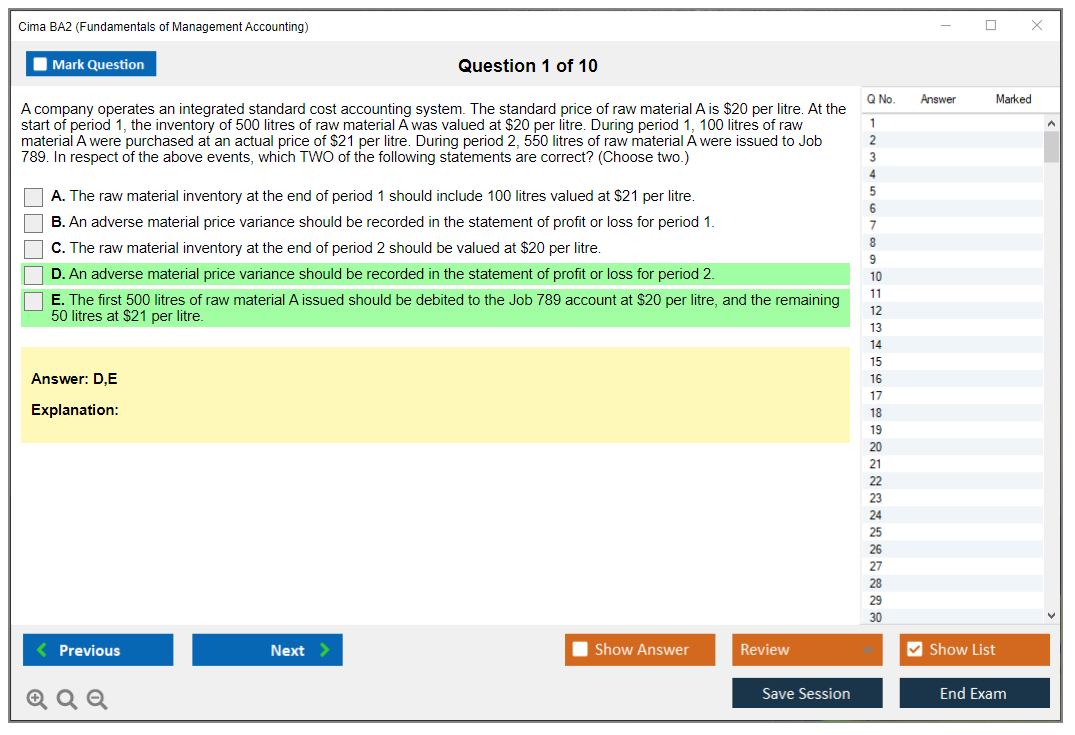
Material price variance timing's a classic trick. Calculate at purchase or at usage, and the difference's where the variance sits, like in inventory or cost of sales. Sales variances can appear too, price and volume, focused on revenue.
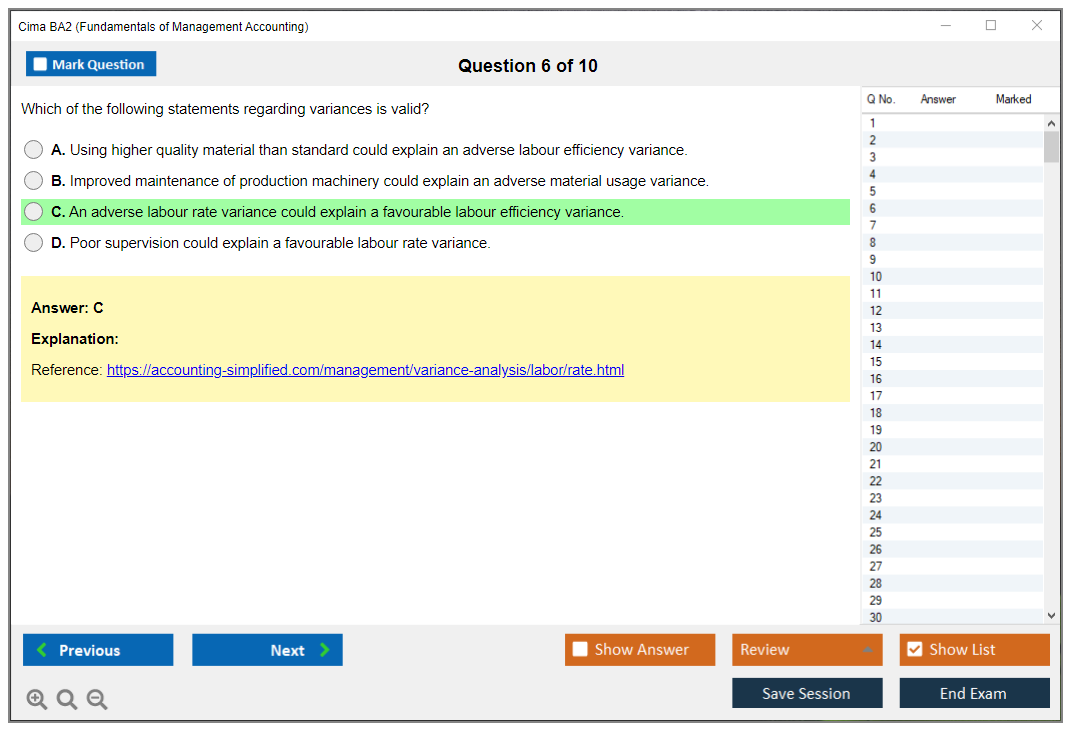
Interpretation's not optional. A favourable variance isn't always "good", like buying cheaper material that causes higher waste. Investigation criteria's about materiality and controllability, plus whether it's a trend or a one-off.
Relevant costing for short-term decisions
Section F's only about 10%, but it's very testable. Relevant costs're future, incremental, and cash-based. Sunk costs're irrelevant. Committed costs're often irrelevant unless the decision changes them. Opportunity cost's relevant even if it doesn't show up in accounting records.
Make-or-buy's compare relevant costs, including avoidable fixed costs and any opportunity cost of freeing capacity. Special orders below normal price're usually fine if there's spare capacity and the order covers variable costs and any extra costs, but you still consider brand impact and customer expectations. Product mix with a single limiting factor's contribution per unit of limiting factor, not contribution per unit. This trips people up constantly. Shutdown decisions're about avoidable costs and whether the segment contributes to fixed costs.
Qualitative factors matter: supplier reliability, staff morale, quality, legal terms. Real life stuff.
Prerequisites and prep time
There're no scary CIMA BA2 prerequisites beyond being enrolled in the certificate route, but you'll be happier if you can do basic algebra, percentages, and read a spreadsheet without fear. If you're new to accounting, plan longer. If you've done BA1 recently, you can move faster.
Rough timing? 4 to 8 weeks.
Exam cost, passing score, difficulty, and validity
People always ask: CIMA BA2 exam cost depends on region and provider, and it changes, so check CIMA's current fee list and your local test centre. Add registration and membership costs if you're new, and resits if you're not confident.
The CIMA BA2 passing score's set by CIMA's scaled scoring for objective tests. You'll see it reported as a fixed pass mark on the score report, so treat mocks seriously and aim comfortably above the line, not right on it.
CIMA BA2 exam difficulty is "fair but strict". The math's not advanced, but the traps're reading traps, time traps, and logic traps, especially in variances and absorption versus marginal.
For CIMA BA2 renewal and validity, BA2 itself doesn't expire like a subscription. Your broader CIMA status depends on staying in good standing with CIMA policies, so keep your records and don't ignore membership requirements.
Study materials and practice strategy that actually helps
For CIMA BA2 study materials, start with the official syllabus and learning outcomes, then pick one main text and one question bank. Don't collect five textbooks. That's procrastination with receipts.
For CIMA BA2 practice tests, do timed sets early, not just at the end. Build an error log, rewrite the rule you missed, and redo the question a week later. Integrated questions're common, so your practice should mix topics, not live in tidy chapter bubbles.
Calculator comfort helps. So does basic spreadsheet thinking, even though the exam's not Excel-based.
Quick FAQs people search
How much does the CIMA BA2 exam cost? It varies by region and it changes, so confirm on CIMA's site and budget for registration and possible resits.
What's the passing score for CIMA BA2? It's a scaled pass mark reported by CIMA on your result, so focus on getting consistently strong mock scores rather than chasing the minimum.
Is CIMA BA2 difficult for beginners? It can be, mostly because of time pressure and multi-step questions, but beginners who practice enough calculations usually do fine.
What're the best study materials and practice tests for CIMA BA2? One solid textbook plus a revision kit and lots of timed question practice's the combo that works, and official syllabus outcomes keep you from drifting.
Does CIMA BA2 expire or require renewal? The exam pass itself doesn't "expire", but your CIMA registration status and progression rules still apply, so keep proof of completion and stay current with CIMA requirements.
CIMA BA2 Prerequisites and Recommended Background
Here's what's wild about CIMA BA2 prerequisites, they're way more flexible than you'd think. No mandatory prerequisite exams required. Zero.
CIMA technically lets you tackle Certificate level exams in whatever order suits you, which sounds fantastic until you stop and think whether that's actually smart strategy-wise. I mean, sure, you could dive straight into BA2 without even glancing at BA1 (Fundamentals of Business Economics) or BA3 (Fundamentals of Financial Accounting), but should you? Probably not.
What you actually need before booking
The only real requirement? Registering as a CIMA student member. That's literally it. Pay your membership fee, grab your login credentials, and you're good. Book BA2 whenever you feel ready. There's no minimum educational qualification screened at Certificate level, meaning you could've left school at 16 and still sit this exam (16 being the minimum age in most places, though this shifts slightly depending on your jurisdiction).
Previous accounting qualification? Not necessary. You don't need AAT, don't need a degree, don't even need some bookkeeping course from your local college. CIMA's Certificate level is an entry point, though, honestly, that doesn't make it a cakewalk.
Why BA1 matters even though it's "optional"
Officially optional? Yeah. Practically useful? Absolutely, no question.
BA1 covers fundamental business economics stuff that keeps showing up in BA2 scenarios. Things like supply and demand, market structures, how businesses actually function under different economic conditions. When you're grinding through a BA2 question about cost behavior or pricing decisions, that BA1 foundation makes concepts click way faster.
I've watched people completely skip BA1 and jump straight into BA2. Look, some of them struggle way more than necessary. The business context just doesn't resonate the same way. But here's the thing: if you've got solid work experience in a commercial environment or studied business at any level previously, you might not actually need BA1 first. Depends on your situation.
The math situation (this matters more than people think)
BA2 isn't advanced mathematics. Not even close. No calculus. No statistical distributions. No complex probability theory you'd encounter at P2 (Advanced Management Accounting) or P3 (Risk Management) level.
But you definitely need solid numeracy skills. I'm talking percentages, ratios, basic algebra for equation solving. When calculating break-even points or working through variance analysis, you're constantly manipulating formulas. Rearranging them, substituting values, checking your logic makes sense.
If percentages make you anxious or you completely freeze when seeing fractions, brush up before starting BA2 study.
Graphical interpretation shows up too. Cost-volume-profit charts, step costs, linear cost functions. You've gotta read these accurately and fast. Spreadsheet skills help enormously here since you'll want to model scenarios in Excel while studying. The exam itself doesn't make you build spreadsheets, but practicing with them during preparation? Makes concepts stick better.
Calculator proficiency sounds ridiculously obvious but I'm serious when I say it matters. You'll be doing rapid-fire calculations under timed pressure. Know your calculator functions cold. Practice with the on-screen calculator if your test center uses those digital ones.
What accounting background actually helps
Complete beginners can pass BA2. I've seen it. But they need more hours and realistic expectations about the learning curve.
Previous bookkeeping or financial accounting? You've got a slight edge. Not because BA2 covers debits and credits (it doesn't, that's BA3 territory), but because you're already comfortable with accounting logic and terminology. You get what revenue and costs mean in business context. Financial numbers don't intimidate you.
Prior costing experience accelerates things notably. If you've worked in manufacturing and dealt with product costs, or prepared departmental budgets in some admin role, BA2 concepts feel familiar instead of completely alien. You're learning formal techniques for stuff you've already encountered practically.
Accounting degree students typically blitz through BA2 in 6-8 weeks since they've covered similar material (often more deeply) during university courses. Non-accounting graduates should realistically add 50-100% more study time reaching the same comfort level.
Technology expectations (surprisingly minimal)
Specialized accounting software? Not required. You won't touch Sage or QuickBooks or any ERP system for the BA2 exam. It's a computer-based objective test. Multiple choice and similar formats, answered directly on screen.
That said, spreadsheet competency during study makes life way easier. Building budget templates, creating variance analysis models, playing with sensitivity analysis. All this cements concepts better. Formula creation in Excel, basic data manipulation, formatting tables so they're actually readable. These skills matter during preparation even though the exam doesn't directly test them.
Get comfortable with computer-based testing interfaces before exam day. CIMA offers practice platforms so you can familiarize yourself with how the on-screen calculator works, how to work through between questions, whether you can flag items for review later. Small stuff, but, I mean, it reduces anxiety on the day.
How long you actually need to prepare
This varies wildly based on background. Complete beginners with zero accounting exposure? I'd recommend 12-16 weeks of consistent study, probably 6-8 hours weekly. That's 72-128 hours total, which sounds massive but BA2 covers substantial ground. Costing systems, cost behavior, budgeting, standard costing, variance analysis, relevant costing for decisions. Not shallow material.
Candidates with basic accounting knowledge usually manage in 8-12 weeks. You're not learning business concepts from scratch, so you're spending time on technique rather than fundamental understanding.
Finance professionals with practical costing experience might do it in 4-6 weeks, especially if they're disciplined about covering the full syllabus rather than just bits they already know. Work experience helps but doesn't perfectly align with exam requirements.
The BA2 Practice Exam Questions Pack at $36.99 becomes pretty valuable regardless of your timeline since it exposes gaps you didn't even know existed. You might think you understand absorption costing until you hit some tricky question revealing you've been confusing it with marginal costing this whole time.
Part-time students juggling work need to extend whatever timeline seems reasonable by at least 50%. Studying when you're exhausted after a full workday is just less efficient than full-time dedicated study. That's just reality, honestly.
I remember talking to someone who tried cramming BA2 in three weeks while working full-time. She passed, technically, but barely. And she couldn't remember half the material two months later when starting P1. Sometimes slower is actually faster if you think about the bigger picture.
Filling knowledge gaps before you start
Basic business mathematics rusty? Fix that first. Khan Academy has free resources. YouTube's got countless tutorials. Spending a week solidifying percentages and ratios before starting BA2 proper saves massive frustration later.
Read CIMA's detailed syllabus document. Seriously, actually read it. It tells you exactly what's examinable and at what depth. No surprises whatsoever. You'll see some topics are just "understanding" level while others require "application" or even "analysis" level competency.
Consider whether completing BA1 first makes sense for your situation. If business concepts are entirely unfamiliar (you've never worked in commercial environments, never studied business in any form) BA1 provides useful context. If you're already immersed in business? Might be unnecessary delay.
Free CIMA resources exist. Use them. Introductory webinars, syllabus guides, specimen exams. These cost nothing except time and give you proper orientation.
Language considerations (often overlooked)
The exam's in English globally. No getting around that. If English isn't your first language, you need strong reading comprehension since BA2 questions often contain scenario descriptions. Company situations, operational contexts, specific circumstances affecting the correct answer.
Technical accounting vocabulary requires familiarity. Terms like "overhead absorption rate" or "contribution margin" or "flexed budget" aren't everyday language. You'll learn them during study, but non-native speakers should budget extra time for terminology mastery.
Translation dictionaries aren't allowed in exam rooms. Can't look up words during the test. This means you must understand technical English before sitting the exam, not during it.
Practice with English-language questions throughout preparation. The BA2 Practice Exam Questions Pack helps here since you're encountering actual phrasing and terminology style used in the real exam. Pattern recognition matters.
The progression pathway (because BA2 isn't isolated)
BA2 sits within the CIMA Certificate in Business Accounting alongside BA1, BA3, and BA4 (Fundamentals of Ethics, Corporate Governance and Business Law). Completing all four gets you the Certificate, which then opens up Operational level: P1 (Management Accounting), E1 (Managing Finance in a Digital World), F1 (Financial Reporting).
Understanding this pathway matters since BA2 knowledge directly feeds into P1, which goes deeper into management accounting techniques. If you barely scrape through BA2 without really understanding variance analysis or relevant costing, P1 will hurt. Better solidifying fundamentals now.
BA2 doesn't expire. Once you pass, that result stands forever on your CIMA transcript. You don't need to renew or retake it. Your Certificate remains valid indefinitely, though obviously you'd need continuing studying to reach higher qualification levels like E3 (Strategic Management) or F3 (Financial Strategy).
Bottom line: BA2 has minimal formal prerequisites but meaningful practical ones. Get your math solid, understand basic business concepts, allocate realistic study time based on your background, and don't skip practice questions. That's the formula.
CIMA BA2 Exam Format, Passing Score, and Grading System
What BA2 actually is
CIMA BA2 Fundamentals of Management Accounting is the part of the CIMA Certificate in Business Accounting BA2 that moves you from "I can record transactions" into "I can explain what the numbers mean and what to do next". Different vibe entirely. More decisions, more costing logic, more "why did profit change" questions that'll make you second-guess yourself.
It's a certificate-level exam. That matters, honestly. There's no essay writing, no long-form case study like the later CIMA levels, and no need to sound like a consultant who swallowed a thesaurus. You either pick the right option or you don't. Simple in theory. Stressful in practice, though.
Where it fits in the certificate
BA2 sits alongside BA1, BA3, and BA4. It's the management accounting one, so you'll see costing techniques and cost behaviour, budgeting, and budgeting and variance analysis constantly. Like, prepare to dream about them. If you're trying to get into finance ops, junior analyst work, or even just be the person in admin who can talk to the finance team without your brain shutting down, this one does some real work for you.
One sentence reality check here. It's not "easy accounting". It's "fast accounting with no mercy".
Who should take it
Career switchers like BA2 because it's practical stuff you can actually use. People already in AP/AR like it because it finally explains what happens after the invoices vanish into the system. Students take it because they have to. Fair enough.
If you've never touched accounting, you can still pass. I mean, people do it all the time. But you'll want decent CIMA BA2 study materials and a lot of repetition, because the exam doesn't give you time to think from scratch on exam day when you're already panicking about the clock. Look, it rewards pattern recognition more than genius.
What the syllabus is really testing
The official CIMA BA2 syllabus and objectives cover the expected areas, but the exam questions tend to rotate around a handful of repeatable mechanics that show up in slightly different outfits each time.
Costing and cost classification is where they check if you can sort costs without overthinking every decision. Direct versus indirect. Fixed versus variable. Product versus period. Easy marks if you drill it until you're bored, then drill it some more.
Cost behaviour and CVP is where people start melting down mid-exam. Break-even charts, contribution, margin of safety, limiting factor decisions that sound simple until you're staring at the screen. It's not hard math in a vacuum. Just ridiculously easy to mess up when you're rushing and you swap sales and contribution in your head because your brain decided to betray you.
Budgeting methods show up as both calculations and "what would you do" questions that test whether you actually understand or just memorized. Incremental budgeting, zero-based, rolling budgets. Some are common sense. Some are memorize-the-definition-word-for-word situations.
Variance analysis is a big one that makes people cry. It's the part that makes CIMA BA2 exam difficulty feel higher than it actually is, because the logic is fussy, the signs confuse everyone including people who've passed, and the question writers absolutely love giving you one irrelevant number just to see if you bite and waste three minutes on the wrong calculation. I've watched someone spend ten minutes trying to reconcile a figure that wasn't even in the question, just something their tired brain invented. Don't be that person.
Short-term decision-making is the sneaky area where confidence kills you. Relevant costing, make or buy, special orders, shutdown decisions. The trick is always the same: ignore sunk costs, focus on incremental cash flows, and don't get sentimental about allocated overheads that don't actually matter to the decision.
Prereqs and the background that actually helps
No formal gatekeeping
For CIMA BA2 prerequisites, there's no big formal barrier beyond being registered with CIMA and having access to book the exam. You can book it when you're allowed to book certificate exams, and you sit it at a test center like a normal person taking a stressful test.
The stuff that makes studying less painful
Basic math skills matter here. Comfort with percentages that don't make you reach for a calculator every time. Being able to multiply without freezing up. Spreadsheets help too for studying, even though the exam itself is not Excel-based, which is honestly a relief.
If you've done any bookkeeping before, it won't hurt you, but BA2 is its own weird thing. Management accounting fundamentals CIMA style is more about internal reporting and decision support than financial statement rules that auditors obsess over.
Prep time depends entirely on you and your background. If you're already working in finance and you're comfortable with numbers, 3 to 5 weeks is realistic with steady practice. If you're new to all of this, 6 to 10 weeks is more comfortable. You need time for the ideas to actually stick in your brain, not just the formulas you'll forget under pressure.
How the computer-based exam works in real life
The CBT setup at Pearson VUE
BA2 is delivered exclusively as a computer-based objective test CIMA BA2 at Pearson VUE test centers. So yes, you're in a quiet room with other people clicking mice and trying not to sigh too loudly when they realize they misread a question.
Questions appear on-screen one at a time or in scrollable format depending on the interface version. You select answers electronically. There are no essay questions, no written explanations where you can beg for partial credit, no "show your workings for part (b)" that might save you. Just pick the best option, move on, repeat 60 times without crying.
An on-screen calculator is built into the testing interface and it's.. fine. Not amazing, not terrible. If you're used to a physical calculator, the first few questions can feel clunky and weird, so practice with the on-screen one during mocks if your provider offers it. Muscle memory matters more than you'd think.
You also get scratch paper or a whiteboard at the test center for manual workings. Use it without shame. Even if you think you can do it in your head because you're good at math, time pressure makes people do silly stuff like invert a ratio and then confidently select the wrong option while feeling smart.
Question types you might see
Most questions are standard multiple-choice with four or five options, single best answer, one mark each. No negative marking, so guessing carries absolutely no penalty, which changes your strategy a lot. Never leave blanks, ever.
Variations do show up though and they throw people off:
- Multiple-response questions where you select more than one correct option from the list. Read the instruction carefully because picking only one can auto-fail that question, which is annoying and feels unfair but whatever.
- Scenario-based sets where a short case is followed by a few related questions. This is where people waste time re-reading the same paragraph four times. Don't do that to yourself.
- Fill-in-the-blank numeric entries can appear, where you type a number into a box. Not common, but it happens, and it punishes sloppy rounding or forgetting to read what units they want.
- Drag-and-drop matching or ranking questions exist, less common than standard MCQ, but they're still objective format so there's one right answer configuration.
True/false style questions also show up regularly, usually dressed up as "which statement is correct" with four statements to evaluate.
Exam structure and scoring mechanics
There are 60 objective test questions total. All carry equal weighting. One mark per question. That's it. No partial credit anywhere. If you're "almost right" on a variance calculation because you got the formula but messed up one number, you still get zero points.
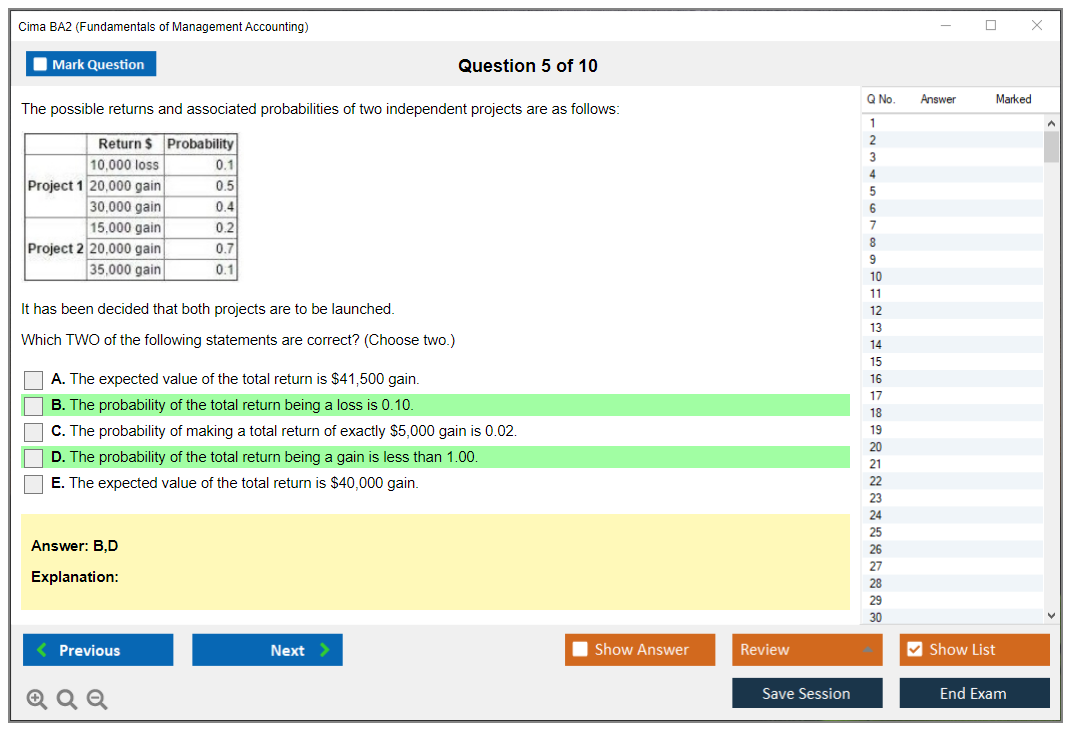
The mix is usually computational questions that need actual calculation and working, conceptual questions testing principles and techniques you need to memorize, and application questions where you interpret a scenario and pick what a manager should do, which tests both knowledge and common sense.
Questions are randomly selected from the bank, so your exam will not match your friend's even if you sit the same day. Same syllabus coverage, different wording, different numbers, same pressure and anxiety.
Timing and why it feels tight
You get 90 minutes total. No designated reading time like some exams give you. The clock is on-screen the whole time, which is great for pacing, unless you're the type who keeps checking it every 20 seconds and spirals into panic mode.
That's about 1.5 minutes per question on average if you do the math. Some will take 20 seconds because they're definitional. Some will take 3 minutes if you let them, especially variance questions that have multiple steps.
You can flag questions for review and come back later, which is honestly a lifesaver. Do it without guilt. Here's the time approach that works for most people I've seen pass without drama: aim for 60 to 70 minutes to attempt everything once, then reserve 20 to 30 minutes to revisit flagged questions and clean up mistakes you made because your brain was moving too fast. The review block is where a lot of passes are actually made, because your brain is warmed up and you spot the dumb errors like using the wrong variance formula.
Time pressure is a huge reason people rate CIMA BA2 exam difficulty higher than BA1, even though the topics aren't actually harder. It's not that the topics are impossible to understand. It's that you're doing them at speed with zero partial marks and a calculator that feels weird.
Passing score and grading system
What score you need
The CIMA BA2 passing score is 70%. With 60 questions, that means 42 correct answers minimum to pass.
That's higher than many academic exams where 40 to 50% might scrape through with a "passing grade," and it catches people completely off guard the first time they hear it. You can't wing it. You need accuracy, not just exposure or "I've heard of that topic before."
Scoring is absolute and mechanical. There's no curve. Your result is not adjusted based on how everyone else did that week or whether the questions were harder. Each correct answer gives one mark, incorrect gives zero, and the maximum score is 60 out of 60, shown as 100% on your report.
Certificate-level CIMA exams don't do "distinction" classifications or honors categories. So a pass is a pass is a pass. Employers rarely care if you got 71% or 91% anyway. They care that you finished and you can talk about budgeting and cost behaviour without sweating through your shirt.
Results and feedback
When you submit, you get your result right there on-screen, which is both amazing and terrifying. Pass/fail and percentage. Then you get a printed score report at the test center right after you finish. That immediate feedback is nice, honestly, because waiting weeks like some exams make you do would be absolutely brutal.
Your digital transcript updates in MyCIMA within 24 to 48 hours usually, sometimes faster. You also get a performance breakdown by syllabus area, so you can see where you were strong or weak. You will not get a detailed question-by-question review, and you won't be told exactly which items you missed or what the right answers were. That's normal for secure question banks that get reused.
If you fail, that breakdown is the whole game for your resit. Use it to target your restudy. Don't just redo everything from page 1 unless you truly have no idea what happened and you were guessing randomly.
Retakes: what happens if you don't pass
There's no limit on retake attempts, which is good for persistence but bad for your wallet. And there's no mandatory waiting period either. You can book the next available slot right away at Pearson VUE if you want to get it over with or if you're feeling confident about what went wrong.
You do pay the full exam fee again each time, though. No discounted resit fee, no "you almost passed so here's a break" pricing. That's why people suddenly start caring intensely about CIMA BA2 practice tests after a fail when they should've cared before.
My opinion here: give yourself 2 to 4 weeks minimum before the retake unless you missed by literally one question and you know exactly why and it was something stupid. Most fails aren't actually knowledge gaps where you don't understand the content. They're speed plus accuracy problems, and you fix that with timed practice and an error log where you write down every mistake, not with vibes and hoping it'll be different next time.
Previous attempt scores do not affect future grading in any way. Each attempt is independent. So you don't "average out" or get flagged as a repeat taker. You just need the pass eventually.
Cost and the money side people ignore
What you'll pay
CIMA BA2 exam cost varies by region and pricing updates from CIMA, so I'm not going to pretend there's one global number that stays true forever and then lie to you. Expect the exam fee plus any CIMA registration or subscription fees if you're new to the system.
Extra costs sneak in like hidden fees everywhere. Tuition provider packages, revision kits, mock exams that aren't free, travel to the test center if it's not local, and resits if needed which double your cost instantly. Those add up fast and nobody warns you.
If you want to reduce total cost without sacrificing pass rate, focus on two things that actually work. First, use the official syllabus and specimen questions as your baseline, because free clarity beats paid confusion every time. Second, buy fewer resources but actually finish them properly. Half-used materials are just expensive guilt taking up space on your desk.
Study materials and practice: what actually moves your score
Picking materials that match the exam
For CIMA BA2 study materials, you want something that looks and feels like the real exam, not just theory. Lots of objective questions, clear workings shown step-by-step, and explanations that tell you why each wrong option is wrong, not just why the right one is right which leaves you confused about your mistakes.
A textbook is fine for learning the concepts initially. But your actual pass is built on question practice and repetition. If your kit doesn't have enough computational drills and variance questions that make you want to throw things, you'll feel okay in study mode and then get absolutely wrecked on exam day when it's real.
How many mocks and what score to aim for
For CIMA BA2 practice tests, do enough timed sets that 90 minutes feels normal and not like a sprint. Two full mocks is the absolute minimum. Four is better and gives you data. More if you keep making the same category of mistakes which means you haven't actually fixed the underlying problem.
Aim for 75 to 80% consistently in mocks before you sit, not just once by luck. Could you pass with less? Sure, people do. But the real exam has nerves, weird wording that's slightly different from your mocks, and those couple of questions that make you stare into space questioning your life choices. Your mock score needs buffer room.
Renewal, validity, and progression
Does BA2 expire
People ask about CIMA BA2 renewal and validity all the time. For the exam credit itself, it doesn't "expire" in the normal sense once you've passed it as part of the certificate track, but your student status and CIMA policies can change over time, so keep your MyCIMA account active and save your transcript somewhere safe like you would any important document.
What comes next
BA2 feeds into finishing the Certificate, then you move on to professional level if that's your plan and you want to keep going. Even if you stop at the certificate level and call it done, BA2 is the one that gives you actual talking points in interviews, because you can discuss cost behaviour, budgeting, and short-term decisions like a real finance person who knows things, not just someone who memorized journal entries and hopes nobody asks questions.
Quick FAQs people keep asking
How much does the CIMA BA2 exam cost?
It depends on region and current CIMA pricing that changes periodically, plus any registration fees. Check CIMA and Pearson VUE booking pages before you plan your timeline or budget.
What is the passing score for CIMA BA2?
70%, which is 42 correct answers out of 60 total questions.
Is CIMA BA2 difficult for beginners?
It can be, mostly because of time pressure and variance logic that confuses everyone, not because the math itself is advanced or impossible.
What are the best study materials and practice tests for CIMA BA2?
Pick resources with lots of exam-style objective questions and timed mocks that simulate pressure, plus clear explanations. One good revision kit used repeatedly beats five scattered resources you never finish.
Does CIMA BA2 expire or require renewal?
The pass itself is recorded permanently in your CIMA account, but keep your account in good standing and download your transcript for your records just in case.
Conclusion
Wrapping up your BA2 path
Look, CIMA BA2 Fundamentals of Management Accounting isn't the hardest exam you'll face, but it's not a walk in the park either. The management accounting fundamentals CIMA tests here (costing techniques and cost behaviour, budgeting and variance analysis, all that stuff) form the backbone of everything you'll do later in your accounting career. You can't really master the advanced papers if you're shaky on basic variance calculations or don't understand how fixed costs behave differently from variable ones. That's foundational knowledge you'll need forever.
Here's the thing about the CIMA BA2 exam difficulty: it catches people off guard because it's memorization. Sure you need to know formulas and definitions, but that computer-based objective test CIMA BA2 throws at you requires speed and application under pressure. You've got what, 90 minutes for 60 questions? That's barely enough time to second-guess yourself, let alone work through complex scenarios methodically. Which is why understanding the CIMA BA2 syllabus and objectives inside-out matters way more than cramming the night before.
The CIMA BA2 exam cost (typically around £71 to £85 depending on your region) is honestly reasonable considering what you're getting. Not gonna lie, the total investment adds up when you factor in CIMA BA2 study materials, maybe a course, possibly a resit if things don't go your way. Happens to the best of us. But compared to other professional qualifications? Pretty accessible. Just make sure you're hitting that CIMA BA2 passing score of 70% on practice runs before you book.
Nothing worse than paying twice.
Regarding CIMA BA2 prerequisites, there aren't formal ones technically, but having basic spreadsheet skills and some accounting exposure helps. A lot, actually. If you're coming in cold, budget extra weeks for sure. My mate Simon tried jumping straight in after five years away from any finance work and ended up needing three months instead of six weeks. Sometimes you don't realize how rusty you are until you're staring at a cost allocation problem that should take two minutes.
The CIMA Certificate in Business Accounting BA2 doesn't expire once you pass, which is great, but you still need to keep moving through BA3 and BA4 to actually complete the certificate. Don't let momentum die or you'll regret it six months later when you've forgotten half the material.
Before you sit the real thing, honestly the best move is drilling CIMA BA2 practice tests until the question patterns feel familiar. I've seen too many people study theory perfectly then freeze when they see how questions are actually worded. Their brain just stops working. The BA2 Practice Exam Questions Pack gives you that real-exam feel without the pressure, lets you identify weak spots while there's still time to fix them properly. Work through it twice minimum. Mark the questions you bombed, understand why you got them wrong, then test yourself again a week later to see if it stuck.
You've got this. Just don't wing it.