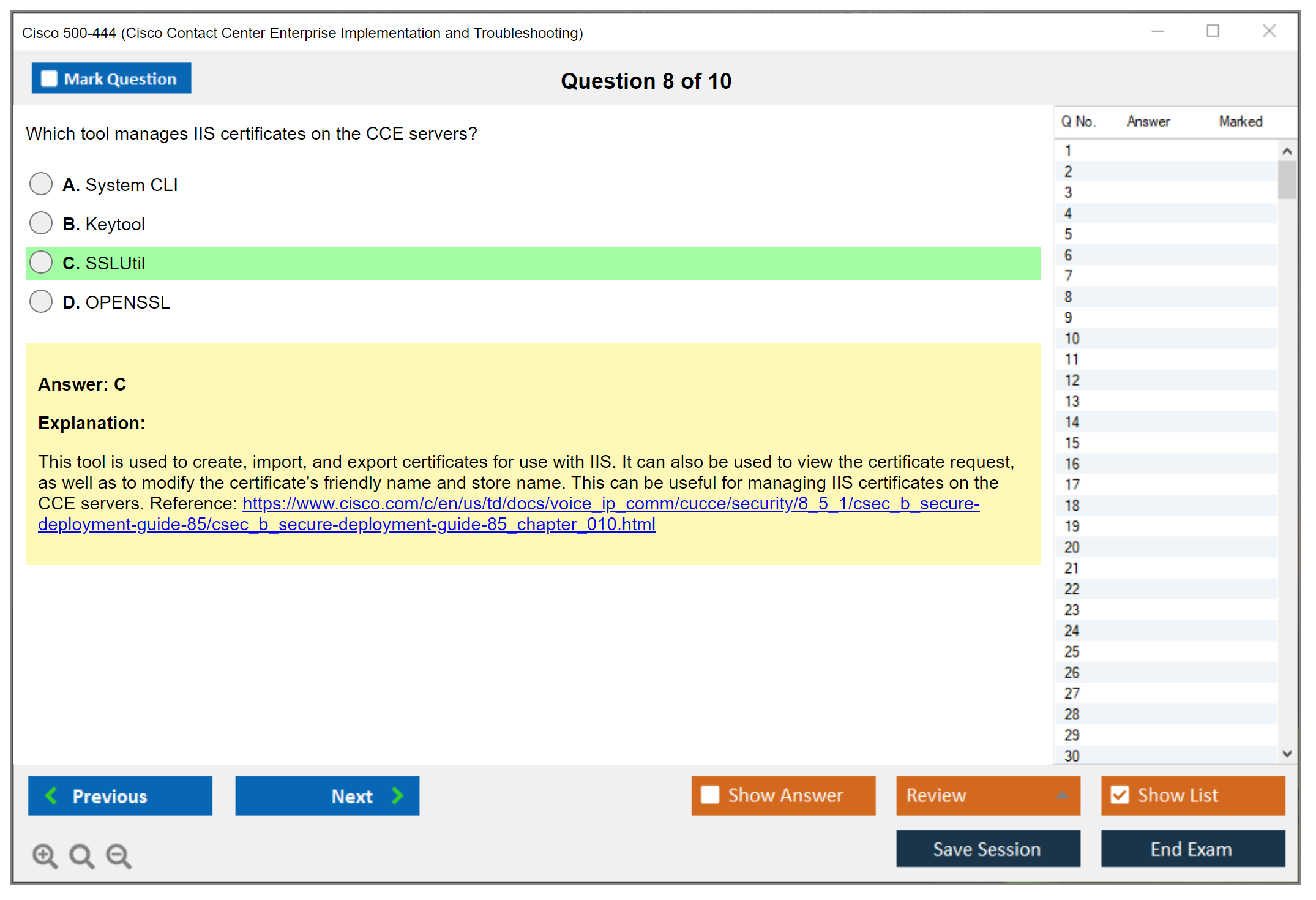
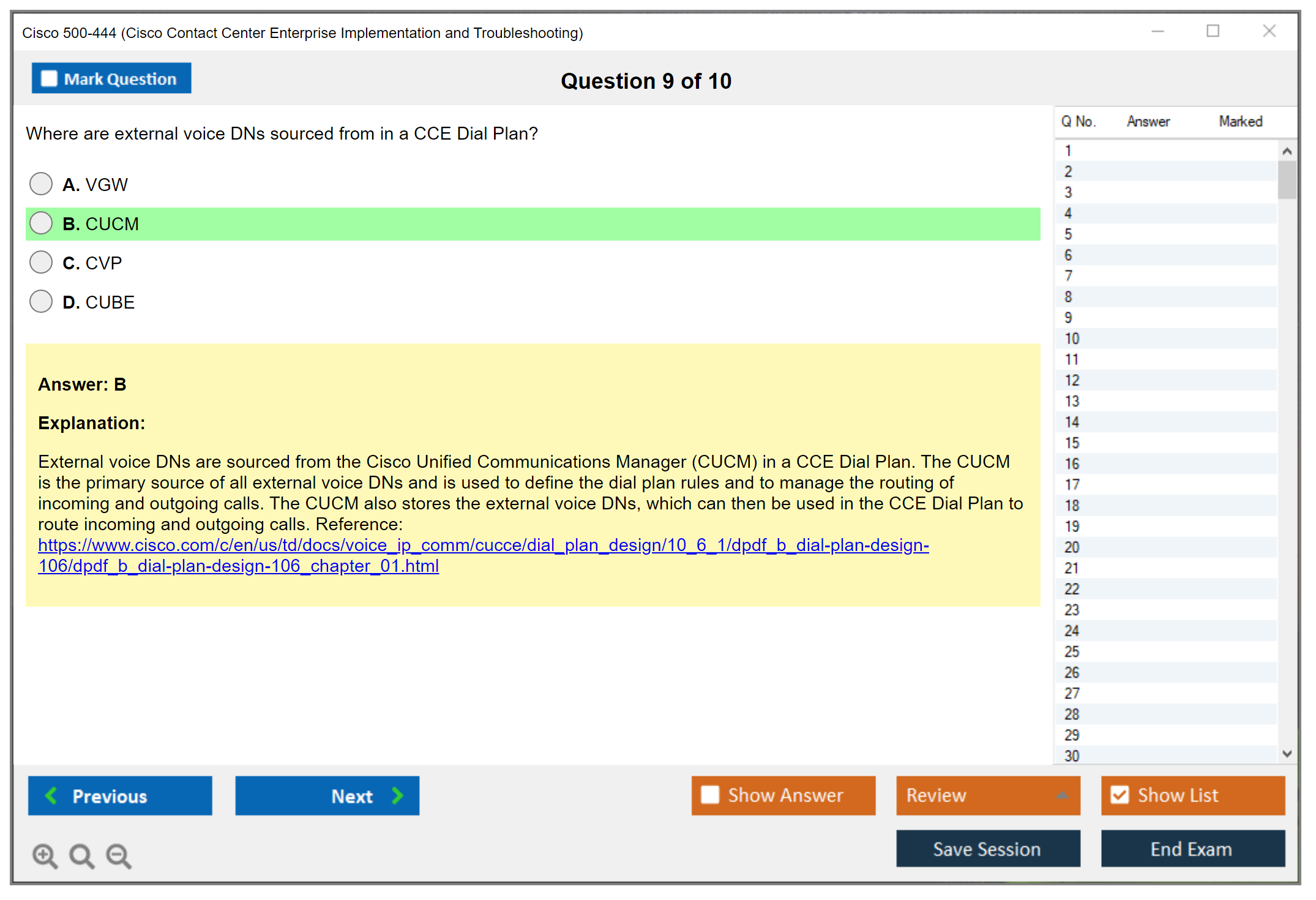
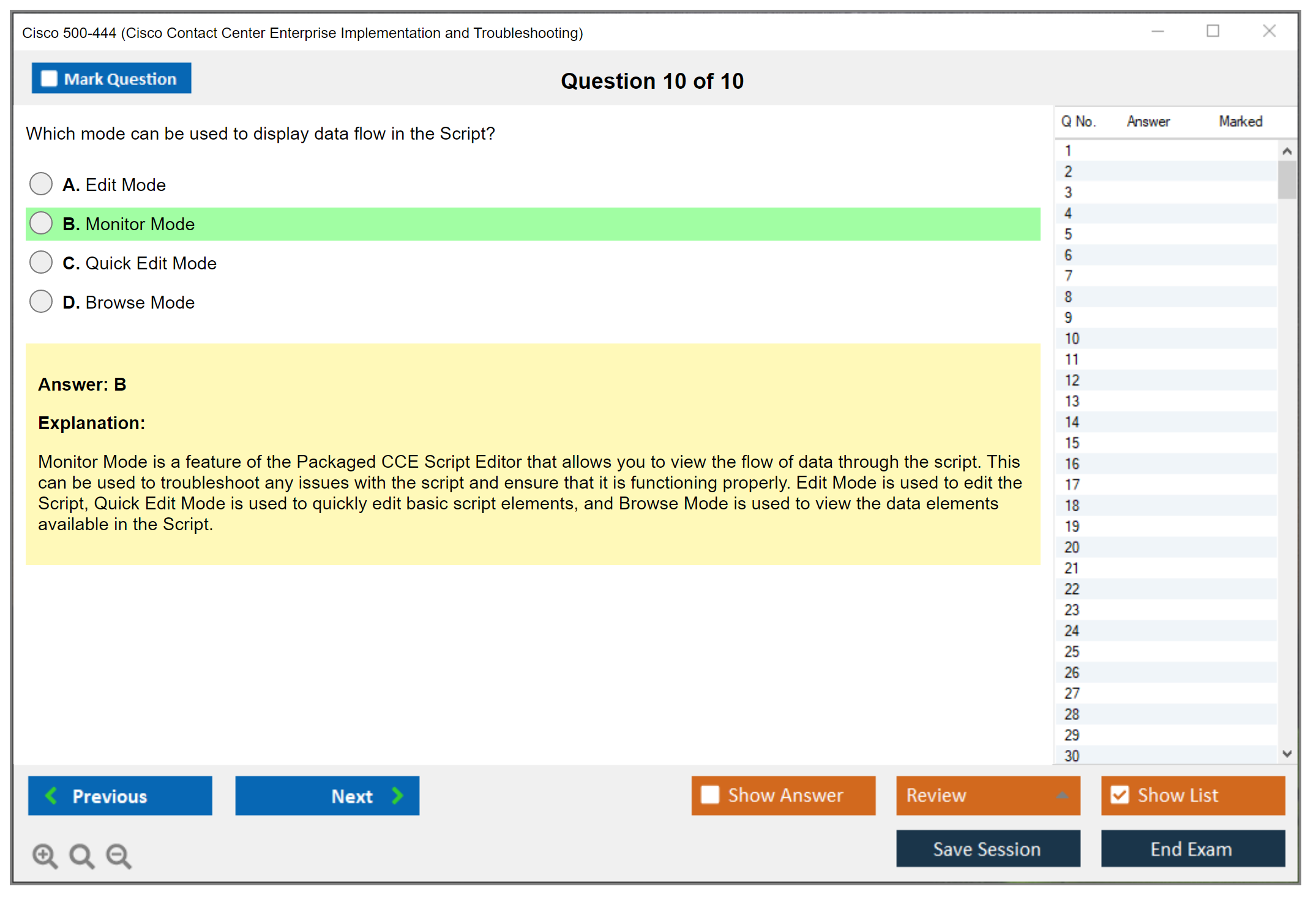
Cisco 500-444 Exam Overview (Cisco Contact Center Enterprise Implementation and Troubleshooting)
Introduction to the Cisco 500-444 exam
If you're working in contact center environments, you already know how complex Cisco Contact Center Enterprise deployments can get. The architecture alone involves so many moving parts that it's really overwhelming until you've built a few systems from scratch. The Cisco 500-444 exam exists specifically to validate that you can actually implement, configure, and troubleshoot these systems when things inevitably go sideways. This is not just another checkbox certification. It's designed for people who need to prove they can handle real-world CCE scenarios, from initial deployment through to diagnosing why calls suddenly are not routing correctly at 2 AM.
This exam measures your ability to work with both Unified Contact Center Enterprise (UCCE) and Packaged Contact Center Enterprise (PCCE) environments. The difference matters because these architectures serve different scales and use cases, but the troubleshooting mindset stays pretty similar once you understand the core components. I've seen engineers struggle for weeks just mapping out the relationship between ICM routers and peripheral gateways before anything clicks.
What the 500-444 certification exam validates
Real capability here.
The exam confirms you know how to deploy CCE solutions from the ground up, configure routing scripts that actually work, maintain system health, and diagnose issues when components fail or integrate poorly. You're expected to understand the entire ecosystem: how CVP handles call treatment, how Finesse provides the agent desktop interface, how ICM/UCCE manages call routing intelligence, and where CUCM fits into the voice infrastructure.
This is one of those exams that balances theoretical knowledge with hands-on diagnostic skills in ways that catch people off guard if they've only studied documentation without touching actual systems. You need to understand call flows conceptually, but also recognize log patterns that indicate database replication failures or SIP trunk misconfigurations. The troubleshooting portion is not abstract. You're identifying root causes based on symptoms, which means understanding how components interact when everything's working and when it's broken.
Who should take the Cisco 500-444 exam
This exam targets contact center engineers who implement and support enterprise-grade solutions. Unified communications specialists transitioning into contact center roles benefit from the structured validation. VoIP administrators already familiar with voice infrastructure can expand into the contact center domain. Technical consultants who design or deploy CCE systems for clients need this credential for credibility and sometimes for maintaining Cisco partner status.
If you're already troubleshooting UCCE environments regularly, the exam formalizes what you probably already know. For those newer to CCE but experienced with related Cisco technologies like Implementing Cisco Collaboration Core Technologies (350-801 CLCOR), this represents a logical specialization path into contact center work.
Organizations in finance, healthcare, retail, telecommunications, and government sectors rely heavily on omnichannel customer engagement platforms. Certified CCE professionals remain in demand because these systems require specialized knowledge that general network engineers typically do not possess.
Exam format details
You're looking at 55 to 65 questions spread across 90 minutes. That's tight. Question types include multiple choice, multiple select (where you pick several correct answers), drag-and-drop matching exercises, and simulation-based scenarios where you might need to identify configuration errors or select appropriate troubleshooting steps.
The simulations can be tricky because they test applied knowledge rather than memorization. You might see call flow diagrams where you identify the failure point, or log excerpts where you determine which component is causing errors. This honestly requires pattern recognition you only develop through actual experience or really thorough lab practice.
Languages available
English is the primary option, though depending on your region and Pearson VUE policies, additional languages might be available. Check with the testing partner for your specific location.
Certification track positioning
The 500-444 sits within Cisco's collaboration and contact center specialist credentials. It's not entry level. You should already understand networking fundamentals and preferably have experience with Cisco voice technologies. If you've tackled exams like Implementing Cisco Enterprise Network Core Technologies (350-401 ENCOR) or collaboration-focused certifications, you'll find some conceptual overlap in areas like QoS, SIP trunking, and integration architectures.
This exam often complements other specialist tracks. Engineers pursuing full collaboration expertise might pair it with Implementing Cisco Advanced Call Control and Mobility Services (CLACCM) to round out their skill set.
Real-world application
Passing this exam demonstrates you can handle complex deployments involving multiple integrated components. You understand how CUCM provides call control, how CVP delivers IVR functionality and network-based call treatment, how Finesse gives agents their working interface, and how the ICM/UCCE routing engine ties everything together with intelligent call distribution based on business rules.
Integration challenges are constant in CCE environments. Database synchronization issues between paired ICM servers, SIP trunk problems between CVP and CUCM, agent desktop connectivity failures, reporting database replication delays. These are the daily realities this exam prepares you for, which makes it more practical than some of the purely theoretical certifications out there.
Career relevance in 2026
Contact centers have not disappeared. They've evolved into omnichannel engagement platforms. Organizations still need experts who can deploy and maintain these systems. The certification signals to employers that you possess validated skills beyond what resume claims suggest.
Differences between implementation and troubleshooting focus
The exam does not just test whether you can follow deployment guides. It assesses diagnostic methodology, log analysis capabilities, and root-cause identification skills. You need design knowledge to implement correctly, but also troubleshooting instincts to fix what breaks.
Exam delivery method
Pearson VUE handles testing through physical centers or online proctored sessions. Online testing requires meeting system requirements, having a webcam, and completing identity verification. Some people prefer test centers to avoid technical issues with proctoring software.
Score reporting
Immediate results.
You get preliminary pass or fail feedback right away. Within 48 hours, a detailed score report breaks down performance by exam domain, showing where you excelled and where you struggled.
Validity period
Cisco certifications typically remain valid for three years. Recertification maintains active status through retesting or continuing education options.
Cisco 500-444 Exam Cost and Registration Process
The Cisco 500-444 exam targets Cisco Contact Center Enterprise implementation and troubleshooting work. You need to know how pieces connect, deploy them right, and fix things when they fall apart. Real-world stuff, not theory.
You'll hit topics like ICM/UCCE configuration, how core components talk to each other, and those "why's this call routing breaking at 9:03am but working perfectly two minutes later" mysteries that make you question everything. If you've never cracked open a CCE deployment guide or hunted through logs during a system brownout, this exam's gonna feel like it's got a personal grudge against you.
Engineers doing UCCE/PCCE builds. That's who.
Also upgrades, migrations, and that endless "keep it alive" operations work that nobody thanks you for until something breaks. Consultants too. People who basically live inside Cisco Unified CCE troubleshooting tickets and dream in script editor syntax.
Newer folks can pass, sure. Way smoother when you've actually touched routing scripts, wrestled with Finesse, configured CVP, and survived at least one integration that fought you every step of the way.
Exam price and currency considerations
The 500-444 exam cost typically lands around $300 to $400 USD, though it shifts. You should absolutely verify current pricing on Cisco's official certification site before budgeting anything because one day it's one number, next quarter it's something completely different.
Regional pricing variations? Totally real. Currency conversion, local taxes, and whatever regional Cisco policies are in play can shift what you actually pay by a noticeable chunk. Someone booking in the US and someone in, say, APAC might not see the same final checkout total even though they're scheduling the exact same exam code.
Additional costs (training, labs, retakes)
The exam fee's the small part. The real spend? Preparation.
Official instructor-led training can run $3,000 to $5,000. Self-paced modules often land around $500 to $1,500. Lab subscriptions commonly hit $100 to $300/month. A decent 500-444 practice test platform might be $50 to $150.
Then there's the rest. Books, community courses, rack rentals if you're building your own lab environment, and that "I need a new headset because online proctoring's stupidly picky about audio quality" purchase. Total budget planning usually ends up somewhere between $800 to $6,000, depending on how hands-on you go and whether you've already got lab access or employer resources backing you up.
Exam voucher purchase options
You can typically buy or schedule through Pearson VUE directly, the Cisco Learning Network Store, or authorized Cisco Learning Partners. Actually most people just use Pearson VUE because you're already there when scheduling anyway, but if your company buys vouchers centrally, the Cisco store or partner channel's often how that happens.
Discount opportunities
Discounts exist. They're just not always obvious.
Cisco Live attendee vouchers can cut costs. Cisco Learning Credits (super common in partner orgs) can cover training and sometimes exam-related expenses. Some enterprises negotiate volume discounts when they're training batches of engineers. Student or academic discounts apply in certain programs and regions.
One I'll explain more: Learning Credits. If you're at a partner, ask whoever owns your training budget whether you've got CLCs sitting unused. They expire and people forget. It's really painful watching an engineer pay out of pocket while credits just die on a spreadsheet somewhere.
Is there an official passing score?
People keep searching 500-444 passing score, but Cisco doesn't always publish a simple fixed number for every exam in a way that stays consistent forever. Don't build your entire plan around some rumored "X out of Y" target you saw on a forum three years ago.
How Cisco scoring typically works (scaled scoring)
Cisco exams commonly use scaled scoring models. Basically means different question sets can map to the same scaled result, and the "raw percent" isn't always the point. Focus on the 500-444 exam objectives and making sure you can actually do the tasks, not just recognize trivia.
How hard is 500-444 for implementation vs. troubleshooting roles?
Is Cisco 500-444 difficult? Depends on your background.
If you implement CCE daily but rarely troubleshoot, the break/fix questions can sting. If you troubleshoot all day but haven't done clean installs or upgrades recently, the build-order details can absolutely trip you up.
It rewards people who can move between architecture diagrams, config screens, and log files without getting lost. Fast context switching, which is the job anyway. I knew a guy who could read ICM logs like most people read email, and he breezed through. Others with more implementation background struggled with the diagnostic portions, spent weeks drilling trace analysis before retaking. Different backgrounds, different challenges.
Common areas candidates find challenging
Integrations. Always integrations.
CVP and Finesse integration issues, certificate mismatches, service dependencies, and those "this node shows up but isn't really up" situations that waste hours. Also, contact center call routing scripts and the logic behind why a script behaves completely differently depending on peripheral states and skill group calculations.
Contact Center Enterprise architecture and components
Know what talks to what, why it talks, and what breaks when DNS, NTP, or certificates drift. Not glamorous. Very testable.
Implementation and configuration workflows
Expect sequencing questions. What comes first, what depends on what, and what you validate after each stage.
Call routing and scripting fundamentals
You don't need to be a full-time scripter, but you do need to understand how routing decisions get made, where variables come from, and how to sanity-check a broken flow.
Troubleshooting methodology and tools
Logs, traces, service status checks, and a consistent approach. The exam loves "what would you check next" logic.
Integrations and common failure points
CVP, Finesse, CUCM, gateways, and identity/cert pieces. The stuff that fails at 2am.
Recommended experience
For 500-444 prerequisites, Cisco doesn't always require a formal prerequisite exam, but you'll absolutely want real exposure to UCCE/PCCE, voice fundamentals, and basic networking before you even think about scheduling.
Helpful prior knowledge: CUCM, SIP call flows, gateways, QoS basics, and Windows server comfort. If "services.msc" scares you, fix that first.
Official Cisco learning and documentation
Start with Cisco's official training track and product docs, plus the CCE deployment guide for your version. Then map everything back to the blueprint.
Hands-on labs and building a practice environment
Hands-on wins every time.
Even a limited practice environment where you can rehearse installs, validate ICM/UCCE configuration, and break/fix common issues will help more than reading another PDF.
Study plan (2 to 6 weeks / 6 to 10 weeks options)
If you're already on CCE weekly, 2 to 6 weeks is realistic. If you're ramping from general voice, plan 6 to 10 weeks and schedule labs like gym sessions. Non-negotiable.
How to use practice questions effectively
Use a 500-444 practice test to find weak spots, then go back to docs and labs. Don't memorize answers. That's how people fail twice.
Final-week revision checklist
Review objectives, redo your weakest labs, and make sure you can explain common integration failures without guessing.
How Cisco renewal typically works (time-based validity)
For "How do I renew or recertify after passing 500-444?", Cisco certs typically have time-based validity and require renewal via retesting or continuing education, depending on program rules at the time. Always confirm current policy on Cisco's site because it changes.
Registration process walkthrough
Create or sign into your Cisco Certification Tracking System account, then link it with your Pearson VUE profile. Pick the exam. Choose a test center or online proctoring. Select a date. Pay.
Payment methods vary but usually include major cards, and vouchers if you've got them.
Scheduling flexibility matters. Peak times fill up fast, especially around end-of-quarter training pushes, so book early. If you need to reschedule or cancel, policies commonly require 24 to 48 hours notice or you risk forfeiting the fee.
Confirmation and preparation
After registration, you'll get confirmation emails with appointment details. For test centers, read directions and arrival rules. For online proctoring, verify your ID requirements, run the system test, clean your desk area. Don't wait until five minutes before start time to discover your webcam hates your laptop.
Retake policy and costs
If you don't pass, you'll usually wait at least 5 days for the first retake, then 14 days for later attempts. You pay the full exam fee again. Not gonna lie, that's why I always budget for one retake even when I'm confident.
Employer sponsorship
Many employers will reimburse the exam and Cisco 500-444 study materials if you make the business case properly. Ask with specifics: tie it to fewer outage hours, faster deploys, cleaner upgrades, and reduced vendor spend. Submit the receipt, your pass result, and a short summary of how the skills map to current projects. Managers love that.
Cisco 500-444 Passing Score and Scoring Methodology
Understanding Cisco's scaled scoring system
Look, Cisco doesn't just count up your correct answers and call it a day. The 500-444 exam uses scaled scoring, which means your raw score (how many you actually got right) gets converted into a scale typically ranging from 300 to 1000. Most Cisco specialist and professional exams set the passing mark somewhere between 750 and 850 on that scale.
Here's the thing though. Cisco rarely publishes the exact passing score for specific exam versions. You might see forum posts claiming "it's definitely 825" or whatever, but honestly? That number can shift depending on which version of the exam you get and how the psychometric analysis shakes out for that particular question pool. I mean, they're not exactly broadcasting this information.
Why they keep the exact number under wraps
Not gonna lie, it's frustrating when you're trying to figure out exactly what score you need. But Cisco has actual reasons for this secrecy beyond just being annoying. The exam uses adaptive difficulty principles and multiple question pools, so publishing one fixed number wouldn't even make sense. Wait, let me rephrase that.
A harder version of the exam might require fewer correct answers to hit that scaled 800, while an easier version demands more. Makes sense when you think about it, I guess.
They also do this whole psychometric analysis thing. Basically statistical voodoo that ensures fairness across different test forms. If they locked themselves into "you need exactly 72% to pass," they'd have to constantly adjust question difficulty to maintain that exact threshold. Instead, the scaled score accounts for variations in difficulty automatically.
Maintaining exam integrity matters too. When you're dealing with multiple versions and question pools (especially important for specialist exams like the 350-801 CLCOR or contact center focused tests), keeping some flexibility in scoring prevents people from gaming the system. Smart move, honestly.
How your raw score becomes your final score
So you finish the exam. You got, say, 55 out of 75 questions correct. That raw score doesn't directly translate to your scaled score. Instead, Cisco's scoring algorithm looks at which questions you got right and wrong, weighs them based on difficulty and statistical performance data from thousands of other test-takers, then spits out your scaled number.
Wild part? Two candidates could theoretically get the same number of questions correct but receive different scaled scores if one person nailed the statistically harder questions while the other got lucky with easier ones. The system aims for fairness, ensuring that passing the exam demonstrates the same competency level regardless of which specific questions you faced. Kinda makes you wonder how much luck factors in.
And honestly, I've always thought this scoring approach mirrors how real-world troubleshooting works. Some network issues are just objectively trickier to diagnose than others, right? A basic interface down problem versus some weird CCE call routing failure that only happens during specific holiday schedules with particular skill group configurations. Both are problems you need to solve, but one requires way deeper knowledge.
What you actually see in your score report
When you complete the 500-444, you get immediate preliminary pass/fail notification right there on screen. Nerve-wracking moment. But the detailed breakdown? That arrives via email within 48 hours, sometimes sooner if you're lucky.
Your score report won't show exact percentages for each domain, which honestly annoys people (myself included). Instead you get performance indicators for each exam section. Stuff like "Needs Improvement," "Below Target," "Near Target," or "Above Target." These map to the exam objectives covering CCE architecture, implementation workflows, call routing scripts, troubleshooting methodology, and integrations with components like CVP and Finesse.
If you passed, congrats. Your score is permanently recorded. Whether you barely scraped by at 750 or crushed it at 950, you get the same credential. Higher scores don't unlock special certification tiers or bragging rights on your official transcript, though they do indicate stronger mastery of Cisco Unified CCE troubleshooting and deployment concepts. Mixed feelings about that, honestly.
The harsh reality of all-or-nothing scoring
Here's something that catches people off guard: there's no partial credit. Multiple-select questions where you need to choose three correct answers? You either get all three right or you get zero points. Picked two correct and one wrong? Zero. This isn't like college exams where professors give you partial marks for showing your work.
Brutal but fair?
This makes practice tests absolutely key. Not just for learning the material, but for getting comfortable with Cisco's question formats. Same reason people preparing for the 200-301 CCNA or 350-401 ENCOR spend so much time with practice questions. Can't stress that enough.
When you don't quite make it
Failed by what feels like one question? Your score report becomes your roadmap. Focus your restudy efforts on whichever domains showed "Needs Improvement" or "Below Target." Maybe you crushed the ICM/UCCE configuration sections but struggled with call routing scripts. Now you know exactly where to drill deeper.
Each exam attempt is evaluated independently, by the way. Your previous scores don't carry over or average out. You could score 740 on your first attempt and 820 on your second. Only that passing 820 matters for certification purposes. Fresh slate every time.
If you think something went wrong
Cisco does have an appeals process for score disputes, though it's pretty rigorous. If you experienced technical issues during exam delivery (computer crashed, proctor interference, whatever), you need to report it immediately to Pearson VUE. Content challenges are trickier since Cisco maintains pretty tight security around exam questions, similar to how they handle specialist exams like the 300-715 ISE implementation test. The thing is, they don't mess around with exam security.
Is Cisco 500-444 Difficult? Understanding the Challenge Level
The Cisco 500-444 exam covers Cisco Contact Center Enterprise implementation and troubleshooting, which is just a fancy way of saying you need to know how CCE's put together and how to fix it when it breaks at 2 a.m. It's intermediate to advanced. Not going to sugarcoat this one. This isn't "study a book, pass a test" territory. It rewards people who've actually touched UCCE/PCCE, chased logs through three different servers, and understand why call routing logic can look completely fine but still fail spectacularly because one tiny integration point's off.
If your background's in voice and data networking, Windows Server admin, or contact center operations, you're already ahead. If you've been living in CUCM, gateways, SIP trunks, and you've at least read a CCE deployment guide, this exam feels like a hard but fair step up rather than a brick wall. You can map questions to real systems and real failure modes instead of just memorizing trivia that doesn't stick.
People always ask about 500-444 exam cost. Thing is, Cisco pricing varies by region and currency, and Pearson Vue sometimes shows local taxes, so you really need to check your country at registration time. Expect "specialist exam" pricing. Not CCNA cheap. I once saw someone budget for the exam but forget about the lab environment entirely, which was a mistake that cost about five times the exam fee when he had to rent cloud lab time at the last minute.
The exam fee's the easy part. The expensive part? Time plus lab access, because Cisco Contact Center Enterprise implementation and troubleshooting is hands-on by nature. Period. Retakes add up fast. Labs add up even faster. If you don't have a work lab, you'll be tempted by shortcuts like a 500-444 Practice Exam Questions Pack at $36.99, and it can help you calibrate question style and pacing, but it doesn't replace building real instincts with actual logs and configs.
For the 500-444 passing score, Cisco typically doesn't publish a fixed number that stays the same forever. Annoying? Yeah. Also normal.
Scoring's usually scaled and tied to question weighting, so two different exam forms can feel totally different while still being scored the same way. Translation: you can't game it. You need broad coverage of the 500-444 exam objectives and enough depth to survive scenario questions that pull from multiple domains.
Is Cisco 500-444 difficult? Yeah, for most people. The balance is a big reason. Roughly 40% implementation and configuration, and about 60% troubleshooting and diagnostic scenarios where you're reading symptoms, interpreting logs, and picking the most likely root cause under time pressure. Implementation folks sometimes struggle because the exam keeps pulling them into "what do you check next" thinking. Troubleshooting folks sometimes get burned by small config sequencing details that only show up during greenfield builds.
Time pressure hits hard too. You've got 90 minutes for 55 to 65 questions. Maybe 75 to 90 seconds per question. Some scenarios are long, cross-domain, and full of distractors, so you have to decide fast whether you're dealing with CUCM trunk issues, ICM routing, CVP call flow, or an integration mismatch that's masquerading as something else entirely.
Candidates routinely complain about contact center call routing scripts. The ICM Script Editor questions can get really dense because you're juggling routing logic, variables, nodes, and "what happens if this fails" behavior all at once. CVP/VXML troubleshooting's another classic pain point because one broken app path or misread VXML server log can look exactly like a gateway issue, and that's where people spiral.
Other rough spots show up constantly. Database replication issues on ICM/Logger. Finesse gadget customization when you're not a web person. Multi-site deployment considerations where latency, QoS, and HA expectations collide in ways that aren't obvious until you've been burned once or twice.
The 500-444 exam objectives expect you to know the CCE building blocks and what talks to what. CCE components. Their roles. The "why" behind design choices. You'll see ICM/UCCE configuration concepts, HA clustering, and how CVP and Finesse integration fits into the call path. Not just surface-level stuff.
You need the order of operations in your head. Not perfectly. But enough to spot what's missing when a deployment fails halfway through because a service isn't running, a port's blocked, or certificates don't match across components.
Scripting and routing logic's where people without a programming-ish background feel exposed. Simple branches, error handling, variable passing, and understanding what the script's actually doing across a transfer or a VRU leg matters. The exam loves multi-step "why did the call end up here" puzzles.
Cisco Unified CCE troubleshooting's less about magic and more about a repeatable process. Start with the symptom. Confirm the call path. Pull the right logs. Then isolate one layer at a time. Sounds basic, but under exam time pressure it's shockingly easy to chase the wrong thing and waste three minutes.
Expect SIP and H.323 basics, CUCM trunk behavior, gateway signaling, SQL concepts for ICM databases, Windows Server administration, and network QoS mechanisms. Also, high-availability clustering. And the "gotchas" where one misconfigured region, codec, or DNS record makes the whole thing look haunted.
Recommended experience (UCCE/PCCE, voice, networking)
For 500-444 prerequisites, Cisco doesn't always enforce formal prereqs, but the practical prereq's real exposure. If you've never built or supported UCCE/PCCE, the perceived difficulty spikes hard, and those pass rate estimates people throw around, like 60 to 70% first-attempt for experienced CCE engineers, drop fast for newcomers without that foundation.
Helpful prior knowledge (CUCM, SIP, gateways, QoS, Windows)
Strong Unified Comms fundamentals make this exam way easier. So does comfort with Windows services, certificates, basic SQL thinking, and reading logs without panicking.
For Cisco 500-444 study materials, start with Cisco's official courseware plus docs like the CCE deployment guide, CVP guides, and Finesse dev docs. Boring? Absolutely. Effective? Also yes.
A lab's the difference between "I read about it" and "I can actually fix it." Build what you can, even if it's partial. Break it on purpose. Then repair it. That's how you get fast at the 60% troubleshooting portion that trips people up.
Study plan options
If you touch CCE daily, 4 to 6 weeks is realistic. If you're newer, plan 8 to 12 weeks with heavy lab time, plus targeted review on scripting and integrations. If you want exam-style reps, use something like the 500-444 Practice Exam Questions Pack to find weak spots, then go back to the lab and prove the answer.
Don't just memorize answers. Use a 500-444 practice test to identify patterns. Which logs you forgot. Which component you mis-identified. Which integration you keep blaming. Then fix that gap with real configs and troubleshooting runs.
What to look for in quality practice tests
Look for scenario-heavy questions that force you to reason across CUCM, ICM, and CVP at the same time, not just vocabulary checks. If you're using the 500-444 Practice Exam Questions Pack, treat it like a diagnostic tool, not a replacement for learning how the system actually behaves under stress.
Clean up the basics. SIP call flows. ICM script logic. Common CVP failure modes. Finesse and desktop behavior. SQL replication concepts. Then do timed sets, because speed's part of the exam whether you like it or not.
Cisco certs generally expire on a timer, and renewal rules change over time, so verify your track in the Cisco cert portal. Don't assume anything.
Renewal options (retake vs. continuing education)
Often you can renew by retaking an exam or using continuing education credits, depending on the certification track you're applying this specialist exam toward. Check current rules.
Keeping skills current for CCE implementations
CCE changes. Integrations change faster. Staying current means you keep reading release notes and you keep troubleshooting real systems, because that's what the exam's really testing. Not just memorization.
How much does the Cisco 500-444 exam cost?
Check Pearson Vue for your region because currency and tax vary, but budget for specialist-level pricing plus lab and training costs on top.
What is the passing score for Cisco 500-444?
Cisco usually doesn't publish a permanent official 500-444 passing score, and scoring's commonly scaled across forms.
Is Cisco 500-444 difficult?
The Cisco 500-444 exam is intermediate to advanced, and it's hardest for people without hands-on UCCE/PCCE exposure, scripting comfort, and real troubleshooting practice.
What are the objectives for the 500-444 exam?
The 500-444 exam objectives focus on CCE architecture, implementation workflows, routing scripts, troubleshooting tools, and integrations like CVP and Finesse integration.
How do I renew after passing 500-444?
You typically renew via retesting or continuing education, depending on how this exam applies to your cert track, so confirm the current rules in Cisco's portal before you let it lapse.
Cisco 500-444 Exam Objectives and Blueprint Breakdown
Official exam topics overview
Cisco publishes detailed exam blueprint outlining percentage weights for each domain. You can find it on Cisco Learning Network and certification pages. This is not some vague "know contact center stuff" situation. The Cisco 500-444 exam blueprint breaks down exactly where your study time should go, percentage by percentage. It makes prep way more manageable than those exams where you just guess what matters.
The exam focuses on Cisco Contact Center Enterprise implementation and troubleshooting. Pretty straightforward about it too. You will see domains weighted from 10% all the way up to 25%, which tells you where the heavy lifting happens. Spending equal time on everything? You are doing it wrong.
Domain 1: Contact Center Enterprise Architecture and Components (approximately 20% of exam)
This chunk covers the foundational architecture. UCCE versus PCCE deployment models and architectural differences matter here. You have got to know when you would pick one over the other and why. Understanding the core components is where most people either get it or they do not: ICM/AW (Administration & Data Server), Peripheral Gateway (PG), CTI Server, Router, Logger.
CVP architecture gets deep. VXML Server, Call Server, Reporting Server. These are not just names to memorize. You need to understand how they interact during an actual call flow, which is a totally different beast than just recognizing terminology on a multiple-choice question.
Finesse desktop components show up too: notification service, desktop layout configuration, the whole workflow piece. Database architecture is critical. Central Controller, Historical Data Server (HDS), replication mechanisms. This knowledge saves you when things break. High-availability design comes into play with redundancy for AW, PG, CTI servers, database mirroring, all that stuff. Sizing considerations include subscriber capacity, call volume planning, server resource requirements.
Integration touchpoints span CUCM, SIP trunking, PSTN gateways, third-party applications. The reporting infrastructure (Cisco Unified Intelligence Center or CUIC, Live Data reports) ties it together. If you have worked with 350-801 CLCOR, some of this CUCM integration will feel familiar. Still plenty of CCE-specific quirks though.
Domain 2: CCE Implementation and Configuration Workflows (approximately 25% of exam)
This is the heaviest domain. Installation prerequisites matter: Windows Server versions, SQL Server requirements, network prerequisites. Get these wrong and you are rebuilding everything. ICM configuration fundamentals include enterprises, sites, skill groups, precision queues. Agent and supervisor setup covers person records, agent desk settings, team assignments.
Dialed number configuration gets technical fast. Dialed number plans, translation routes, call types. Not rocket science, but there is a learning curve. Peripheral Gateway configuration for connecting to CUCM via PG involves route patterns, CTI ports, route points, all working together in ways that are not immediately obvious.
CVP deployment includes call studio application development, VXML server configuration, microapplication deployment. Finesse configuration is where desktop layout XML, workflow actions, gadget integration, agent state management all come together. The XML part can be tedious, honestly. Trunk and gateway configuration between CUCM and CVP involves SIP trunk setup, codec selection, DTMF relay. Technical but straightforward once you have done it a few times.
Network scripting covers ICM routing scripts, formula editor, script variables, conditional logic. You will either love it or hate it. No middle ground there. Precision routing configuration includes attributes, rules, precision queues, step configuration. Outbound option setup might show up, though it is not the primary focus. System monitoring configuration rounds it out.
You know what trips people up? The interdependencies. Change one thing in your routing script and suddenly three other components start throwing errors. I once spent an entire afternoon tracking down why callbacks were failing, only to find someone had modified an ECC variable name in a totally unrelated workflow. Fun times.
Domain 3: Call Routing and Scripting Fundamentals (approximately 20% of exam)
ICM routing script structure is bread and butter here. Common script nodes like Queue to Skill Group, Select, Run External Script, Send to VRU, Label. You need hands-on time with these, not just theory. Call variables include system variables (call.CallingLineID, call.CalledNumber), user variables, ECC variables. They are everywhere in real implementations.
Script Editor interface work covers creating, testing, validating, deploying scripts. This is practical knowledge that separates people who have actually built these systems from folks just studying slides. Translation routing shows how dialed numbers map to routing clients and scripts. Precision routing logic evaluates attributes, matches rules, selects queues based on criteria that can get surprisingly complex.
CVP call flows involve VXML applications, subdialogs, microapps for queue treatment, courtesy callback. If you have not worked with VXML before, it feels archaic but it is still everywhere in contact centers.
Failover and error handling matter more than you would think. Network VRU scripts, requery intervals, label returns. These prevent catastrophic failures when something goes sideways at 2 AM. Post-routing operations include reporting variables, call context data, screen pop integration. Best practices focus on script efficiency, minimizing database queries, avoiding infinite loops that will tank your whole system.
Domain 4: Troubleshooting Methodology and Tools (approximately 25% of exam)
Another heavy domain. Systematic troubleshooting approach starts with problem definition, information gathering, hypothesis formation, testing, resolution. The scientific method basically, but for broken phone systems. Log file locations and analysis span ICM logs (AW, Router, PG, Logger), CVP logs, Finesse logs, CUCM traces. You are going to spend quality time grepping through these.
Real-Time Monitoring Tool (RTMT) tracks performance counters, alerts, log collection. ICM diagnostic tools include Database Administration (DBA) utility, script validation, configuration checks. CVP troubleshooting uses Operations Console, Call Studio debugger, VXML browser traces. Each tool has its place. Knowing which to use when saves hours.
Finesse troubleshooting leverages browser developer tools, REST API testing, desktop XML validation. Network troubleshooting requires packet captures (Wireshark), SIP ladder diagrams, QoS verification. These skills overlap with 350-701 SCOR if you have done security work, which is kind of nice because you are building transferable knowledge.
Common call routing failures include script errors, trunk issues, CTI port exhaustion (this one is sneaky), database replication lag. Agent state issues, performance degradation diagnosis, component failure scenarios, using Cisco TAC resources effectively. All testable, all practical.
Domain 5: CVP and Finesse Integration (approximately 10% of exam)
Smallest domain, thankfully. CVP-to-Finesse integration architecture shows how CVP passes context data to Finesse desktop. Seems simple but there is detail. Screen pop configuration uses ECC variables, CAD variables, workflow triggers. Finesse gadget development covers third-party gadgets, OpenSocial containers, REST API consumption.
Call context preservation during transfers, troubleshooting integration issues, multi-channel considerations, browser compatibility. These are practical troubleshooting scenarios you will hit in production environments.
Domain 6: ICM/UCCE Configuration and Database Management (approximately 10% of exam)
ICM database schema fundamentals cover key tables. Configuration Manager navigation, database replication, backup and recovery (please test your backups), software upgrades, licensing management, security configuration. This is foundational admin work that keeps everything running smoothly and prevents those nightmare scenarios where everything is down and nobody knows why.
Prerequisites and Recommended Experience for Cisco 500-444
Cisco's pretty relaxed about 500-444 prerequisites officially. No formal gatekeepers for the Cisco 500-444 exam, no "hold this cert first" nonsense, zero mandatory courses. But here's the thing: this test centers on Cisco Contact Center Enterprise implementation and troubleshooting, and honestly, showing up without genuine CCE exposure? That's like attempting to decipher a deployment guide while bouncing around in a car and somebody keeps rerouting your GPS every thirty seconds.
Hands-on experience matters. Seriously.
What Cisco expects, even if they don't say "required"
Cisco skips formal prerequisites, yet they definitely recommend foundational knowledge and field time. The exam's crafted assuming you've already wrestled with ICM/UCCE configuration during those fun 2 a.m. outages, not that you binged YouTube tutorials and scribbled notes in a Starbucks.
Bare minimum? I'd say 1 to 2 years working directly with UCCE or PCCE in deployment, administration, or support roles. Not simulated lab time. Actual fieldwork. Tickets. Change windows. Outages. Upgrades. Those bizarre edge cases that make you question reality.
UCCE/PCCE core knowledge you should already have
You need solid comfort with ICM architecture and component communication. Roggers, PGs, AWs, CVP, Finesse. The mental blueprint. If sketching components and traffic flows from memory sounds impossible, studying becomes a slog because every 500-444 exam objectives bullet assumes you already know log locations and which server owns what function.
Core stuff requiring instant recognition:
- routing scripts and basic logic, contact center call routing scripts, understanding why calls follow specific paths
- skill groups versus precision queues, plus what wrecks reporting when you carelessly blend concepts
- call types, dialed number plans, DN to call type mapping, why one tiny change can redirect half your business calls
Configuration limits and deployment choices appear too, but the above represents daily operational bread and butter.
CUCM and call control skills that keep you from drowning
CUCM knowledge isn't optional in practice. You should comfortably build and troubleshoot SIP trunks, CTI route points, translation patterns, partitions and calling search spaces, device pools, basic registration issues without staring blankly at screens hoping they'll confess their sins first.
Integrations too. CVP and Finesse integration surfaces constantly in real-world scenarios and Cisco Unified CCE troubleshooting situations, since calls can appear "working" from CUCM's perspective while customer experience completely tanks.
Voice networking fundamentals (yes, still)
You don't need wizard-level voice expertise. But fundamentals? Absolutely: SIP and H.323 concepts, codecs, DTMF relay methods (RFC2833, SIP KPML, in-band), QoS basics like DSCP markings and queuing behavior. Add voice gateway configuration basics. I mean, when gateways misbehave they often masquerade as "CCE is down" for everyone who doesn't dig deeper.
Learn QoS basics.
Windows Server and SQL basics for ops reality
CCE isn't purely Cisco territory. It's Windows. You should understand Active Directory basics, service management, event logs, performance monitoring, IIS fundamentals for Finesse because when agents can't authenticate, you're frequently examining Windows and IIS long before touching any routing script.
SQL Server basics help: replication concepts, backup and restore procedures, basic SELECT queries for quick configuration verification. Not complex joins. Just enough to confirm "does this thing actually exist" when GUIs lie or synchronization hasn't completed.
Networking knowledge that saves time
TCP/IP basics, DNS, routing and switching fundamentals, VLANs, firewall rules matter. Contact center traffic flows get picky, and if you can't reason through ports and pathways, you'll burn hours blaming innocent components. Fragments matter. DNS matters. Firewalls. VLANs.
Scripting mindset (not full developer mode)
No, you don't need programmer credentials. But conditional logic, variables, flow control help massively with ICM scripting and VXML troubleshooting. Many "platform issues" are actually logic problems that only resemble platform failures when you're stressed and speed-reading logs at midnight.
Certs and training that make life easier
Helpful prior certifications include CCNA Collaboration and the Cisco Certified Specialist Collaboration Core. Previous contact center certs assist, though they're not mandatory. For training, Cisco's "Implementing Cisco Contact Center Enterprise" and "Troubleshooting Cisco Contact Center Enterprise" courses provide the straightest path through complexity.
If you want structured preparation, a targeted question bank identifies knowledge gaps efficiently. I've watched people use the 500-444 Practice Exam Questions Pack as a checkpoint after documentation review, then circle back into weak areas before scheduling the actual test.
If you're missing experience, build it on purpose
Reading alone won't suffice. You need practice environments, even limited ones, because the exam loves "what would you check next" reasoning, not memorized trivia. Plan 2 to 4 months if starting with thin experience: Cisco documentation, the CCE deployment guide, dedicated lab time, troubleshooting drills where you intentionally break components and repair them step by step.
For readiness assessment, conduct honest self-inventory. Strong in voice but weak in contact center concepts? Invest time in ICM architecture, routing mechanics, and reporting impacts. CCE admin but shaky on CUCM and gateways? Build trunks, route patterns, trace calls end to end until it becomes second nature. Wait, I mean until you could do it half-asleep.
Boring is good.
And when you start asking "how to pass Cisco 500-444," that's typically the signal to stop hunting for magical 500-444 practice test shortcuts and instead validate you can really execute tasks implied by Cisco 500-444 study materials. Use the 500-444 Practice Exam Questions Pack once you've nailed fundamentals, not as your foundation. Same applies to budgeting. Between labs, training, maybe a retake, the 500-444 Practice Exam Questions Pack at $36.99 represents the inexpensive part compared to your invested time.
Quick note: people constantly ask about 500-444 exam cost and 500-444 passing score. Cisco can adjust pricing and scoring details, so verify through the official exam page, but don't let that distract you. The genuine prerequisite? Being able to troubleshoot messy CCE deployments without panic-freezing.
Best Cisco 500-444 Study Materials and Resources
Where to actually find good material for this thing
Okay, so here's the deal. The Cisco 500-444 exam? It's not exactly swimming in study materials like the 200-301 or 350-401 exams you've probably heard about. You've gotta be smart here. Official Cisco learning resources remain your authoritative sources for exam prep, but honestly, they're kinda scattered across different platforms and documentation sets, which is annoying.
The Cisco Learning Network's where I'd start. It's got the exam topics broken down, study groups where people actually share what they encountered on the exam (without violating NDA, obviously), and discussion forums packed with peer support. Some of the best tips I've stumbled across came from random forum posts where someone casually dropped "yeah that CVP integration question got me" and boom, suddenly you know exactly what to focus your energy on.
Cisco.com documentation? Massive. But critical. You'll need the CCE configuration guides, troubleshooting guides, and design guides for current and recent versions since the exam pulls scenarios straight from real-world implementations. These aren't light reading by any stretch. Some of those PDFs clock in at 500+ pages, maybe more, but they're what actual implementations rely on day-to-day. Skip the fluff chapters if you're short on time. Zero in on call routing architecture, script editor workflows, and especially the troubleshooting methodology sections.
Labs and hands-on environments
Cisco DevNet deserves its own section. Why? Because it's really useful. They've got sandbox environments where you can mess around without destroying production systems, learning labs that walk through specific tasks step-by-step, and API documentation for Finesse and other programmable components. The Finesse API stuff especially matters here. Once you understand how desktop behavior ties back to backend calls, troubleshooting suddenly makes way more sense than it did before.
Building your own lab? Tough for CCE because of licensing headaches and the sheer number of components you need running simultaneously. Unified CCE needs CUCM, CVP, maybe some gateways, database servers. The whole works, basically. Even a partial lab helps tremendously though. If you can at least get familiar with the script editor and basic routing logic, you're already ahead of most candidates walking into that testing center.
Funny thing is, I once spent an entire weekend trying to get a lab environment running only to discover my VM host didn't have enough RAM. That was a frustrating lesson in checking system requirements first. Anyway.
Cisco Press books are limited for the 500-444 specifically. There's no "Official Cert Guide" like you'd find for 350-701 or 350-801, which is frustrating. General CCE implementation and troubleshooting titles provide valuable foundation knowledge that translates well though. Look for books covering Unified Contact Center Enterprise architecture. Even if they're a version or two behind, the core concepts honestly don't change that dramatically.
Official training courses worth considering
Instructor-led training from official Cisco courses delivered by authorized learning partners? Expensive, not gonna sugarcoat it. But full. The "Implementing Cisco Contact Center Enterprise v1.0 (IMPCCEE)" course covers architecture, installation, and configuration in serious detail. Like five days of deep implementation work where they walk through deployment scenarios, configuration workflows, the whole integration chain from SIP trunks through CVP all the way to agent desktops.
The "Troubleshooting Cisco Contact Center Enterprise v1.0 (TCCEE)" course focuses specifically on troubleshooting methodology. This one's more valuable if you're weak on the diagnostic side. They teach you how to actually read traces, where to look when calls mysteriously fail, how to trace a single call through multiple components without losing your mind. Troubleshooting methodology separates people who pass from people who just memorize config commands and hope for the best.
Some folks skip official training entirely because of cost. They just use the course outlines to structure their self-study instead. That works if you've already got hands-on experience under your belt. If you're new to CCE implementations though? The training's probably worth the investment.
Practice materials and real-world prep
For practice tests specifically, the 500-444 Practice Exam Questions Pack at $36.99 gives you scenario-based questions that actually mirror the exam format. I'd use these after you've studied the concepts though, not before. Wait, let me clarify that. Take a practice test, identify your gaps, go back to documentation for those weak areas, then repeat the cycle.
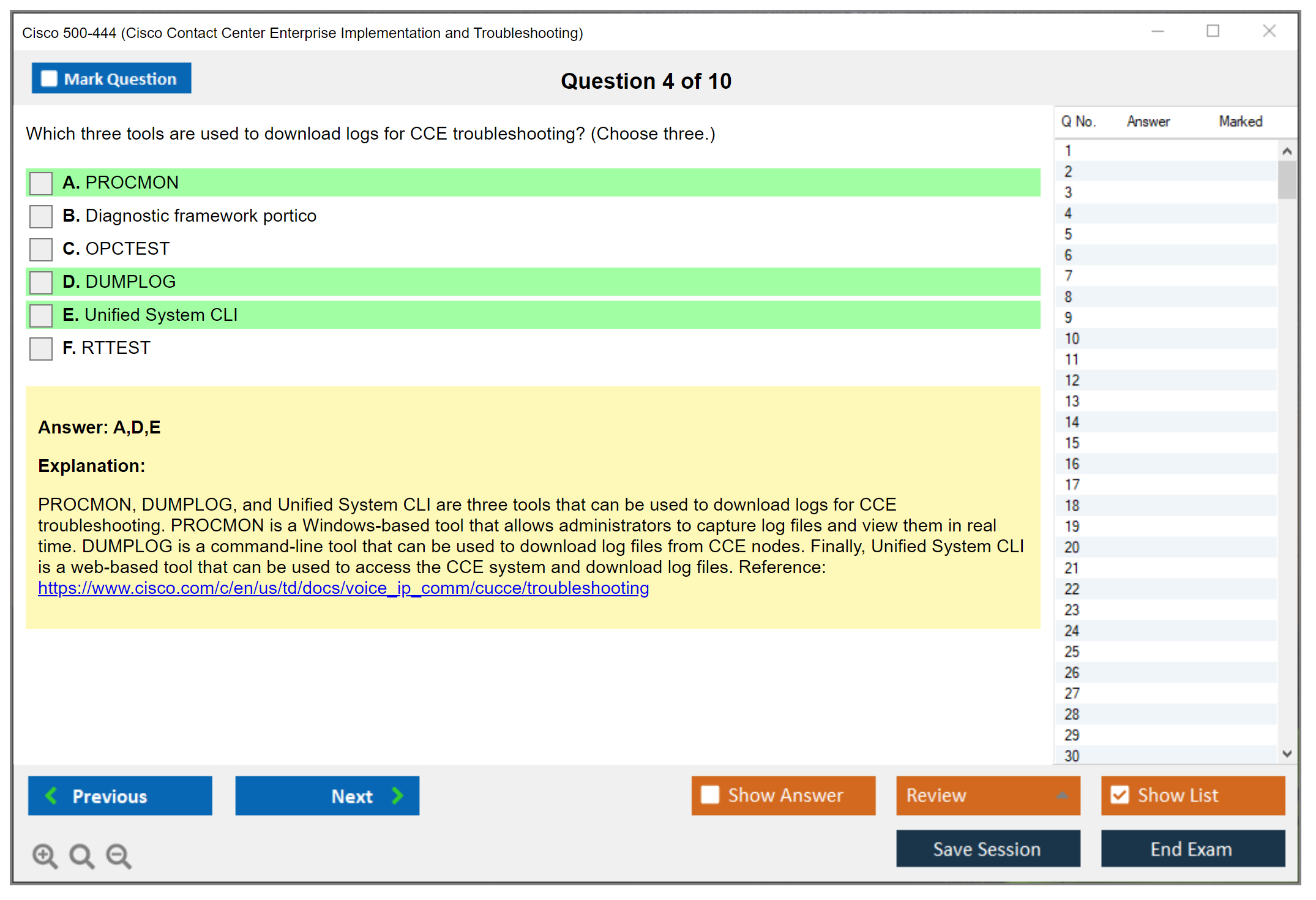
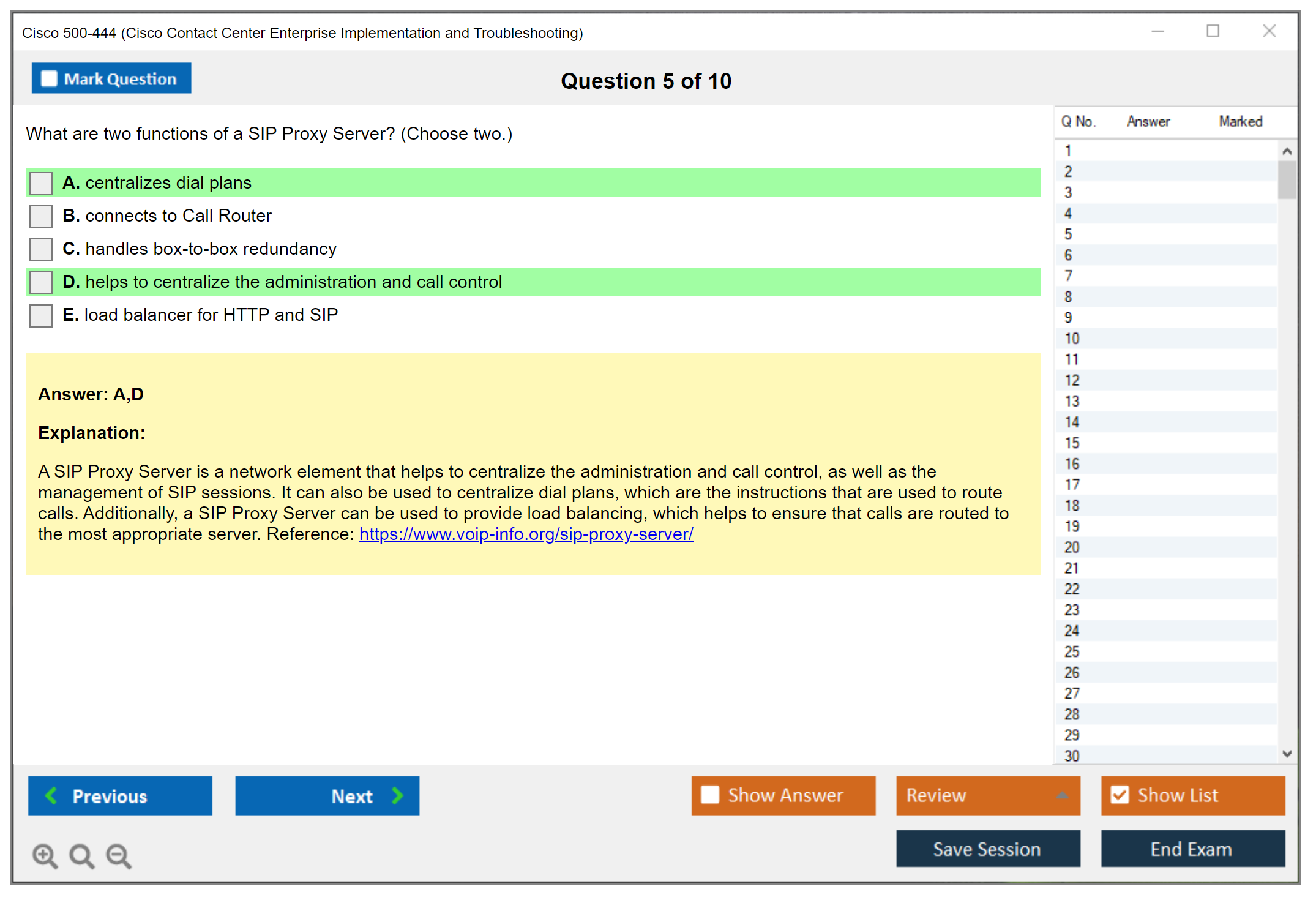
Quality practice tests should have detailed explanations. Not just answer keys. You want to understand why option C is correct and why option B looked right but actually wasn't quite there. The exam loves those "which troubleshooting step should you perform FIRST" questions where multiple answers are technically valid but only one follows proper methodology according to Cisco's framework.
If you've worked with collaboration technologies before (maybe you've already passed 300-815 or 500-325), some concepts will definitely overlap. Call routing logic, SIP troubleshooting, integration patterns, that sort of thing. But CCE is its own beast with ICM/UCCE configuration quirks you won't encounter elsewhere.
The 500-444 exam tests both implementation knowledge and troubleshooting skills simultaneously. You can't just memorize commands and expect to cruise through. You need to really understand call flow, how scripts interact with routing decisions, what happens when Finesse can't reach CTI, where to check logs when CVP calls fail inexplicably. Real-world experience is honestly the best study material you could ask for, but documentation and labs can get you surprisingly close if you're methodical and disciplined about it.
Conclusion
Getting ready for the real thing
Look, the Cisco 500-444 exam? Not something you casually wing. I mean, honestly, we're talking Contact Center Enterprise implementation and troubleshooting here. The exact stuff that either keeps production environments humming smoothly or has your pager screaming bloody murder at you when it's 3 AM and you're half-asleep. The exam objectives throw everything at you, from CVP integration and Finesse configuration to the whole ICM/UCCE setup, and the thing is, you've gotta know this material cold. Not in some theoretical "I read the chapter once" way, but in that "yeah, I've actually debugged this nightmare scenario before and lived to tell about it" kind of way.
The 500-444 exam cost? Few hundred bucks. That's not exactly pocket change for most of us, right? You definitely want to pass on your first attempt and avoid shelling out again. That means getting really serious about Cisco Contact Center Enterprise implementation and troubleshooting topics way before you hit that schedule button. Now, the 500-444 passing score isn't publicly posted anywhere (Cisco does that scaled scoring thing that nobody really understands), but most candidates I've talked to report needing to nail somewhere around 70-80% of questions to actually clear the bar. Don't quote me on those exact numbers, though. I'd plan accordingly just to be safe.
Here's what I've actually seen work. For people who pass? They build a lab environment if they possibly can, even if it's completely virtual and sort of cobbled together with spare resources. Get your hands dirty. Mess with call routing scripts, intentionally screw up a deployment on purpose, then troubleshoot your way out of the mess you created. The CCE deployment guide is really your friend here, not just some massive PDF you skim through once while drinking coffee and promptly forget.
I remember helping a friend prep for this exam last year and he kept insisting he could just memorize configuration steps without understanding the underlying logic. That went about as well as you'd expect. Failed twice before he finally buckled down and actually worked through the troubleshooting methodologies properly.
Practice tests matter. A lot. Because the question style on Cisco exams has its own weird flavor that catches people completely off guard if they're not prepared.
If you meet the 500-444 prerequisites (couple years working with UCCE or PCCE, solid networking background, decent voice experience), honestly you're already halfway there before you even open a study guide. Cisco 500-444 study materials are plentiful online, but quality varies wildly from one resource to another. You want resources that actually mirror real exam scenarios, not just those brain-dump theory sites that teach you nothing practical.
Not gonna lie here, when you're in the final stretch of prep and reviewing everything, a solid 500-444 practice test can literally be the difference between walking into that testing center feeling confident versus second-guessing yourself through all 60 questions and leaving with that sinking feeling. Check out the 500-444 Practice Exam Questions Pack if you want something that actually reflects what you'll face when you're sitting in that uncomfortable chair at the testing center staring at the screen. Good practice questions don't just test basic recall. They make you think through troubleshooting scenarios the exact way the actual exam does, which is valuable.
You've got this. Just put in the work upfront and don't cut corners.