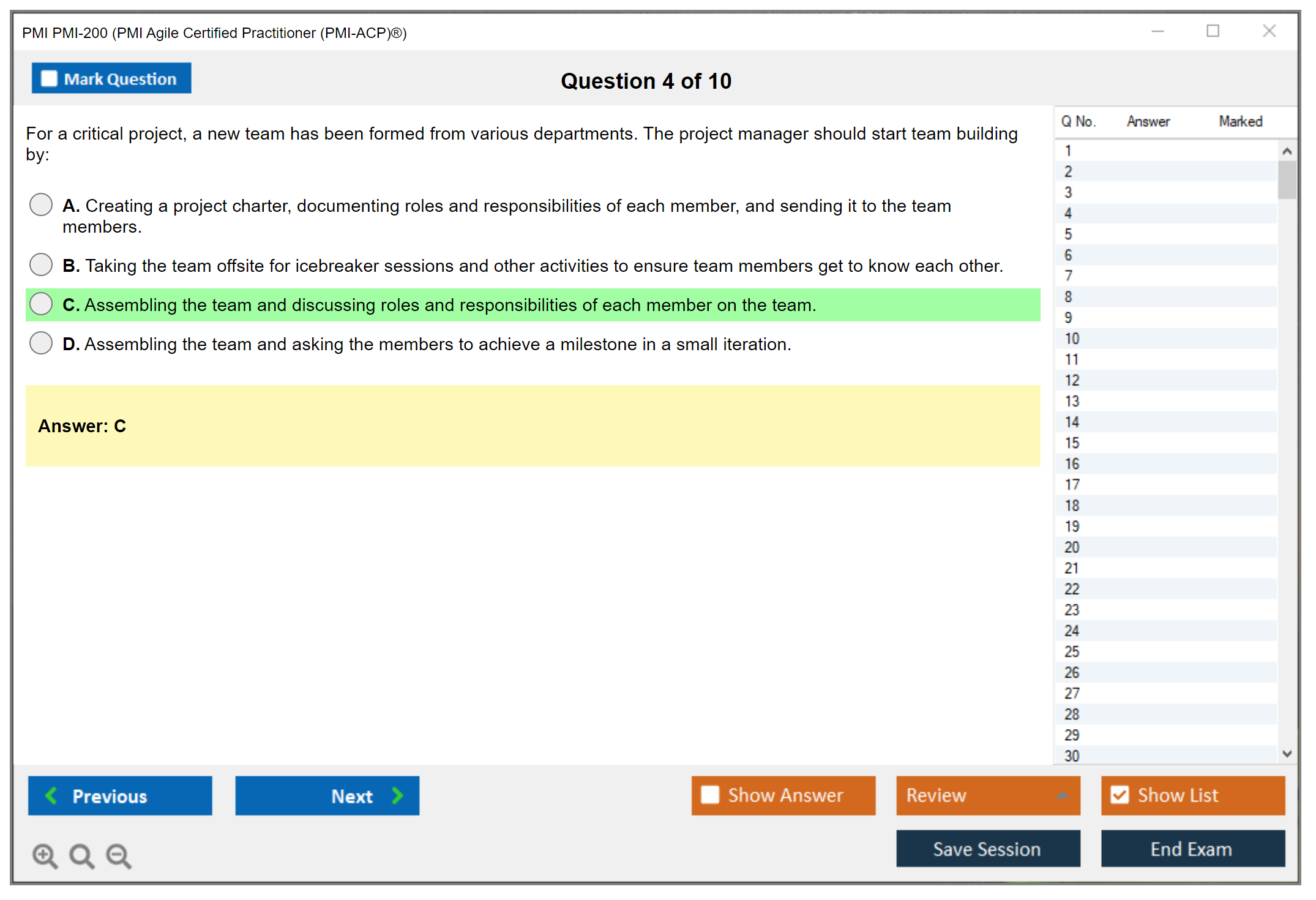
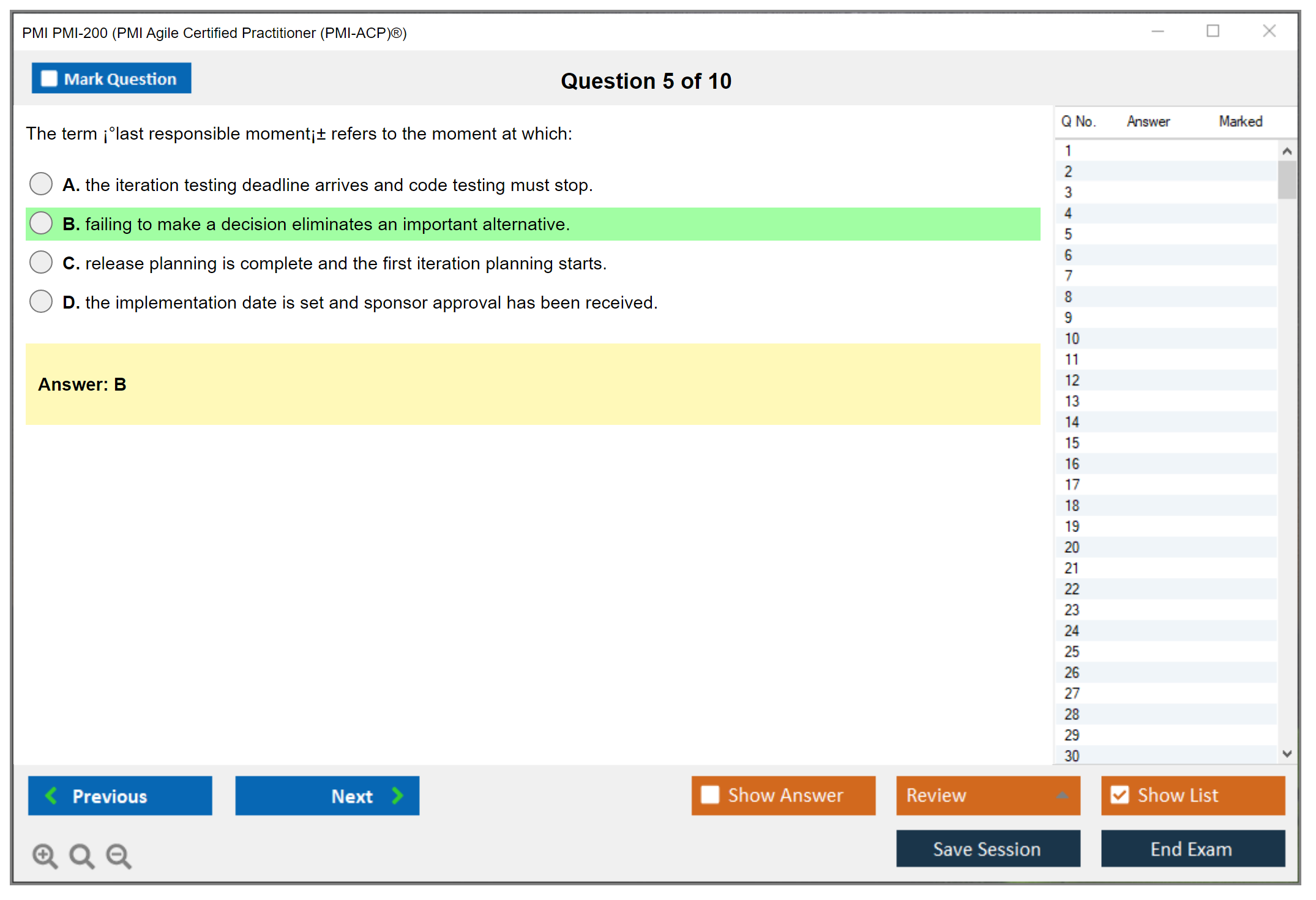
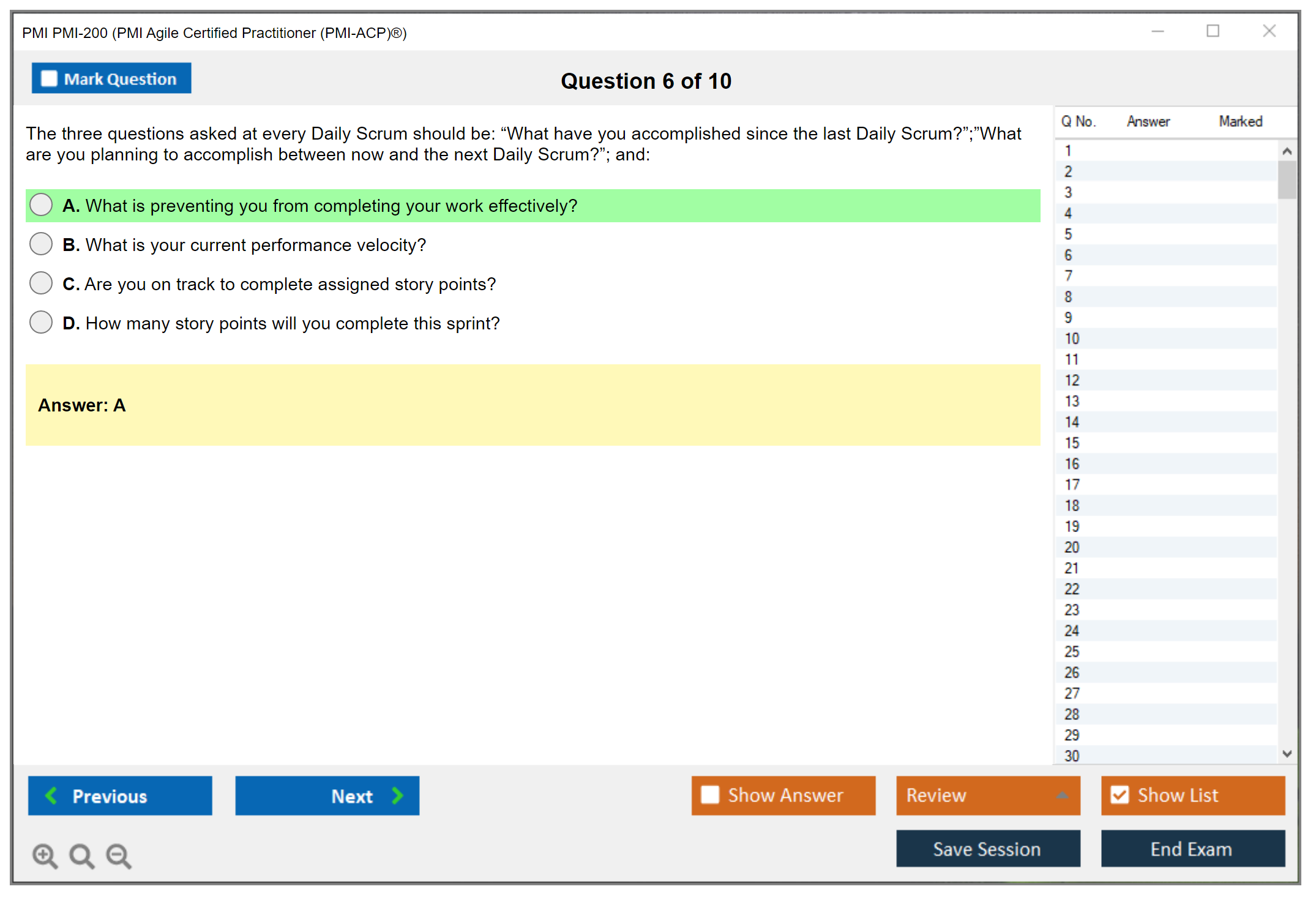
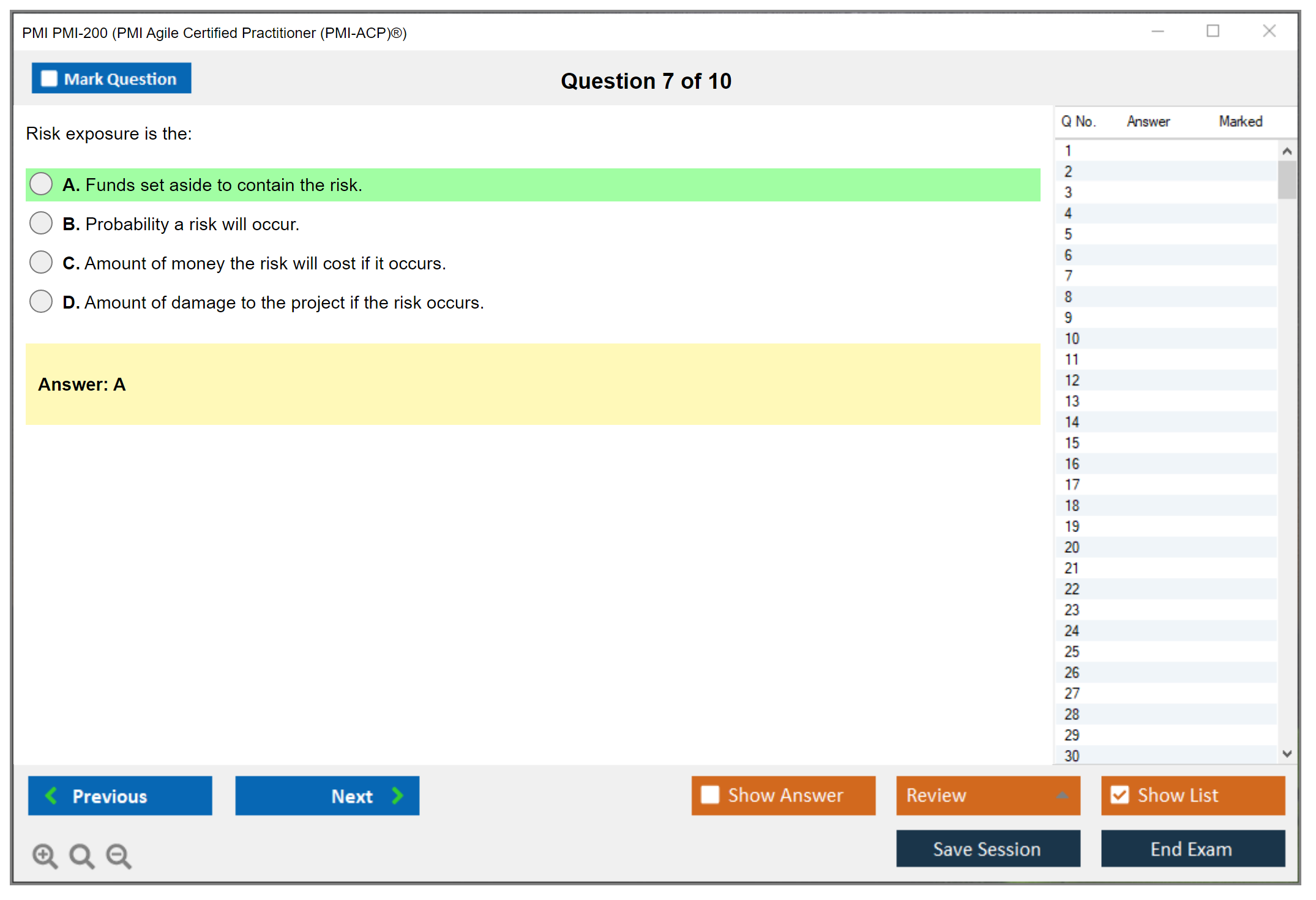
PMI PMI-200 (PMI Agile Certified Practitioner (PMI-ACP)®)
PMI-ACP (PMI-200) Exam Overview
What is the PMI Agile Certified Practitioner (PMI-ACP)®?
The PMI Agile Certified Practitioner (PMI-ACP)® certification is a globally recognized credential that validates your knowledge of agile principles, practices, tools, and techniques across multiple frameworks. CSM or PSM certifications focus exclusively on Scrum. Single-methodology approaches. But the PMI-ACP demonstrates full understanding of how different agile approaches actually work when you're dealing with real projects in unpredictable environments.
This certification is issued by the Project Management Institute (PMI), which is the world's leading project management professional association. They cover Scrum, Kanban, Lean, extreme programming (XP), test-driven development (TDD), plus other agile approaches in one exam. That's what makes it stand out. You're not locked into one framework, which is refreshing when most certifications try to convince you their way is the only way.
Employers increasingly value practitioners who can adapt to hybrid and multi-framework environments. I mean, how many organizations actually use pure Scrum or pure Kanban these days? Most teams I've seen blend approaches based on whatever works for their specific context, and the PMI-ACP reflects that messy reality. Both its strength and what makes studying for it more challenging since you can't just memorize one playbook.
The credential complements PMP certification for project managers transitioning to or integrating agile methods. If you already hold a PMP certification, adding the PMI-ACP shows you can operate in both traditional and agile environments. Exactly what most enterprise organizations need since they're rarely fully one or the other.
Who should take the PMI-ACP certification?
Scrum Masters seeking broader agile knowledge beyond the Scrum framework should absolutely consider this. You might be great at helping with sprints and managing a Scrum team, but what happens when your organization adopts Kanban for support work or wants to implement Lean principles in manufacturing? The PMI-ACP fills those gaps.
Product Owners managing backlogs across different agile methodologies benefit too. Same with project managers working in agile or hybrid project environments, agile coaches and consultants wanting recognized professional credentials, and business analysts who need to speak the language of agile delivery.
Developers and team leads benefit.
Anyone required to demonstrate formal agile competency to employers or clients should look into it. Not gonna lie, some organizations won't even interview you for senior agile roles without a recognized certification on your resume. Feels silly sometimes since certifications don't guarantee competence, but that's the hiring reality we're dealing with. You can have ten years of experience and still get filtered out by an applicant tracking system looking for three letters after your name.
Career benefits and market value of PMI-ACP
The average salary premium is 20-30% compared to non-certified agile practitioners. That's real money we're talking about, not just resume padding or bragging rights at meetups. Enhanced credibility when applying for senior agile roles or consulting engagements matters. Clients and hiring managers see PMI-ACP and know you've met rigorous standards, passed a challenging exam, and maintained ongoing education requirements.
It demonstrates commitment to professional development and ongoing learning. Sounds fluffy but actually distinguishes candidates in competitive job markets across industries where everyone has similar experience levels. The certification provides a common language and framework for working with distributed global teams, which is increasingly important as remote work becomes standard.
Some organizations specifically require PMI credentials. Period. You could be the best agile practitioner in the world, but if the job posting says "PMI-ACP required," you're not getting past the applicant tracking system without it. Frustrating but true.
How PMI-ACP differs from other agile certifications
The broader scope compared to Scrum Alliance CSM or Scrum.org PSM is the biggest differentiator. Those certifications dive deep into Scrum, which is valuable if you're only doing Scrum, but they don't cover Kanban flow metrics, Lean waste elimination, or XP technical practices in any meaningful way.
PMI-ACP has more rigorous prerequisites requiring documented agile project experience. You can't just attend a two-day workshop and walk out certified like you can with some other credentials. The framework-agnostic approach versus vendor-specific certifications means you're learning principles that apply everywhere, not just in organizations that happen to use a particular methodology or toolset.
PMI maintains the certification with ongoing PDU requirements ensuring current knowledge. You'll need to earn 30 PDUs every three years to keep your credential active, which honestly keeps you engaged with the agile community and learning new practices rather than just letting your knowledge stagnate after passing the exam. Compare that to the DASM certification which also requires ongoing learning but focuses specifically on Disciplined Agile. Another framework-specific approach.
The credential is recognized across industries, not limited to software development where most agile certifications originated. I've seen PMI-ACP holders working in construction, healthcare, finance, manufacturing. Anywhere projects happen and agility matters, which surprised me initially since I thought agile was just a tech thing. It integrates well with PMI's broader certification portfolio like PMP, CAPM, and PMI-PBA.
PMI-ACP exam code and naming conventions
The exam is officially designated as exam code PMI-200 in scheduling systems. This matters when you're booking your test appointment or searching for study materials. You'll see both "PMI-ACP" and "PMI-200" used interchangeably, which can get confusing if you're not expecting it.
The full credential name is PMI Agile Certified Practitioner (PMI-ACP)®, complete with that trademark symbol they're weirdly protective about. Here's an important distinction: PMI-ACP is the certification you earn. PMI-200 is the exam identifier you'll take to earn it. Previous exam versions may have used different codes, but PMI-200 is current as of 2026.
Your certification remains valid regardless of which exam version you took. Reassuring since PMI updates content outlines periodically to reflect evolving agile practices. You don't need to retest just because they released a new version. Once you're certified, you're certified. You just need to maintain it through PDU requirements.
PMI-ACP exam cost and fees
Look, the PMI-200 exam cost varies depending on whether you're a PMI member. Non-members pay $495 for the exam, while PMI members pay $435. That's a $60 difference. PMI membership itself costs $139 annually, so if you're taking the exam soon, the membership pays for itself immediately through the discount alone, plus you get access to member resources.
Additional costs include required agile training (21 contact hours minimum), which can range from free online courses to $1,500+ instructor-led programs depending on quality and format. Study materials run another $50-200 for books and practice tests. Wait, actually decent practice exams alone can be $100+. Retake fees are $375 for members and $425 for non-members if you don't pass on the first attempt. Painful on top of the original fee.
Honestly, budget around $800-1,200 total if you're starting from scratch with no agile training completed. That includes membership, exam fee, a decent prep course, and study materials. Not counting your time investment, which is substantial. It's not cheap, but compared to some IT certifications that cost several thousand dollars, it's reasonable. Though that doesn't make it easy to justify if you're self-funding.
PMI-ACP prerequisites and eligibility requirements
You need a secondary degree (high school diploma or equivalent) as the baseline education requirement. Pretty standard. Then comes 2,000 hours of general project experience working on project teams within the last five years. This doesn't have to be agile work. Any project experience counts here, which helps since not everyone started their career in agile environments.
On top of that, you need 1,500 hours of agile project experience working on agile project teams within the last three years specifically. These hours can overlap with your general project experience, which helps mathematically, but you've still got to document everything clearly. Twenty-one contact hours of agile training are required before you can even submit your application. No exceptions.
The application and audit process works like this: you submit your application online with detailed information about your experience and training. Dates, project descriptions, your specific roles. PMI randomly audits about 10-15% of applications, so keep documentation ready. Training certificates, supervisor contact information, project details, everything. If you're audited and can't provide proof within the timeframe they give you, your application gets denied and you lose the fee. Brutal.
PMI-ACP exam objectives and content outline
The exam covers seven domains with different weightings that you need to memorize for strategic studying. Agile principles and mindset gets about 16% of questions. Value-driven delivery takes roughly 20%, stakeholder engagement around 17%, team performance maybe 16%, adaptive planning around 12%, problem detection and resolution about 10%, and ongoing improvement roughly 9%. Though these percentages can shift slightly between exam versions.
Key frameworks covered include Scrum (obviously, it's everywhere), Kanban for flow management and visualizing work, Lean for waste elimination and value optimization, extreme programming for technical practices like pair programming and integration, and test-driven development for quality assurance built into the development process. You'll also see questions on crystal methods, feature-driven development, and agile modeling, though these appear less frequently since fewer organizations actually use them in practice.
The weighting tells you how to prioritize study time if you're strategic about it. Spend more hours on value-driven delivery and stakeholder engagement since they represent larger portions of the exam. That's basic test-taking math. Don't ignore the smaller domains completely, but allocate your study time proportionally to maximize your chances of passing.
PMI-ACP exam format, duration, and scoring
You'll face 120 questions with three hours to complete the exam. That's 90 seconds per question on average, which sounds generous but goes faster than you think when you're reading scenario-based questions with four plausible answer choices where three sound almost correct and you're second-guessing yourself.
All questions are multiple-choice with four options. No true/false, no matching, no essays, which is merciful. The exam uses computer-based testing at Pearson VUE centers or online proctoring from home. I mean, online proctoring has become the default for most people. You save travel time and can test in your own environment, though the technical requirements and monitoring can feel intrusive when someone's watching you through your webcam for three straight hours.
PMI-ACP passing score: what you need to know
PMI doesn't publish a fixed passing score. Frustrates everyone preparing for the exam and makes studying feel like aiming at an invisible target. They use psychometric analysis and scaled scoring, meaning the passing threshold can vary slightly between exam forms to maintain difficulty across different versions. Your score report shows performance as "Above Target," "Target," or "Below Target" in each domain rather than a numerical score or percentage. Less stressful and more ambiguous at the same time.
Most candidates need to answer roughly 65-70% of questions correctly to pass, based on community feedback and experience from people who've tracked their practice exam scores against their actual results. But that's not official, and you can't bank on it being accurate for your specific exam form. The exam adaptively adjusts difficulty, so you might see harder questions if you're performing well or easier ones if you're struggling. Though honestly, I'm not sure how much the difficulty actually adjusts in practice.
How do you gauge readiness without an official cut score? Getting 75% or higher on quality practice tests is a good indicator that you're ready. If you're barely hitting 65% on practice exams, you're not ready. The real exam often feels harder than practice tests because of time pressure and stress, so give yourself a buffer.
Similar certifications like the PMI-PBA and PMI-RMP use the same scoring approach, so if you've taken other PMI exams, you know what to expect and won't be surprised by the format. The ambiguity around passing scores is just something you have to accept with PMI certifications. Frustrating, but complaining doesn't change it.
PMI-ACP Exam Cost and Fees
PMI-ACP (PMI-200) exam overview
What is the PMI Agile Certified Practitioner (PMI-ACP)®?
The Agile Certified Practitioner certification is basically PMI's way of saying "yeah, you actually know agile," and honestly, this PMI-ACP exam (PMI-200) guide you're reading right now is mostly about what it'll cost you to prove that knowledge on paper.
Here's the thing. This exam doesn't marry one framework. Scrum shows up. Kanban shows up. XP and Lean too. That mix? That's literally the entire point.
Who should take the PMI-ACP certification?
If you're working on agile teams and you're tired of watching your resume get filtered out because you don't have the "right" acronym next to your name, PMI-ACP is a practical pick. It tends to fit Scrum Masters, delivery leads, agile project managers, and product-ish folks who basically live in backlogs and stakeholder chaos. Works well if you're stuck in a hybrid org where agile and "we still need a Gantt chart" somehow coexist.
Look, if you're brand new to agile, you can still aim at it. The exam assumes you've seen real projects, real tradeoffs, real constraints. Also those annoying questions where two answers feel correct but one is "more PMI-ish."
PMI-ACP exam cost and fees
PMI-ACP exam fee (PMI member vs non-member)
For the PMI-ACP exam fee structure for 2026, here's the clean breakdown:
PMI member pricing. $435 USD. Initial attempt.
Non-member pricing. $495 USD. Initial attempt.
That's a $60 difference, which is why people constantly ask about the PMI-200 exam cost and whether membership is "worth it." The exam fee includes the computer-based testing fee, so you're not getting slammed with some surprise testing center add-on charge at checkout. Refreshing in certification land, honestly.
Additional costs (PMI membership, training, retake fees)
PMI membership itself costs $139 annually plus a $10 one-time application fee. So yeah, you're not magically saving money in year one if you only care about the exam discount, because you pay $149 to save $60.
But. Here's the real math.
If you join anyway, you're offsetting part of that first-year membership, and you get the extra member perks while you're studying. My recommendation is simple: join PMI before applying for the exam so you snag member pricing from the start and you don't have to play the "can PMI refund the difference" game later.
Retakes matter too. Not gonna sugarcoat it. Plenty of solid practitioners fail because they underestimate how scenario-heavy it is and how picky PMI can be about "best next action." Retake pricing within your one-year window is:
- First retake: $335 (member) or $375 (non-member)
- Second and third retakes: same pricing as the first retake
- You get three attempts per application. The fourth try requires a brand-new application and paying the full exam fee again
One detail people miss: that one-year window starts when your application is approved, not when you schedule your first attempt. If you apply early and procrastinate, the clock is still ticking. After three failed attempts, reapplication is basically starting over with the full fee and another application review.
PMI membership benefits beyond exam discount
The discount is the headline. The other stuff is the reason I tell people to join if they can swing it.
You get access to PMI's digital library with standards, templates, and research papers. That can be surprisingly useful when you're trying to interpret what PMI thinks "agile governance" means, because the exam vibe is not always the same as how your team actually operates on a Tuesday afternoon. I once spent an hour in their library just trying to figure out how PMI defines "servant leadership" versus how my last boss defined it, which was basically "do whatever I say but with more smiling." Different universes.
Other benefits, quick hits:
- Free or discounted webinars, virtual events, local chapter meetings
- Networking through chapters and online groups
- Discounts on future PMI certs and renewal fees
- Monthly access to PM Network magazine and other publications
- Career resources like job boards and salary surveys
The networking part? That's the one I'd actually explain. If you show up to a chapter meetup and talk to people who are hiring, you'll hear what they really want when they say "agile." That feedback loop can influence what cert you do next, how you write your experience for the PMI-ACP application process, and how you position your work so you're not stuck arguing about whether your title was "project manager" or "delivery lead."
PMI-ACP prerequisites and eligibility requirements
Education requirements
PMI expects a secondary degree (think high school diploma or global equivalent) at minimum. If you've got a bachelor's degree, cool. The exam isn't "degree gated" the way some people assume.
Agile project experience requirements
You'll need agile project experience hours. The exact hour requirements depend on PMI's current rules, so always cross-check the latest PMI-ACP eligibility requirements on PMI's site before you submit. PMI updates wording and audit expectations more often than blogs get refreshed.
General project experience requirements (if applicable)
Some candidates also need general project experience hours, depending on their background and what PMI counts. Again, check the current PMI-ACP prerequisites (experience and training) page because "general project experience" gets interpreted differently by candidates than by auditors.
Required agile training/contact hours
You need 21 contact hours of agile training. This is the cost bucket that swings your total budget the most. Training pricing is all over the place.
How the application and audit process works
You submit experience and training. PMI approves it. Or audits it.
Audits aren't a moral judgment. They're paperwork. If you get audited, you'll provide proof of training and experience. If your training provider is legit and your experience write-up is clear, it's annoying but survivable.
Required training costs (21 contact hours)
Training options, typical ranges:
- Self-paced online courses: $200 to $500 for a full prep program
- Instructor-led virtual training: $800 to $1,500 for multi-day bootcamps
- In-person classroom training: $1,200 to $2,500 depending on provider and location
- Free or low-cost options: YouTube tutorials, webinars, employer-provided training
One thing to slow down on: many prep courses bundle the 21 contact hours with study materials and practice exams. That bundling can be a good deal if you were gonna buy a question bank anyway.
Also, make sure the provider is a PMI Registered Education Provider (R.E.P.) if you want "guaranteed acceptance" vibes for the hours. Honestly, lots of non-R.E.P. training is fine. If you're trying to avoid audit stress, R.E.P. is the low-drama route.
PMI-ACP exam objectives and content outline
PMI-ACP domains and task areas (what you're tested on)
The PMI-ACP exam objectives are basically PMI's way of testing whether you can make good decisions across the agile lifecycle. Expect questions on team performance, stakeholder engagement, adaptive planning, problem detection, improvement, and delivering value. It's less "define Scrum" and more "your stakeholder wants X, your team velocity is Y, what do you do next."
Weighting by domain (how to prioritize study)
PMI publishes a content outline with domain weightings. Use it. If you ignore it, you'll over-study your favorite framework and under-study the areas where PMI can trick you with wording.
Key agile frameworks covered (Scrum, Kanban, Lean, XP, etc.)
Scrum. Kanban. Lean. XP. Some SAFe-ish concepts show up in the wild too, but the exam isn't a SAFe cert. The exam likes principles more than brand names, so make sure you can reason about flow, WIP limits, feedback loops, and quality practices. Not just ceremonies.
PMI-ACP exam format, duration, and scoring
Number of questions and time limit
PMI can change details, so verify the current PMI-ACP exam format and duration on the official page before scheduling. In general, expect a timed, computer-based exam with a lot of situational questions that reward calm reading more than frantic memorization.
Question types and exam delivery (online vs test center)
You can typically take it via online proctoring or at a test center. The cost is already baked into the exam fee, so choose based on your environment. If your home setup is noisy or your internet is sketchy, pay for the commute and take the test center.
PMI-ACP passing score (what PMI discloses vs what candidates should know)
People obsess over the PMI-ACP passing score. PMI doesn't publish a fixed cut score, so you can't aim for "X percent and I'm safe" the way some other exams work.
PMI-ACP passing score: what you need to know
Why PMI doesn't publish a fixed passing score
PMI uses psychometric scoring and exam forms vary. Translation: your exam may not match your friend's exam exactly. PMI wants flexibility.
How to gauge readiness without an official cut score
Use practice tests and consistency. If you're doing timed sets and scoring comfortably in a range you can repeat across multiple exams, you're probably fine. If your scores swing wildly depending on domain, don't schedule yet.
Study material and practice test costs
Here's the typical shopping list for PMI-ACP study materials and PMI-ACP practice tests:
- Official PMI-ACP Exam Prep book: $40 to $60
- Third-party study guides: $30 to $80 each (I'd stick to one or two good ones, not a whole shelf)
- Practice exam simulators: $50 to $150 for 500-plus question banks
- Flashcard sets and mobile apps: $10 to $30
- All-in-one prep bundles: $300 to $800 (training, books, practice tests, coaching)
If you're budget-conscious, you can do this in $150 to $300 total by picking one solid book, one good question bank, and using free videos to fill gaps. The trap is buying five resources and finishing none.
PMI-ACP exam difficulty (realistic expectations)
What makes the PMI-ACP challenging
The PMI-ACP exam difficulty is mostly about ambiguity. Multiple answers sound reasonable. PMI wants the "best" agile response that matches their principles, often involving transparency, collaboration, and addressing root causes over quick fixes.
Common reasons candidates fail
Rushing the reading. Ignoring the content outline. Memorizing terms only.
Another big one? Treating agile like a set of rituals instead of a way to make decisions under uncertainty. The questions punish cargo-cult Scrum hard.
PMI-ACP vs PMP difficulty (high-level comparison)
Compared to PMP, PMI-ACP usually feels less math-y and less process-heavy, but more "judgment call" heavy. If PMP is about controlling scope and managing change formally, PMI-ACP is about adapting while still being disciplined. That mental shift trips people up.
Total investment estimate for PMI-ACP certification
Here's what most people actually spend, all-in:
- Minimum budget: $600 to $800 (membership, exam, basic materials)
- Moderate budget: $1,200 to $1,800 (quality training plus thorough prep)
- Premium budget: $2,000 to $3,000 (bootcamp, multiple resources, coaching)
Long-term value is real if you use it. In many markets, the credential can pay for itself within three to six months through a raise, a job change, or just getting past HR filters. Assuming you already have experience and you can interview well.
PMI-ACP renewal and maintaining certification
Renewal cycle length
PMI certifications renew on a cycle (verify current timing on PMI's site). Don't ignore this part, because you don't wanna be the person who passes the test and then lets it expire.
PDUs required and qualifying activities
You'll need PDUs for PMI-ACP renewal requirements (PDUs). Webinars count. Chapter events count. Some work activities can count. Track them as you go instead of trying to recreate a year of learning from memory.
Renewal fees and reporting PDUs in CCRS
There's a renewal fee, and you report PDUs in PMI's CCRS system. Membership can reduce renewal costs, which is another quiet reason the "membership is pointless" argument doesn't hold up if you plan to stay in the PMI world.
What happens if your certification expires
It lapses. You scramble. You pay more.
Sometimes you can reinstate within a grace period. Don't build your plan around grace periods.
PMI-ACP FAQ
How much does the PMI-ACP (PMI-200) exam cost?
$435 for PMI members and $495 for non-members for the initial attempt in 2026, with computer-based testing included.
Is there a passing score for the PMI-ACP exam?
PMI doesn't publish a fixed PMI-ACP passing score, so treat readiness as repeated practice test performance plus strong coverage of the exam objectives.
How hard is the PMI-ACP compared to PMP?
Different hard. PMI-ACP is more scenario and principle-driven, PMP is more process and control-driven. Your background decides which one feels worse.
What are the PMI-ACP prerequisites and required experience hours?
You need education, agile experience hours, and 21 contact hours of agile training. Check PMI's current page for the exact hour requirements because that's the part that can change.
How do you renew PMI-ACP and how many PDUs are needed?
You renew by earning and reporting PDUs in CCRS and paying the renewal fee. The exact PDU count is defined by PMI's current renewal rules, so confirm it before you plan your year.
Best practice test score targets before scheduling the exam
If you're not stable across multiple full-length exams, don't schedule. I mean stable, not one lucky score at 2 a.m. after memorizing answer patterns.
How long does PMI-ACP preparation typically take?
Two weeks if you're already living agile daily and you test well. Eight weeks if you need to rebuild fundamentals, learn PMI wording, and grind practice questions without burning out.
PMI-ACP Prerequisites and Eligibility Requirements
Educational background requirements
PMI keeps things simple here. You need a secondary degree, that's it. High school diploma, associate's degree, or whatever your country's equivalent is. They're not demanding a bachelor's in computer science or anything fancy like that. Any discipline works, honestly. Medieval literature? Sure. Automotive repair? Absolutely fine. Doesn't matter one bit.
The global equivalent part actually matters more than you'd think, because PMI operates worldwide and they get that educational systems vary wildly from place to place. Finished secondary education in India, Brazil, Germany, wherever? You're good to go. Just be ready to prove it if PMI decides to audit your application, and honestly, they audit maybe 10-15% of submissions randomly. Not super common but definitely happens.
One thing that's different from the PMP certification? There's no alternative pathway here. With PMP, if you lack a four-year degree, you can compensate with additional experience hours. Not here though. No secondary education means no PMI-ACP eligibility, period. PMI might request your diploma or transcript during the audit process, so don't toss those documents in a box somewhere in your basement. My cousin actually had to call his old high school three times to get a copy when PMI came knocking, and apparently the registrar kept insisting they'd already sent it when they hadn't. Nightmare.
General project experience requirements
Here's where it gets interesting.
You need 2,000 hours of general project experience within the last five years. That's roughly 12 months of full-time work, though the calculation gets a bit fuzzy depending on how you slice it. These hours can come from any project type: waterfall, agile, hybrid, whatever you've got in your background. The key word is "general." This requirement exists to make sure you understand basic project dynamics before diving into agile-specific territory, which makes sense when you think about it.
Part-time work counts. This is huge for a lot of folks trying to break into this field or juggling multiple commitments. PMI tracks hours, not calendar months. Worked 20 hours a week on projects for two years? That's your 2,000 hours right there, all accounted for. Volunteer work counts too, as long as you document it properly and someone can verify it, which brings up the whole reference situation we'll get to later.
Your role doesn't need to be fancy or executive-level. Team member works just fine. Developer, tester, business analyst, product owner, project manager, all acceptable. If you participated in project work in any meaningful capacity, you probably qualify, I mean, the bar isn't crazy high. Multiple projects across different organizations? Totally acceptable. Changed industries three times? Doesn't matter.
Now here's the catch that trips people up constantly. These 2,000 hours must be distinct from your agile experience hours, no double-counting whatsoever. If you worked 1,500 hours on an agile project, you can't also count those same hours toward your 2,000 general hours. You need 3,500 total hours for most candidates. That's 2,000 general plus 1,500 agile-specific, which sounds like a lot but accumulates faster than you'd expect.
There's one exception worth knowing about. If you already hold an active PMP or PgMP certification, PMI waives the 2,000-hour general experience requirement entirely, which is pretty generous of them. They figure you've already proven your project chops through those rigorous certifications. You still need the 1,500 agile hours though. That's non-negotiable for everyone, regardless of what other credentials you've earned.
Agile project experience requirements (the critical component)
This is the big one, honestly.
1,500 hours of agile project experience earned within the last three years. Notice the tighter window. Three years versus five for general experience, which catches people off guard sometimes. That's approximately eight months of dedicated agile work, and it must be recent, not from some project you did back in 2015.
Not gonna lie, "agile project experience" has a specific meaning here that PMI's pretty strict about. You can't just claim you read about Scrum and called your waterfall project "agile" because you had some shorter milestones. PMI expects you worked on teams actively using agile methodologies in real, practical ways. Scrum, Kanban, Lean, XP, Crystal, DSDM, FDD, any recognized framework counts toward this requirement. Hybrid approaches work too, as long as there's genuine agile practice involved rather than just agile theater.
Active participation matters here. You can't observe sprint planning from the hallway or glance at the Kanban board occasionally and count those hours. Were you in daily standups? Did you participate in retrospectives? Work with user stories and acceptance criteria? Contribute to sprint demos or reviews? That's the kind of involvement PMI expects to see documented.
Your role could be anything on the agile spectrum. Scrum Master, Product Owner, development team member, agile coach, QA engineer working in sprints. The thing is, even business analysts or stakeholders who actively participated in agile ceremonies can count hours, as long as they weren't just occasionally dropping by to check status or demand features without engaging in the actual process.
Documentation becomes key during audits, trust me on this. You should be ready to describe which sprints or iterations you worked in, what agile artifacts you created or used (backlogs, burndown charts, kanban boards), which ceremonies you attended regularly. Vague descriptions like "worked on agile stuff" won't cut it if PMI comes knocking with verification requests.
And remember, these 1,500 hours sit on top of your 2,000 general hours. They don't replace them. Even if you hold a PMP, you still need these agile-specific hours documented and verified. PMI wants proof you've actually done agile work, not just read about it or attended a conference session. If you're currently working on agile projects and trying to hit 1,500 hours, keep detailed records now. Future you will thank present you when audit time comes around.
Required agile training (21 contact hours)
Before you can even submit your application, you need 21 contact hours of agile-specific training completed. One contact hour equals 60 minutes of structured learning, breaks excluded, so yeah, that's 21 full hours of actual instruction time, not just sitting in a room with agile materials nearby.
The training must cover agile principles, practices, tools, and techniques in a structured curriculum. Most exam prep courses designed for the PMI-ACP naturally fulfill this requirement since they're teaching you what you need to know anyway for the actual test. Instructor-led classroom training works perfectly. Virtual instructor-led sessions count just the same. Self-paced online courses work if they include assessments and come from legit providers that PMI recognizes.
Here's what doesn't count: reading the Agile Practice Guide on your couch, watching random YouTube videos about Scrum, chatting with your agile coach over coffee about sprint retrospectives. PMI wants structured curriculum from PMI Registered Education Providers (R.E.P.s) or documented training programs with verifiable completion certificates that have actual accountability built in.
You'll need those certificates during an audit. Absolutely necessary. Keep every PDF, every completion email, every piece of documentation you receive. I've seen people scramble to track down training records from two years ago when PMI audits them. Not fun, believe me. Some training providers only keep records for a limited time, so download and save everything immediately to your own storage.
Many candidates knock out this requirement while studying for the exam anyway, which is smart time management. A thorough PMI-200 practice test prep course typically provides 21+ contact hours, so you're getting exam preparation and meeting the prerequisite at the same time. Just verify your chosen course is from an approved provider and explicitly states it provides PMI contact hours or PDUs before you spend money on it.
How the application and audit process works
The application itself lives on PMI.org. Create an account, start filling out forms. Pretty straightforward interface. You'll document your 2,000 general project hours by listing project names, dates, your role, brief descriptions of what you actually did. Same deal for your 1,500 agile hours, except you'll specify which methodologies you used and what agile artifacts or practices were involved in those specific projects.
For each experience entry, provide supervisor or colleague contact information. Someone who can verify you actually did what you claim without hesitation. Use current contact info if possible, not outdated emails from companies that've been acquired or restructured. Nothing delays an audit like PMI trying to reach a supervisor who left the company three years ago and nobody knows where they went.
Enter all your training details: provider name, course title, dates, contact hours awarded. Double-check everything before submitting. Application errors cause delays and sometimes outright rejections, which means restarting the whole process.
Once you submit with the non-refundable payment (ouch), PMI typically processes applications in 5-7 business days if you're not audited. But 10-15% of applications get randomly selected for audit immediately. It's like a lottery you don't want to win. You'll know right away though. PMI sends an email if you're chosen, usually within a day of submission.
The audit gives you 90 days to submit documentation, which sounds generous but can feel tight if you're scrambling to locate old records. They'll want training certificates, verification letters from supervisors, detailed project descriptions that go beyond what you initially submitted. Verification letters need supervisor contact info, project dates, your role, hours worked, and specific activities. Signed letters required, though scanned copies work fine. They don't need physical mail.
Incomplete documentation gets rejected without much sympathy. Unsatisfactory explanations get rejected. Take the audit seriously from day one. If you prepared your documents before applying (smart move), the audit becomes a minor inconvenience rather than a panic-inducing scramble where you're calling former colleagues you haven't spoken to in years.
After submitting complete audit materials, approval typically takes 5-10 business days assuming everything checks out. Then you can finally schedule your exam and move forward with the actual testing process. Many candidates preparing for certifications like CAPM or PMI-PBA learn this lesson the hard way: gather documentation first, apply second, never the other way around.
Common prerequisite pitfalls to avoid
The biggest mistake?
Counting the same hours for both requirements. Your 1,500 agile hours must be separate from your 2,000 general hours. Period. PMI explicitly prohibits double-counting in their application guidelines, and auditors catch this constantly because it's such a common attempt to inflate qualifications.
Second biggest mistake is submitting training from non-approved providers thinking PMI won't notice or care. Your buddy's agile workshop at a local meetup probably doesn't count, even if it was really educational and you learned valuable skills. Stick with R.E.P.s or well-documented training programs that explicitly provide PMI contact hours with proper certification.
Inflating hours or fabricating experience seems tempting when you're close but not quite there. Maybe you're at 1,300 agile hours and figure rounding up won't hurt. Don't do it. PMI verifies information through your references, and ethics violations can get you banned from all PMI certifications permanently, not just the PMI-ACP. Not worth torching your entire project management career trajectory over a few hundred hours.
Watch those time windows carefully. Agile experience older than three years doesn't count, even if it was fantastic, modern experience at the time. General experience older than five years? Also doesn't count anymore. If your experience is aging out, accumulate new hours before applying rather than hoping PMI won't check dates.
Some people apply before they've actually accumulated required hours, thinking they can finish up while the application processes or during the audit window. Nope, doesn't work that way. All hours must be complete before submission. PMI checks dates during verification, and premature applications get automatically rejected with no refund.
Finally, incomplete supervisor contact info makes verification impossible during audits, which tanks your application. "Bob from accounting" doesn't help PMI reach anyone. They need full names, titles, email addresses, phone numbers that actually connect. Make sure your references actually remember you and would respond positively to PMI's inquiries. Awkward if they don't.
The prerequisites might seem bureaucratic and overly detailed, but they make sure PMI-ACP certified practitioners actually have hands-on agile experience rather than just theoretical knowledge from books. Once you're through the application maze, you can focus on the actual exam preparation. And trust me, having solid prerequisites behind you makes studying for the PMI-200 much less stressful since you're not worried about your application getting rejected halfway through your prep.
PMI-ACP Exam Objectives and Content Outline
PMI-ACP (PMI-200) exam overview
What is the PMI Agile Certified Practitioner (PMI-ACP)®?
The PMI-ACP is PMI's Agile Certified Practitioner certification. The exam behind it? PMI-200.
It's not a "Scrum-only" badge. More like proving you can run agile delivery in the messy, chaotic real world where nothing goes according to plan, not just recite a framework word-for-word like you're reading from a textbook.
It also shows up in hiring conversations because it's vendor-neutral, which matters more than people think. Some orgs want Scrum certs, others want SAFe, and a lot of places want someone who can translate between product, delivery, and leadership without turning every meeting into a methodology debate that makes everyone want to quit.
This cert's aimed right at that.
Who should take the PMI-ACP certification?
If you're a Scrum Master, agile project manager, delivery lead, product owner, BA working in agile, or even an engineering manager who keeps getting pulled into planning and stakeholder wrangling, the PMI-ACP exam (PMI-200) guide is relevant. Your day job includes backlog prioritization? Iteration planning, reviews, and dealing with "but we need a fixed scope" conversations? You're already living inside the exam objectives.
Beginners can study it, sure.
Without real agile exposure though, the scenario questions feel like a foreign language. You can brute-force memorization, but PMI tends to test judgment, not trivia.
PMI-ACP exam cost and fees
PMI-ACP exam fee (PMI member vs non-member)
People ask about PMI-200 exam cost because it's not pocket change. PMI pricing moves around, so check PMI.org for the current number, but it's typically cheaper if you're a PMI member than if you aren't. Membership itself costs money. Do the math based on whether you'll also want discounts on other exams, access to standards, and local chapter stuff. Worth it?
Depends on your situation.
Additional costs (PMI membership, training, retake fees)
Training isn't "optional" in the eligibility sense, because you need the contact hours. Retakes also cost extra. Then there's the quiet spending nobody budgets for: a decent question bank, maybe the best PMI-ACP prep course if you learn better with structure, and a book or two that actually matches how PMI writes questions. Adds up fast.
PMI-ACP prerequisites and eligibility requirements
Education requirements
PMI-ACP eligibility requirements include a basic education requirement (secondary degree or higher). PMI's wording can be specific, so read their current handbook. Don't assume anything.
Agile project experience requirements
PMI-ACP prerequisites (experience and training) include documented agile project experience hours. This is where people mess up their application. The hours need to be real, and they need to be tied to agile work, not "I attended standups once" or some vague description that sounds like you watched agile happen from across the room.
General project experience requirements (if applicable)
Depending on PMI's current rules, there can also be a general project experience component. Sometimes your agile experience can overlap with general project experience, sometimes it can't. Read the latest PMI instructions before you submit, because this trips people up constantly.
Required agile training/contact hours
You need agile training/contact hours from a course, workshop, or program PMI accepts. Keep proof. If you get audited, you'll want completion certificates, dates, and provider details ready, not "I think I took something in 2019."
How the application and audit process works
The PMI-ACP application process is mostly you describing your experience clearly, with dates, hours, and what you did. Not a novel. Just clear.
PMI can audit you, randomly. Not a scandal. Just paperwork. If you've been honest and you kept records, it's annoying but survivable.
PMI-ACP exam objectives and content outline
PMI-ACP domains and task areas (what you're tested on)
The heart of your prep? The PMI-ACP exam objectives, and PMI lays them out in the Examination Content Outline (ECO).
PMI publishes a detailed ECO and updates it periodically. The current version referenced by PMI is the 2026 ECO, which is the blueprint for everything that matters. It defines the task domains, the tasks inside each domain, and the knowledge and skills the exam expects. Yes, the exam questions are mapped back to those tasks. So if you're studying "random agile trivia" that doesn't connect to an ECO task? You're probably wasting time.
The ECO is based on a role delineation study surveying thousands of agile practitioners globally, which is PMI's way of saying, "we didn't invent this in a conference room." And it's software development. You'll see concepts that fit marketing, ops, compliance-heavy environments, and hybrid orgs that are trying to act agile while still reporting like it's 2009.
The ECO's also a free PDF download from PMI.org. Nice, right? You really should treat it as required reading, not optional reference material.
My cousin worked at a healthcare company where they tried going agile while simultaneously using waterfall templates for every deliverable. The project managers literally had to maintain two sets of documentation because the compliance team refused to accept working software as proof of progress. That's the kind of environment these exam questions pull from, not some perfect Silicon Valley startup where everyone's already bought in.
Weighting by domain (how to prioritize study)
PMI weights domains. That means your study plan should be weighted too, unless you enjoy spending three nights on a topic that might show up twice.
Here are the domains and what they mean in real prep terms.
Domain I: Agile principles and mindset is 16 percent of the exam, about 24 questions. This is where PMI checks whether you actually think in agile terms, or you're just doing ceremonies because someone told you to. Advocate for agile principles inside the organization. Promote shared understanding. Defend agile principles when challenged by traditional project management approaches. Support experimentation and learning culture. This domain's heavy on Agile Manifesto values and principles, servant leadership, empiricism, and self-organization. Memorize the 4 values and 12 principles, yes, but don't stop there, because the questions usually ask what you do when the values collide with a sponsor demanding a Gantt chart and "full scope by Friday".
Domain II: Value-driven delivery is 20 percent, about 30 questions. This is the biggest slice, so treat it like the biggest slice. You're expected to prioritize and maintain a product backlog based on business value, plan and deliver in increments, assess and update the approach to ensure value delivery, and appraise quality and value using agile metrics. The concepts get a little finance-y: ROI, NPV, IRR, plus MVP, incremental delivery, and value stream mapping. Prioritization methods matter here. If you only learn one deeply, learn WSJF well enough to explain it and apply it in a scenario, because PMI likes "choose the best next step" questions that smell like cost of delay. MoSCoW and Kano show up too, usually more lightly.
Domain III: Stakeholder engagement is 17 percent, about 26 questions. This is the domain that surprises technical folks. You need to understand stakeholder needs through engagement, manage expectations across the lifecycle, build trust, and deal with concerns transparently. Tools like personas, user stories, story mapping, stakeholder analysis, empathy mapping, and stakeholder onion diagrams fit here. The thing is, it's not about drawing an onion diagram for fun. It's about figuring out who has influence, who has pain, who needs what kind of communication, and how you keep momentum without letting stakeholders hijack the sprint with "urgent" work every day.
Domain IV: Team performance is 16 percent, about 24 questions. People and systems. Create an environment of trust, learning, collaboration, and conflict resolution. Mentor and support the team. Help through delegation and impediment removal. Measure performance with agile metrics and continuous improvement. This is where servant leadership really matters, and where PMI loves to test coaching vs directing. Wait, actually that's the whole exam, isn't it? Expect Tuckman stages, velocity as a planning input (not a performance weapon), emotional intelligence, and quality practices like definition of done. Scrum roles matter, but also XP practices like pair programming and collective ownership.
Domain V: Adaptive planning is 12 percent, about 18 questions. Rolling wave planning, release planning, iteration planning, timeboxing, planning poker, and coordinating with other work. Also Kanban WIP limits and Lean flow ideas show up, because planning isn't only "make a sprint backlog". Estimation techniques are fair game: story points, ideal days, T-shirt sizing, velocity-based forecasting. PMI tends to reward teams that plan based on empirical data and adjust, not teams that promise dates based on vibes.
Domain VI: Problem detection and resolution is 10 percent, about 15 questions. Identify impediments and risks continuously, prioritize them, resolve them, and communicate status. Impediment backlogs, risk-adjusted backlogs, spike solutions, root cause analysis with 5 Whys and fishbone. This is also where escalation paths appear. The "best" answer usually keeps the team owning the problem first, escalates when needed, and stays transparent.
Domain VII: Continuous improvement (product, process, people) is 9 percent, about 14 questions. Kaizen, PDCA, A3 thinking, and retrospectives that actually produce actions. Retrospective formats like sailboat, starfish, and 4Ls are worth knowing, but the bigger point is: measure, learn, change, repeat. Metrics like cycle time, lead time, and defect rates show up here, and you're expected to pick metrics that improve flow and quality, not metrics that shame people.
Key agile frameworks covered (Scrum, Kanban, Lean, XP, etc.)
Across all domains, you'll see Scrum basics (roles, artifacts, events). You'll also see Kanban principles like visualize workflow and limit WIP, plus Lean ideas like eliminating waste and value stream mapping. XP practices show up more than some candidates expect, especially TDD, continuous integration, refactoring, and sustainable pace. Feature-Driven Development (FDD) can appear too, usually at the "recognize it and know what it emphasizes" level.
PMI-ACP exam format, duration, and scoring
Number of questions and time limit
PMI-ACP exam format and duration gets asked a lot. The exam's timed and includes a set number of questions, and PMI has been known to include unscored questions. The exact counts can change over time, so confirm on PMI.org before you schedule, but your prep should assume you need steady pacing and enough time to read scenarios carefully.
Question types and exam delivery (online vs test center)
Expect situational questions. Lots of them. Online proctored or test center delivery are both common options depending on your region and PMI availability, and each has its own annoying rules. Webcam positioning, ID checks, you know the drill.
PMI-ACP passing score (what PMI discloses vs what candidates should know)
PMI-ACP passing score is the classic frustration topic. PMI does not publish a fixed cut score. That doesn't mean it's random. It means you should focus on consistent performance across domains, not trying to game a number.
PMI-ACP passing score: what you need to know
Why PMI doesn't publish a fixed passing score
PMI uses psychometric methods and can adjust scoring models across exam forms. So you won't get a public "pass at 70 percent" type rule. Annoying? Yes.
Necessary? Apparently.
How to gauge readiness without an official cut score
Use practice tests, but use them correctly. Don't chase vanity scores. Review rationales, track weak domains, then loop back. If you can explain why the wrong answers are wrong, you're getting close.
PMI-ACP exam difficulty (realistic expectations)
What makes the PMI-ACP challenging
PMI-ACP exam difficulty is mostly about ambiguity. The questions often give you multiple "pretty good" answers, and you have to choose the one that best matches agile values, servant leadership, and empirical planning. Also, the exam spans multiple frameworks, so if you only know Scrum, gaps show fast.
Common reasons candidates fail
Rote memorization. Treating velocity like a KPI. Assuming the PM is a command-and-control hero. Ignoring stakeholder management. And not reading the ECO and studying off random internet notes. That'll do it.
PMI-ACP vs PMP difficulty (high-level comparison)
PMI-ACP vs PMP is apples and oranges. PMP's heavier on predictive process and governance. PMI-ACP's heavier on situational team and product decisions across agile and Lean approaches. If you're good at context switching and principles-based reasoning, PMI-ACP can feel smoother. If you prefer strict process maps, it can feel slippery.
Best PMI-ACP study materials (books, guides, and official resources)
PMI official references and exam content outline
The ECO is your anchor. Download it. Print it. Highlight tasks you can't explain. It's literally the map.
Recommended PMI-ACP prep books
Pick one main book that aligns to the ECO domains, then add a second resource only if you need a different teaching style. Too many books becomes procrastination disguised as productivity. Trust me.
Online courses and instructor-led training
A course is useful for the contact hours and structure. The best PMI-ACP prep course is the one that forces you to practice scenario thinking, not just definitions.
Flashcards, notes, and agile glossary resources
Flashcards help with terms like Kano, WSJF, NPV, and retrospective formats. But don't let flashcards replace practice questions. They're a tool, not the strategy.
PMI-ACP practice tests and question banks
How many practice questions you should do
Do enough that you stop being surprised by how PMI phrases things. That's usually a few hundred at minimum, often more.
What to look for in high-quality practice tests
Explanations matter. If the bank can't explain why an answer is best, it's not training you for PMI's logic.
Practice test strategy (reviewing rationales, weak-area loops)
First pass: learn. Second pass: speed and accuracy. Third pass: target the domains where you keep missing, because your score's only as stable as your weakest area.
PMI-ACP renewal and maintaining certification
Renewal cycle length
PMI-ACP renewal requirements (PDUs) follow PMI's renewal cycle rules. Confirm the current cycle length on PMI's site.
PDUs required and qualifying activities
You earn PDUs through learning, giving back, and professional activities that PMI accepts. Track them as you go. Don't wait until the deadline week.
Procrastination's tempting, but don't.
Renewal fees and reporting PDUs in CCRS
There's usually a renewal fee, and you report PDUs in PMI's CCRS system. Keep documentation for anything that's not automatically tracked.
What happens if your certification expires
If you miss renewal, PMI has grace periods and rules, and eventually you can lose the credential and need to retake. Don't play chicken with the calendar.
Conclusion
Wrapping this up
Real talk? The PMI-ACP exam (PMI-200) guide path isn't something you complete overnight. Between meeting the PMI-ACP prerequisites experience requirements, sorting out the PMI-200 exam cost (which honestly adds up when you factor in training and study materials), and actually mastering all those agile frameworks and tools, you're looking at weeks or months of real prep work. Not gonna lie though, that's kind of the point. The certification means something because it's not a cakewalk.
The PMI-ACP exam difficulty surprises a lot of people. I mean you've got folks who've been doing Scrum for years who still stumble on questions about Lean or XP. The exam format and duration gives you 180 minutes for 120 questions, which sounds generous until you're staring at scenario-based questions that require you to actually think about agile principles instead of just regurgitating definitions. And yeah, here's what bugs me: PMI doesn't publish the PMI-ACP passing score publicly, which makes gauging your readiness a bit trickier. You really need those PMI-ACP practice tests to calibrate where you stand.
Here's the thing about PMI-ACP study materials. Quality beats quantity every single time. You could read ten mediocre prep books or take three courses that barely scratch the surface of the PMI-ACP exam objectives, and you'd still walk into that exam unprepared. Focus on resources that mirror the actual test difficulty and cover all seven domains properly. Flashcards? They help. The agile glossary work helps too. But nothing replaces doing hundreds of realistic practice questions that force you to apply concepts in context. That's where most people finally "get it."
Don't forget the PMI-ACP renewal requirements either. You'll need 30 PDUs every three years, which honestly isn't that hard if you stay active in the agile community, attend conferences, or take additional training. Kind of annoying, sure, but manageable. The PMI-ACP application process requires documentation upfront, so keep those project records and training certificates organized now. I spent like an hour hunting down a certificate from 2019 that I should've filed properly. Learn from my mistake.
If you're serious about passing on your first attempt, I'd strongly recommend checking out the PMI-200 Practice Exam Questions Pack at /pmi-dumps/pmi-200/. Real talk: working through full question banks that explain the rationale behind each answer is what separates candidates who pass comfortably from those who retake. Budget your study time. Use quality practice tests. And you'll be fine.